Tuesday, September 30, 2008

1s, 0s, Xs, Ys

Drama tiem: truly epic internets delivered by the central clique of Wikipedia. If you want a cosier telling of the story, one of the chief victims of the associated flamewars tells their story here.

Short version: 19 different Wikipedians, including several moderators and administrators at several different Wikipedia-related projects (Wikiquote, Wikisource, Wikinfo, Wikipedia Review), turn out to be all the same person [link goes to ED, you know it's not worksafe, or any other sort of safe]. Yay sockpuppeting, and added drama because;
a) the most major sock wrote on a lot of sex-related topics, and was heavily involved in 'Wipipedia', a fetish wiki I'd never heard of before now;
b) many of the socks used photographs of very attractive, often scantily-clad, women to represent their identity, something which had apparently bought favour in previous edit wars;
c) the IRLer who runs these socks presents as a cisgender guy. His sockpuppets got caught out due to complaints from the partner of one of the women whose photos he was using.

h/t Seth Finkelstein.


What Seth sees as the key thing here is the collision between the perceived significance of the work the Wikipedia social circle is doing - the Shiny Happy Website - and the very human drama it's spawned. The same applies to a lot of online enterprises, especially the ones which make embarrassingly large stacks of money from human beings socialising with other human beings; they give us a place to put words, and we use words to build places, homes, stages for ourselves, and these places are not reliably honest, they are fragile to destruction from a large number of threats, and are never owned and governed as common public spaces. (People on Brad Hicks's site are talking lately about how MMOs are starting to dispense with public forums, which makes it hard for users to pass on complaints and suggestions. I am sure they do this because people are impossible).


But, couple of other things jumped out of me:

Gender variance is, as ever, being punished. It's that image of gender as being some mile-high wall that must be patrolled rigorously because for someone to walk straight through it as if it's not really there would be simply the most awful thing ever. It's the idea of gender variance as being an act of 'deception'. [edit: Lisa Harney, in comments, points out that I am conflating trans people with gender-variant people in this post, when IRL the two are different categories. I suck at framing things about how much other people make sucky assumptions.]

The person who instigated this drama lives a day-to-day life as a man, but usually presented on the internet as a woman. To be misled, especially by someone you've personally placed an emotional stake in and supported in times of trouble when you would not have done if you'd known more, is very hurtful. But that's not what happened on the Wikipedia Review site. I am so not linking, but I read a few pages of their reaction to all this, and they are referring to this person as 'thing' and 'it'. I've heard this one before. It's not genuine upset, it's personal embarrassment (and I don't even get why it's embarrassing, but hey, I bat for both sides so what would I know?) of a form which we know can be easily turned into murderous hatred, and which is already speaking the language of that hatred. It is transphobia.

Back when I first blogged a bit about anonymity and identities on the internet I mentioned The Strange Case Of The Electronic Lover. This was another instance of someone who lived as a man presenting online as a woman, and engaging in flirtatious and sexual behaviour online before being 'found out'. Joan/Alex, unlike the socks in the Wikipedia drama, sought out women as partners rather than men. There is a temptation to regard the upset of the people who believed they were building a sexual connection online with a cisgendered woman differently when they're women to when they're men. Partly it's because of the whiny strictures of 'masculinity'; the twinned homophobia & transphobia, the bullshit insistence that sexual contact with something other than a cis woman is a breaking of those strictures, makes a man weak, a target for ridicule - that's the supposed reason that wall between genders must be maintained.

And partly it's because women are accustomed to fearing sexual assault by men.

At Wikipedia Review, there is some talk of the 'real victims' - the women whose intimate photos the sock made use of. Nothing has been heard from them personally about how they feel about this violation. There's a wonderful recent Shameless post called Private Parts vs Private Places that notes that the dangers you attract when you put personal information on the internet are framed as threats of theft and trespass if you're a man, threats of beatings and sexual assaults if you're a woman.

This is crappy media framing. Most media trepidations about the truths we tell on the internet are. The real dangers on the internet are the same as the real dangers IRL - you can waste your time, break your heart, lose your soul, hit a rut, meet God amid the ones and zeroes, quit caring, or move on. In a purely physical sense it's safer than IRL. And yet, that media bias Shameless is writing about is also reflective of the way women really are treated on the internet. Like these women whose bodies were appropriated by this mad puppeteer. Shit, back when I was a bbs mod we once had to deal with a stalker who was posting topless photographs of one of our female members.

Then there's this, which happened to me about a year ago (click image to see it in a readable size):
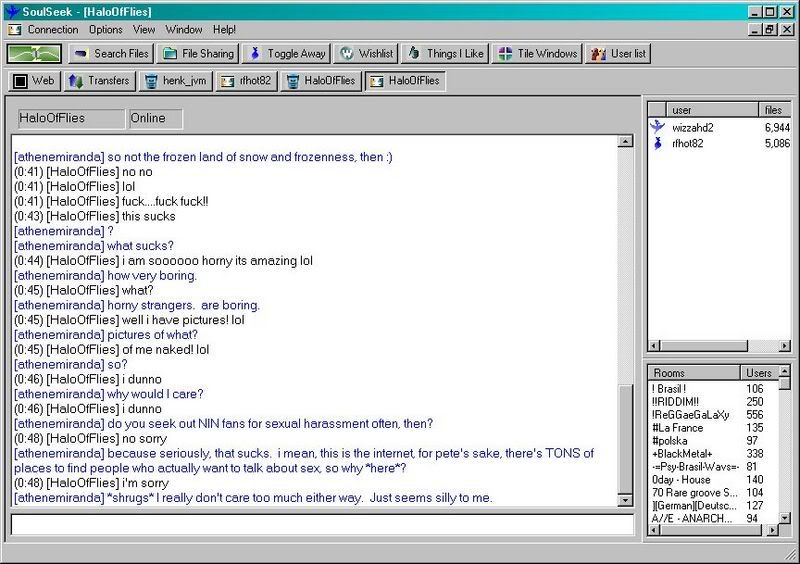


Perhaps I've been lucky, but it was only time this has happened to me since I was a 15-year-old AOLer. I'd say it's not so much down to chance as architecture - I shared the lulz with some other folks online, and one (a straight cis guy...as far as I know) said that he'd been hassled for netsex by men on Limewire; perhaps filesharing and chatrooming lend themselves to solicitation more than other forms of online communication. Soulseek's profile settings serve to make it chattier than other such programs; the twunt originally said he'd IMed me because I'd listed the Nine Inch Nails under 'I like'. (I deleted that immediately after).

I reacted to all this in a predictable fashion; became both pissed-off and very amused, and sought Revenge. I screencapped the lulz; I banned him from downloading from me; and I went to Soulseek's FAQ to see if there was any comment on how to report abuse and annoyance. There wasn't. Sure, each internet banana republic creates its own standards, but having no harassment policy is the sort of oversight that may not be so common if they weren't all run by guys. It's due to Wikipedia's poor response to abuse reports that it took two years from the first complaint about that sock's use of intimate pictures of unconsenting women until this ban, now; they simply have no system in place to respond to this problem.

Friday, September 26, 2008

FMT: an intriguing new fail.

As I've already said, at great length, I take great exception to the way male sf/f/h writers get so hung up on sex work. And if most or all of the women in their story are sex workers, that's a really bad sign. But this, this is interesting, I dare say not good, but at least original in the realms of failure.

[Both the links in the next paragraph rate a warning for talk about rape/SA in abstract & imaginary situations.]

io9.com has this piece up on what it describes as 'zombie feminism'. Basically it's a horror movie trend that's very like r&r in 80s fantasy fiction. They've written about three zombie films with unusual implications for women, but it's the second that pinged the FMT radar - Zombie Strippers:

This flick features porn star Jenna Jameson as a stripper bitten by a zombie infected by a government drug to keep soldiers fighting after they die. The more zombie-fied she gets, the more the clientele goes crazy for her. Even when she drags men into the back room and rips their throats out and bites their dicks off. Soon, the other strippers are begging to be infected too, so they can make more in tips.

Before long, nearly all the strippers are infected, and they've got a giant basement room full of all the reanimated, mutilated men they've been gnawing on. None of these strippers are being raped or murdered by men — they're just dealing with standard-issue stuff like objectification and the dangers of working in the sex industry. And yet it's hard not to see their undeaths as a kind of revenge on men who treat women like objects. These guys come to the strip club to "get some meat," and then they're turned into meat themselves.

The problem here is that the men actually like it. Their favorite strippers are the zombies, and the women have gained "power" only by becoming monsters. Just as our girl in Deadgirl can only fight back because she's a monster. So is the message of zombie feminism that a strong women is always a monster? That she must die and return as a ghoul in order to fight back against rape and less violent forms of sexism?

Thursday, September 25, 2008

Everything I Just Said, But Better

...was put online by David Wong, like, the day after I posted my version. The complete title of Wong's piece is 6 Brainwashing Techniques They're Using On You Right Now [mildly NSFW] - here are the relevant bits.

#4. Controlling What You Watch and Read:
Studies show the brain is wired to get a quick high from reading things that agree with our point of view. The same studies proved that, strangely, we also get a rush from intentionally dismissing information that disagrees, no matter how well supported it is. Yes, our brain rewards us for being closed-minded dicks.

So with a little prodding, the followers will happily close themselves in the same echo chamber of talk radio, blogs and cable news outlets that give them that little "They agree with ME!" high.

This wouldn't have been possible even 20 years ago. I grew up in the 80s, in a house with three TV stations. Three. We got one newspaper, the local one. You didn't get to pick from the conservative news or liberal news, back in my day you took what you got and you were thankful for what you had, dammit.

Today, I go through that many outlets a day just to get my freaking video game news.

And now, that explosion of the 24-hour cable news stations and, later, the web and blogosphere, has created these parallel universes of Right vs. Left media outlets, complete with their own publishing arms.

And for each, their favorite topic of discussion is how corrupt and ridiculous the other side's media is. They each even have "watchdog" groups that exist purely for the reason of hammering away at each other (the left has FAIR and MediaMatters, the right has the Media Research Center).

Recently Seen:
When an MSNBC interview with candidate John McCain got tense, he responded to the question by openly accusing the reporter of being an operative for the other side:

Just days later the campaign called The New York Times "a pro-Obama advocacy organization."

This technique is relatively new, but you'll see a lot more of it in future elections. The candidate will talk right past the reporter asking the questions and says to his supporters, "These guys work for the enemy, don't believe a word they say. Their lies will only poison your mind."

#1. "Us vs. Them"
...we're hard-wired by evolution to form tribes. The more stress we feel, the more we feel love and attachment to those who look and sound the same as us, and the more we feel hatred to those who don't. It's just an old survival mechanism, since the ancient guys who didn't show that kind of blind loyalty were killed off by the fierce tribes formed by the ones who did.

So today we get that petty dehumanization of everybody outside of our group ("hippies," "rednecks," "fundies," "geeks," "douchebags," "libs", "cons," "fags," "breeders," "infidels," "towel-heads," "honkies," "darkies," "players", "haters").

They can play on those old, primal urges for even the most retarded of results, such as fierce brand loyalty (the PS3 vs. 360 vs. Wii flame wars will make you claw your eyes out).

But to really make this one work, They can't just define your group, but have to define your group as the elite group, a shining beacon in a world full of weak-minded walking turds. The items on this list work best in combination, and you'll see in that the element of mockery and insulation from opposing viewpoints we talked about earlier (why listen to the viewpoints of those lesser sheeple?). Often this is combined with siege terminology ("The whole country has gone to hell, but we've got to stand up for common sense, folks! It's us against the world!")

Recently Seen:

Watch five seconds of an election stump speech. Every side does it.

In Sarah Palin's convention speech she talked about how people from small towns are totally the best ("We grow good people in our small towns, with honesty, sincerity, and dignity"). Earlier in the primaries the Clinton campaign did the same thing, talking about small towns as being the backbone of America where real, honest people are found. Always there is the unspoken reminder that these honest rural folk are under siege from those scary, phony freaks in the city.

When speaking to those city folk, on the other hand, Barack Obama made the infamous reference to those same small town types clinging to guns and religion, talking about them like they were savages to be studied through binoculars from a tower, with some peasant disease that needs cured by the enlightened.

Not only is "Us vs Them" the first and most important one on the list, it's the culmination and end goal of all the others. Drawing you into the right tribe is what They want most, because they can accomplish nothing without tribesmen.


(One thing Wong missed is that the 'small towns' line isn't original to Palin, but is a quotation from a long-dead American facist, Westbrook Pegler. Robert F Kennedy Jr wrote about this on HuffPo. Pelger was talking pretty explicitly about the whiteness of small towns, as opposed to cities inhabited by black Americans, by Jews and by other immigrant groups that were considered less than white at the time he was writing).

Saturday, September 20, 2008

the divided states.

So. A few months ago I found that my USian family thought it highly socially inappropriate to talk about atheism. There being variety in the family between the devout and the rest of us, one that was upsetting to one of the Catholic children, meant the best course was for the non-Catholics to not speak of it and to distract non-Catholic young'uns if they tried to bring up the subject right before lunch.

It probably shouldn't've taken me so long, but it took the Palin trainwreck to show me that yes, really, this is how America works: you don't talk to people about your religious and political differences. Shortly after the Palin selection, a family member and I were talking to a family friend, someone who naturally she knew way better than I did. I said something about been creeped-out by Palin asking Alaskans to pray for a $30 billion gas pipeline. Caesar. God. It's creepy, that.

Family member says to me, warningly "He's a Republican."

Um, and...?

If I'm telling someone that I think a politician has said something obnoxious, why would it matter what their partisan views are? I mean, isn't that how you have conversations rather than echo chambers? Maybe there's some sort of upside to praying for gas pipelines that I hadn't seen but Republican Guy would know about and could tell me of. I got a conversation; he said that he thought Palin would make a good advocate for disabled people in the Whitehouse, and that's something he really cares about. I asked if he knew her record in that regard - none of us did, at the time - and suggested he check up on it, just because records are firmer than narrative guesswork. (Thanks partly to Kyrias, I later did, and guess what, she halved educational funds for disabled children in Alaska).

A few weeks on, and the trainwreck has seemingly run its course; lots of flying emotions and everyone's made their mind up - her favourability has fallen to near-zero.

Last night M watched Bill Maher's TV show and I saw a little of it too. I had never seen it before. There's no analogue to the US political media in Britain (reason #3515 why everyone hates the film version of V For Vendetta, that); the best comparison I could think of was if Private Eye was a TV show rather than a magazine. Or it's a bit like Newsnight but intentionally both partisan and humorous, rather than merely misanthropic. (I have a habit of describing US TV hosts entirely in terms of how they differ from Jeremy Paxman [vid, first 20 seconds contain NSFW language]. In that regard, watching Jon Stewart softball Tony Blair on Thursday night was quite painful).

Maher, to great applause, announced that many Americans support Palin because they are too stupid.

Two bloggers I read who've posted a lot of election stuff lately are saying the following:

The frightening part of this is that everyone thinks she’s so great, so much so that it seems like more people support SP than support McCain.

For crying out loud, she’s, if not a total psychopath who is incapable of speaking the truth, a total fake. She is not compassionate, the girl next door, or someone who will look out for the average citizen.

And for those people who posted on Salon.com saying that they’re going to vote for her because her husband is hot and because she proves that women can have it all…I think you should all be taken out of the gene pool, pronto.

from Kyrias. (Admittedly Kyrias is a permanent resident of the USA rather than a US citizen. It is kinda funny that we talk about this crap so much when neither of us can vote here).

Well you know what America? You get what you deserve. I hope that when you're all cowering down in your fallout shelters after the nuclear exchange with the Russians, I hope then that you take a moment to question what your fault in all this is. I hope you ask for forgiveness.

from Combat Queer.

None of these were talking about extreme factions in the US, but about an alternate mainstream that really isn't much different in calibre from their own mainstream. As I said to Kyrias over IM later, some people have dumb reasons for voting for Obama too, such as the fact that everyone on his ticket is be-penised. Or that they believe some conspiracy theory about the US right. There are bad reasons on both sides.

So I. Do Not. Get It.

I don't get how you can assume that no one in your entire nation honestly disagrees with you - that no one simply has different priorities to you, or different feelings, that aren't any the less of yours. That their reasoning can be as good as yours and yet add up to a different result. That it's worth your time to degrade people, but not to engage with them.

It's the nonengagement that spooks me. Funny, I expect it on the internet, where everyone filters themselves via the path of least resistance into groups that are supportive and productive for them, where you don't have to constantly justify your 101s. I can understand nonengagement as a consequence of social behaviour. What I don't understand is why USians seem to hold it as an end goal of social behaviour. Why other views must be dismissed, shunned, or simply avoided just because discussion would be bad.

(Nora and Kyrias say there is no culture war. I can take their point on definitions, but what the hell is this, then?)

I got on this train of thought because of exchanging comments on my last post with Daisy, about the lack of deference for religion in the UK, and the expectation that such things are private. Yet in spite of that, it feels like crossing the floor to talk about God is far more common in the UK than the USA. Maybe the lack of deference means that no one is expected to be defensive about their personal opinions. (As ever, politically secular countries can be more religiously fervent and deferential than those which have established churches. The US and France have that in common).

And politics? People disagree. People are apathetic. There are partisan splits between rural areas and cities, between the English and the rest of 'em, between the rich and the poor. Some people pick a side and keep to it, others don't. There is a dinky yellow safety valve for when your side pisses you off. But everyone is equally subject to question, and all politicians are equally targets for mockery, having their record examined, and Jeremy Paxman. Brad Hicks thinks that there is some fundamental difference in terms of how moral codes are applied between the US right and the US left. I can't imagine such an idea being voiced in the UK.

And the idea, the one that Bill Maher was applauded for on the TV, that the people in your country who don't vote the way you think they should are just inferior to you? It's just plain ugly. What's really crazy there is how the US is so up its own ass about patriotism, and yet wont to applaud the degradation of half its people. Either half, any half, depending on the situation.


[fact: I totally did not understand some of the attitudes about presidents and the presidency in the USA until I read something, perhaps on CiF - CiF! - that said it's easier if you pretend that Obama and McCain are competing to become the Queen. That works. Totally. In a 'this place is on crack' way. It explains why no one pied the Shrub when he went to the Olympics, for instance. And maybe why Stewart wimped out on Blair.]


Finally, a few words I read on LJ earlier, related to that study that said that people disagree with each other because of their PHYSIOLOGIES, ohnoez!:

A moment to rant, because I'll never let something like this go by without a comment:

When you are part Cherokee Indian, and have German Jews in your bloodline, you get a bit sensitive when people start tossing about studies that show a genetic difference, an inferiority, in the people that they don't like.It's been used too many times to justify genocide. I don't buy the excuse, that it's a REAL study, with REAL results, or that you were doing it in all innocence. People have been known to FIND whatever they are looking for, if they skew the results enough.

[Kracken, qwp.]

Saturday, September 13, 2008

a pile of things:

So, Bridge Troll was fired by Cardone Industries UK Ltd for making a blog post that mentioned the company's religious workplace policies, and his atheistic response to same. He's put the whole story on Lj for the world to see, along with some thoughts about increasingly controlling relationships between employers and employees.

Ben Goldacre is no longer being sued by Matthias Rath, an HIV denialist in the vitamin pill industry. Goldacre's article covers the weakness of evidence used to make claims in the supplements industry as compared with other medical research, and the readiness of people in that industry to shut down debate by means of lawsuit. The Grauniad has more details about Rath's activities in South Africa, where he took out newspaper advertisements claiming that people with HIV do not need ARVs.

Kyrias is investigating Landmark Education, an organisation some describe as a psychotherapy cult. (I believe that much of psychotherapy is more of the occult than the scientific - and I value the occult highly, you know? - but these guys sound truly special).

Aishwarya is all in favour of book burning. The blonde one thinks there's nothing 'ironic' about loving knitting and baking. And Kiya is on the warpath, with love.

Friday, September 12, 2008

that campaign finance graph in full:

The Beeb has all the numbers, but the key facts are:

a) Obama has raised over twice as much as McCain; $401 million to $171 million. It's very rare for a campaign to lose with such a huge funding disparity, though it has happened - the UK election in 1997 is an example, but it's notable that the rich losers in that election were long-term incumbents.

b) almost half of Obama's funds came in small packages, under $200. McCain raised only $50 million in that smallest category of donations and a comparable $50 million in the largest, $2000-and-over; at $75 mil, Obama's proportional gains from this group are notably smaller.

c) Obviously Obama far outstrips McCain in most professional categories, because he has twice as much money. This is not true of retired people, the oil/gas industry, the insurance industry, real estate or 'misc finance' (and he's only just ahead in 'misc business' and 'commercial banks'). The truly vast gaps in Obama's favour are among medics, educators, the entertainment and tech industries, and lawyers. Yep, lawyers. There's a detailed Black Agenda Report article expressing bad feeling about this, which is interesting but includes a lot of weasel words and no mention of the fact that the same people are McCain's second biggest donors (the retired are by far the biggest, and are narrowly Obama's second biggest).

d) In spite of lots of recent wittering about the real, 'small-town America', the non-coastal states are not actually giving McCain a lot of money. Even Texas is even-handed in its donations. (538's state profiles mention fundraising, and they've covered four so far where McCain has raised more money than Obama, but these are usually tiny margins and they just aren't giving nearly enough to add colour to the Beeb map. Incidentally, 538 disagree with the Beeb about Florida being a 'key battleground'; see their 'Tipping Point' list).

[addendum: I've just discovered OpenSecrets, which has some wonderful break-downs of data. If you love graphs as much as I do, check out their donor demographic and industries/selected sector breakdowns.]


I've not seen a whole lot of public politics in GA. The day we drove to South Carolina we saw an abundance of signboards, I guess because they had a lot of local election stuff going on at the time. I've seen no signs in our neighbourhood, though there's someone up the road who has a Gavel bumper sticker; one home on the route between here and the nearby highway has a McCain sign, and no one has driven over it yet. We laugh when we pass Ron Paul signs. There are some Senate and Congress signs by the highways, but not a vast number (that the Democrats only picked a Senate candidate a couple of weeks ago might be part of the reason for that). Disturbingly, I've seen more ageing Bush/Cheney04 bumper stickers lately than ones relating to the current election. (Still not many though. The most common political identity emblems you see on cars in GA are firstly the icthos, secondly the Confederate flag).

Tuesday, September 02, 2008

on privacy: a comment I made elsewhere.

[Elsewhere being Alas, specifically. I'd wondered about making a post about the whole Palin circus, leaned towards 'no' simply because I believe that Bristol Palin, though she is breathing for two, is not a valid recipient of media oxygen other than when the McCain campaign decides to start lighting matches, which I am sure it will. But then Mandolin posted that roundup about privacy and its connection (or lack thereof) to reproductive rights, and I found it a good topic for some thinking out loud.]

One thing I’d say is that Bristol Palin’s privacy is not a reproductive rights issue; she deserves privacy because she’s a young woman who has never asked for the world’s media to be on her doorstep. She deserves privacy for the exact same reason all the other candidates’ children deserve privacy. We do not need to interrogate Bristol Palin, ever. Whenever the McCain campaign makes propaganda use of her, talks about what a wonderful choice she made, we need to interrogate the McCain campaign and slam them for their hypocrisy and their inhuman anti-choice values.

It is interesting to see who gets the privacy and who does not, though. The Obama daughters have been regularly paraded on stage because so many people in the media, and allegedly in the US at large, had a nervy, perverse fascination with the idea of a black first family, and the Obama campaign felt forced to respond to that. Because America is a racially unequal society those young black girls don’t get the right to privacy.

And now there’s a young mother-to-be in the spotlight; I don’t know about you, but I haven’t heard the name of her fiancĂ©, nor read anything related to him. I also don’t know the names of any male children of anyone involved in this election. That Obama and Clinton don’t have any skews that, I’m sure - but I don’t even know if McCain, or Edwards, or most of the VP-possibles have children at all. The only people whose children have been talked about are Obama, Palin, and (to a much lesser extent) single father Biden (and there’s Chelsea Clinton, who was known to us from her father’s time in office. Quick, Britons, what’s the fastest rail route between Bristol and Chelsea?). I haven’t heard the names of Biden’s children. I don’t know anything about McCain’s children, not even how many he has, other than that he has at least one adopted child.

In other words, if you’re a white guy, your family gets more privacy. (Barring extremely odd circumstances like Biden’s - and if I may make an aside, I feel that the single father family I grew up in got too much privacy rather than too little; as Amanda wrote, privacy can be a shield for abuse, and also just for plain poor parenting. Single father families are far interrogated far less than single mother families, even given that they outnumber us by 10 to 1).

Saturday, August 16, 2008

more about the olympics

I think what really got the goat this time was the story about the switch-up between the two girls for the opening ceremony. Supposedly Lin Miaoke was more attractive than Yan Peiyi, so Lin Miaoke mimed the song “ode to the motherland” for the opening ceremony whilst the real singing voice was recorded by Yang Peiyi.

[...] What I think is truly despicable about the whole thing, regardless of how Yang Peiyi feels about it — is that this makes a farce of the modern concept of the Olympics.

Athletes gathered here from around the world to participate in competitions to see who is the best. This is a gathering designed, not only to see who is the best, but to give recognition to the best.

For me, the idea of not giving due recognition to someone at the Olympics just goes against the grain.

Kyrias, as promised.


Recently our expectations of coverage of women have been lowered, nullified; we have become used to seeing that strange category - celebrity women - pictured constantly, relentlessly, their image before us for no other reason than that they happen to have headed out for a pint of milk with their makeup on skew-whiff. At Beijing we have seen the antithesis of that - we have been treated to the sight of ordinary women reaching extraordinary heights. The women we have been thrilling to aren't in our eyeline because they happen to be the offspring of some 1970s rocker, or because they've bagged a multimillionaire boyfriend. They aren't on screen because they have starved themselves to a size zero - instead, their bodies are a celebration of strength.

From the Grauniad - h/t to the red one: it's a great article, one that meanders through sport and media and celebrity culture, and you all should go read. Viv.id disagrees:

A couple of years ago, Tigtog posted about athletlcs uniforms and the trend toward sexified, midriff-baring, underwear-style women’s uniforms. ...Minute increases in performance cannot account for this difference, otherwise the men would be in skintight clothing also.

No. It’s not about faster, higher, stronger. Women in sports are promoted as sexualised bodies for ogling; men are promoted as performers.
Viv.id have comparison photos of male and female team costumes for various sports - and prove that the difference was not marked in the 1980s. h/t to a comment at Shameless. (false advertising: that Shameless post is totally not shameless. But thanks for that photo!)

Also, Ren brings the boycandy.

Thursday, August 14, 2008

on presentational devices at your precious non-politicised Olympic Games

Feng Silu, another volunteer, says they have gone through rigid training to achieve perfection. During the training sessions, they have to stand in five to six-inch heels with their jaws tucked in while balancing a 16-page book on their head and keeping a sheet of paper between their knees, for at least an hour at a time. If either object fell or slipped from place, they would have to start the exercise all over again.

"We only take a few minutes' rest every a couple of hours. You know, we need to adjust our pace and stride constantly to achieve perfection. When it was break time, even bending my legs hurt. And as we have our stockings on during training, we may wear out two or three pairs each day."

From CRIEnglish. (h/t Kyrias, who has promised a post on this in the near future. [edit: It's here.]


Wearing a red dress and pigtails, Lin Miaoke charmed a worldwide audience with a rendition of "Ode to the Motherland".

But the singer was Yang Peiyi, who was not allowed to appear because she is not as "flawless" as nine-year-old Lin.

The show's musical director said Lin was used because it was in the best interests of the country.

From the Beeb, with pictures of the two children.


Marina Hyde, for the most part, wrote the Olympics post I didn't want to:

Amazingly, it's not even the IOC's most unedifying moment of the past fortnight. That honour belongs to their decision to suspend the entire Iraqi Olympic team on the basis that the country's National Olympic Committee had not been properly recognised by the IOC. Clearly, Iraq's real crime was not having the right paperwork, though before rescinding the ban on some (but not all) of the athletes, the IOC chuntered that it was because of suspicions of "political interference in the Olympic movement".

Last week I asked them to clarify why they had never suspected political interference when one Uday Hussein was chairman of the NOC. Unfortunately, they were far too grand to comment, but having since read senior IOC member Dick Pound's book, I discover that they couldn't be sure that Uday was a political placeman. Thank God they didn't put two and two together and make five.

Instead, they focus on issuing directives forbidding athletes from making any political statements. Surely it's time the IOC re-examined their definition of what it means to be political. It seems entirely acceptable for states to politicise the games by using them as propaganda, and for corporations to do the same (22 years of McDonald's sponsorship feels faintly agenda-driven). Only the athletes are warned not to step out of line.

Priorities being what they are, the IOC did not bother to issue similar directives instructing China not to bulldoze homes to make way for the new Beijing. And yet they must have known this would happen, as so many games have been preceded by what we might euphemistically describe as a tidying away of humans who don't match the decor. Consider Mexico City, where police opened fire and killed hundreds of student protesters; or Atlanta, where the organising committee actually built the jail to which many people who committed new offences on the city statute book - like lying down in the street - were dispatched.

Saturday, August 09, 2008

Does Equality Pay Its Bills?

Big question. When you pass by equality trainwrecks on the internets, you sometimes see a blind faith in the free market to solve all our problems. I mean, the free market (which exists, honest) being the bastion of efficiency it is, if a problem still exists it must be because there's an economic upside to it, right? If action films with female leads were profitable, there'd be tons of them, but there aren't because it's just not profitable. If women's work was really as valuable as men's work, employers wouldn't discriminate against women, would they?

This faith seems to underlie a lot of the outright disbelief you sometimes meet when you talk to people about equal pay or media sexism. It's basically saying that the desire to make a profit is so great it must override the desire to be sexist, so sexism can't be occurring at the expense of profit, and any further attempts to fight sexism will cause economic harm.

FSF recently linked to a series of articles by Jennifer Kesler about how this blind faith applies wrt the Bechdel Test. One of these directly asks Why Discriminate If It Doesn't Profit?
What tipped me off was that whenever film students pointed out how movies/shows for, by or about women had indeed profited, film professionals wouldn’t hear it. Those movies/shows were exceptions! Or it was really the alien/Terminator/Hannibal Lechter people wanted to see, not Ripley, Connor or Starling. Etc. It couldn’t be that people were actually happy to see movies/shows for, by or about women, because that was impossible - end of argument.

...people who claim to worship profit above all else sometimes actually worship what they want to believe is profitable.


Looking at the inflation-adjusted all-time box office, many of the top names are films that had a specific appeal to female audiences; Gone With The Wind, Titanic, The Sound Of Music, Doctor Zhivago. Three of these four were made a rather long time ago.

I'm not sold on Kelsey's reasoning simply because it relies on pathologising individuals; see her earlier post, Why Film Schools Teach Screenwriters Not To Pass The Bechdel Test:
I concluded Hollywood was was dominated by perpetual pre-adolescent boys making the movies they wanted to see, and using the “target audience” - a construct based on partial truths and twisted math - to perpetuate their own desires.


I find it hard to believe that mere individuals can keep that shit running as long as they do, but does anyone have a better theory? It's important, this. Because the phenomenon goes beyond Hollywood and infests the real world.


Last year, Slate's Ray Fishman declared 'It Takes a Village...to fail to thank its female leader, no matter how good she is':
Rural Indians are learning firsthand what it's like to live under female leadership as a result of a 1991 law that restricted one-third of village council elections to female candidates. The villagers' experiences are analyzed by economists Esther Duflo and Petia Topalova in a recent unpublished study. Using opinion surveys and data on local "public goods"—like schools, roads, and water pumps—Duflo and Topalova find that the villages headed by women invested in more services that benefited the entire community than did those with gender-neutral elections, nearly all of which were won by men. But as the opinion polls showed, for all their effectiveness, the women's governance was literally a thankless effort, with the new leaders getting lower approval ratings than their male counterparts.

[...] They were also less corrupt—villagers with female-headed councils were 25 percent less likely to report having to pay bribes to access basic services like getting ration cards or receiving medical attention.

It's like Hollywood; however well the women perform, it doesn't register with the people who care. (Except that US cinema audiences seem to approve plenty). This really is sexism as a quantifiable pathology, and it merrily flies in the face of any desire for material gain; women suck, no matter how much they've improved your local governance.

Then there's a straightforward headline from workforce.com: Firms With More Women on Boards Perform Better Than Those That Don’t.
During the four-year span of the reporting for the study, Fortune 500 companies with the highest percentage of women on their boards saw equity returns that were 53 percent higher than those companies with the fewest number of women on their boards.


I strongly doubt that either this or the India survey demonstrate any female superiority when it comes to governance; rather, they represent the replacing of mediocre men with brilliant women who in other circumstances are locked out of high places. But the question's still there - if female board members have such a marked effect on profits, why are there so few of them?

If hiring women is basically a way of getting free money, why are so many companies scared of the idea?


When talking about the pay gap, I tend to link to this: the story of the UK's largest ever equal pay settlement:
Early last year, 1,600 women, all of them health workers at two Cumbrian hospitals, won the biggest ever equal pay deal: a total of £300m. At a time when the pay gap between men and women is actually growing, the settlement should have sparked a clamour for equality. Instead, there has since been an eerie silence. The story of how the women, underpaid for years, spurned an offer of £1.5m compensation and achieved £300m, all from one health authority, has been mysteriously buried, as if it were an embarrassment. They sense a fear of "mutually assured destruction" wafting around the headquarters of their union, Unison, which represents more than a million public service workers: a feeling that the settlement was too huge, and the ramifications of it just too enormous - what would happen if it triggered equal pay claims across the whole of the public sector?

[...] The claim was possible because of "equal value", a concept contained in a European directive announced during a late sitting in the Commons 20 years ago by a reluctant, and drunk, employment minister, Alan Clark. It allows different jobs to be compared for skill, complexity and responsibility; it focuses on the work, not the job. In detail, the claim translated the gothic arithmetic and arcane patois of industrial relations into the everyday life of men and women: everything, from bonus, to pension, to the length of the working week, to a working life. "It took a while to convince some of them that what they did was not only of equal value to a man, but more important," says Doyle.

A job evaluation expert, Sue Hastings, assessed the Cumbria dossier and reported that the cases were a golden equal pay opportunity for "exactly the people who ought to get it" - nurses who had been undergraded for decades, cleaners, telephonists and sterile services staff, who prepare instruments for surgery and who had been stuck on the same grade as washers-up since the health service was founded. Doyle had found men willing to stand as comparators: a wall-washer earning £3,000 a year more - and working 104 fewer hours a year - than a seamstress and sterile services staff; a plumber earning more than a nurse; a specialised nurse on a cancer ward, at the top of her scale, earning £8,000 a year less than a plant maintenance man; a nurse on £9,000 less than an engineer.


My suspicion is that the fear of equal pay claims - as in Hollywood - is entirely real; equal pay for equal work means that men will have to take home less, one way or another. Councils in the UK - who finally implemented their equal pay agreements in 2006 - complained that they need central government assistance in order to pay women what their work was really worth. Boo fucking hoo; progressive taxation (as if that existed) passes money from wealthier men to poorer women, cry me a river. Hollywood? Would probably get more money overall if it stopped failing so often. But less of it would go to men. And that would somehow be so threatening it's worth paying to make it go away.


How far does the threat go? Well, the NYT is calling bullshit on the different ways we frame men at home vs. women at home here:

But when men in their prime working years drop out of the workforce we don’t say they’ve gone home to be with their kids.

We say they’re unemployed.


It goes back to families and parenting. It usually does.