I have stuff cooking in my head about the whole moving-to-another-continent topic; til then, these are the best links ever.
Proper srs links:
Daisy is asking if we can support the troops without supporting the war, and where classism fits with that.
Vii on interracial dating.
Brad Hicks on lynching as an economic crime.
The entire internets on those racist mid-Superbowl ads that put us right off our cookies.
Sillier links;
Deathboy on Chanology London - omg, read this, or at least look at the pictures.
Saint Gasoline has a comic strip on How To Be An Asshole With Mathematics.
Punkass on that bit where Mitt Romney said that voting Democrat is surrendering to terrorism.
Aishwarya on the suicidal, sex-obsessed Hobbits who sneaked into her house.
Monday, February 11, 2008

Monday, February 04, 2008
Castor, Achilles, Euryalus, Aretaeus, Alexander, Dubreuil
And Orestes.
[Or, to get into the spirit of the thing: Orestes and.]
I have a long memory - the kind where a good book can lodge for years, with me dropping by its cubbyhole every so often to continue our ongoing conversation. I've got broad tastes; encounters with the current mainstream are generally disastrous, and I tend to go home to sf/f eventually, but I wind up with a lot of isolated loves. Les Misérables is one of them. I don't know the first thing about other literature of the time and the place; it has no context for me, and if I want to grok all its obscurities, I grok alone.
After years of intermittent obsessing, I think I'm finally done talking to this one beautiful passage. It comes close to the end of Part 3, Book 4, Chapter 1: A Group Which Almost Became Historic, and it describes the connexion between Enjolras and Grantaire.
Let's get our priorities straight (ha!) here; the slash, is it canon?
See, that's a totally incommensurable question to begin with. Hugo was writing before queer, before 'homosexual' was a word, let alone a rights movement; I can only guess at what he was trying to say about these two men, but he's left me a few hints. Seven, to be precise. Seven people who belong with seven other people.
Castor and Pollux are twins hatched from the same swan-egg, brothers of Helen of Troy; one mortal, the other divine but generous enough to see eternal life as worth sharing.
Achilles and Patroclus - is there anyone left who hasn't read Troy In 15 Minutes? Because, um, they were totally cousins. Totally. <3<3 Cleolinda.
Nisus, Euryalus? Even Wikipedia isn't quite sure about those two. Lovers for sure, but sexually? Maybe, maybe not.
Eudamidas is a character of 2nd-century satire; given the way people wrote at the time, I can't decide if it's more likely that he was fictional, or a vaguely real gossip-piece. He perhaps got himself on Hugo's radar via The Testament Of Eudamidas, a painting Nicolas Poussin made in 1643 about the guy and his testament, based on the original story by Lucian. This unusual document allegedly willed away not just Eudamidas's meagre possessions, but also his daughter and his mother. From the original Lucian:
Lucian explicitly connected Eudamidas with Pylades. He was writing about two characters having a rhetorical competition over whether Greeks or Scythians had the best friendships. (Lucian himself wrote in Greek but is believed to have been Syrian). The contest begins with Toxaris, the Scythian, telling Mnesippus why Scythians make sacrifices to Orestes and Pylades; "We honour Orestes and Pylades, then, because they excelled in the Scythian virtue of loyalty, which we place above all others; and it is for this that we have bestowed on them the name of Coraci, which in our language means spirits of friendship."
Passing briefly over Alexander and Hephaestion as being too damn famous and Hollywood and canonslashy and all that: the only source I've ever, ever found on Pechméja also refers directly to Orestes and Pylades. (Male Friendship In Pre-Revolutionary France by Jeffrey Merrick, which you can read if you have the right login. I don't, but the blue person is magical like that). Jean Pechméja and Jean Baptiste Léon Dubreuil were both born in the early 1740s in the same small town in Aveyron, but after leaving said small town didn't encounter each other again til the 1770s. By then Dubreuil was a doctor, Pechmeja a writer - their friendship resumed when Pechméja fell ill and Dubreuil moved to the outskirts of Paris to care for him; in return, Merrick tells us, Pechméja dedicated a classical-themed book to Dubreuil with '"respect, affection, gratitude" (le respect, la tendresse, la reconnaissance) for his "austere virtue, generous friendship, and preservative power" (la vertu austère . . . l’amitié généreuse . . . la puissance conservatrice).' The book is about how male friendship is way better than marriage because marriage involves all that complicated sex stuff which just makes people confused and miserable. [Here you may insert your own rant about how much Brokeback Mountain sucked for drawing teh queer as being an idyllic escape from the real-life responsibilities women and children put on a guy, as if queer was somehow the opposite of being a proper grownup who cares for/belongs to a family. Go on. I'll wait here til you're done.]
Here's Merrick's word on the O and the P, if not the intervening T:
I checked the citation on that as soon as I read it, half-expecting it to lead back to Hugo. It didn't. It's from a 1780s-90s thingy called Correspondance secrète, politique, et littéraire. Was that comment influenced directly by Lucian, or was this Coraci thread running wider than that through the literary culture of the time? Also:
Orestes and Pylades, incidentally, are totally cousins. (For real).
So what have we got there? Three men of myth, two of murky classical history, one who died a mere 20 years before Hugo's birth. A brother, three lovers, a testator, and a best friend who we don't really have reason to believe was also a lover. These, held up to two spirits of friendship. These, and Grantaire and Enjolras, who are not even really on speaking terms with each other. The hell?
Hugo is both quite particular about sex and also fond of making exceptions to all his rules in general; Les Misérables has it that God supports the Swedish model, and that male philanderers are bad, except for the cheerful old one; he idolises marital sex, and equates virginity with not just virtuous conduct, but with a virtuous appearance;
And yet; 'all the nuns in the world are not equal to one mother', and other such sentiments. (I love this book, but it's part of the reason why I think anyone who says wives and prostitutes are the only women who get laid is stuck in the 19th century). Hugo seems to elevate wives and mothers when it comes to women, but men he cherishes as virgins. He makes a point of the virginity of almost all his male cast; of Jean Valjean he says; 'His youth was spent in rough and ill-recompensed labour; he never was known to have a sweetheart; he had not time to be in love.' Then later; 'Jean Valjean had never loved anything. For twenty-five years he had been alone in the world. He had never been a father, lover, husband or friend.' Marius is righteously indignant at his grandfather's suggestion that he take Cosette as a mistress; the antagonist Javert's virginity is also spelled out; 'His life was a life of privations, isolation, self-denial and chastity; never any amusement.'
But Enjolras and Grantaire? Well. The former is clear enough;
And Grantaire?
Hugo piles up the adjectives right after that, contrasting Enjolras's 'chaste, healthy, firm, direct, hard, candid nature' with Grantaire's 'soft, wavering, disjointed, diseased, deformed ideas': again chastity is a trait that seems to extend well beyond sex - one Grantaire is devoid of even though he isn't getting any sex. Of course, I don't know what the hell he even meant by 'chastity' (and god help me, but I can't find the second volume of my French copy so I don't even know what the original goddamn word he used was). No sex? Not much sex? Not desiring sex? Sex only with people you're allowed to have sex with?
I could be a smart-alec slash canonista and say that Hugo is explicitly discussing only sex with women, but dude, did you catch the bit where I said the word didn't exist til a decade after his book came out? I am sure the OTP never occurred to him. Except for the part where he's talking about Hephaestion and Patroclus and Nisus and expecting us to grok it. You know, the part I got stuck on in the first place. My friend Kathie, being a little under three times my age, has it that the increasing visibility of queer people since the 1960s - and of queer readings of straight homosocial activities - has put new limits on straight masculinity, made it shy away even from homosocial forms more recent than those Hugo describes - constricting itself in fear of eyes like mine. I am just reading, just knowing that whatever bond he's describing is incommensurable with anything that could ever be written today.
He mentions Pylades only once more, in a chapter heading a full 400 pages later; Orestes Fasting and Pylades Drunk, in which Grantaire finally said "Vive la République! I belong to it," and 'Enjolras grasped his hand with a smile.'
A minor edit: here's 10littlebullets on LJ with some more gay metaphors Hugo pins to Enjolras.
an aside for those of you who've been net-stalking me since 2002; When I read that line early into the Lucian - "do you mean to tell me that you people actually sacrifice to Orestes and Pylades? do you take them for Gods?" "Sacrifice to them? of course we do. It does not follow that we think they are Gods: they were good men." - I put the kettle on and paced around the house until it boiled. I am staying with my person's family atm, so I had the restraint to only make one cuppa, not three.
[Or, to get into the spirit of the thing: Orestes and.]
I have a long memory - the kind where a good book can lodge for years, with me dropping by its cubbyhole every so often to continue our ongoing conversation. I've got broad tastes; encounters with the current mainstream are generally disastrous, and I tend to go home to sf/f eventually, but I wind up with a lot of isolated loves. Les Misérables is one of them. I don't know the first thing about other literature of the time and the place; it has no context for me, and if I want to grok all its obscurities, I grok alone.
After years of intermittent obsessing, I think I'm finally done talking to this one beautiful passage. It comes close to the end of Part 3, Book 4, Chapter 1: A Group Which Almost Became Historic, and it describes the connexion between Enjolras and Grantaire.
There are men who seem born to be the opposite, the reverse, the counterpoint. They are Pollux, Patroclus, Nisus, Eudamidas, Hephaestion, Pechméja. They live only upon condition of leaning on another; their names are continuations, and are only written preceded by the conjunction 'and'; their existence is not their own; it is the other side of a destiny which is not theirs. Grantaire was one of these men. He was the reverse of Enjolras.
We might almost say that affinities commence with the letters of the alphabet. In the series, O and P are inseparable. You can, as you choose, pronounce O and P, or Orestes and Pylades.
Grantaire, a true satellite of Enjolras, lived in this circle of young people; he dwelt in it; he took pleasure only in it; he followed them everywhere. His delight was to see these forms coming and going in the fumes of the wine. He was tolerated for his good-humour.
Enjolras, being a believer, disdained this sceptic, and being sober, scorned this drunkard. He granted him a little haughty pity. Grantaire was an unaccepted Pylades. Always rudely treated by Enjolras, harshly repelled, rejected, yet returning, he said of Enjolras; 'What a fine statue!'
Let's get our priorities straight (ha!) here; the slash, is it canon?
See, that's a totally incommensurable question to begin with. Hugo was writing before queer, before 'homosexual' was a word, let alone a rights movement; I can only guess at what he was trying to say about these two men, but he's left me a few hints. Seven, to be precise. Seven people who belong with seven other people.
Castor and Pollux are twins hatched from the same swan-egg, brothers of Helen of Troy; one mortal, the other divine but generous enough to see eternal life as worth sharing.
Achilles and Patroclus - is there anyone left who hasn't read Troy In 15 Minutes? Because, um, they were totally cousins. Totally. <3<3 Cleolinda.
Nisus, Euryalus? Even Wikipedia isn't quite sure about those two. Lovers for sure, but sexually? Maybe, maybe not.
Eudamidas is a character of 2nd-century satire; given the way people wrote at the time, I can't decide if it's more likely that he was fictional, or a vaguely real gossip-piece. He perhaps got himself on Hugo's radar via The Testament Of Eudamidas, a painting Nicolas Poussin made in 1643 about the guy and his testament, based on the original story by Lucian. This unusual document allegedly willed away not just Eudamidas's meagre possessions, but also his daughter and his mother. From the original Lucian:
Mnesippus. Eudamidas of Corinth, though he was himself in very narrow circumstances, had two friends who were well-to-do, Aretaeus his fellow townsman, and Charixenus of Sicyon. When Eudamidas died, he left a will behind him which I dare say would excite most people's ridicule: but what the generous Toxaris, with his respect for friendship and his ambition to secure its highest honours for his country, may think of the matter, is another question. The terms of the will--but first I should explain that Eudamidas left behind him an aged mother and a daughter of marriageable years;--the will, then, was as follows: To Aretaeus I bequeath my mother, to tend and to cherish in her old age: and to Charixenus my daughter, to give in marriage with such dowry as his circumstances will admit of: and should anything befall either of the legatees, then let his portion pass to the survivor. The reading of this will caused some merriment among the hearers, who knew of Eudamidas's poverty, but did not know anything of the friendship existing between him and his heirs. They went off much tickled at the handsome legacy that Aretaeus and Charixenus (lucky dogs!) had come in for: 'Eudamidas,' as they expressed it, 'was apparently to have a death-interest in the property of the legatees.' However, the latter had no sooner heard the will read, than they proceeded to execute the testator's intentions. Charixenus only survived Eudamidas by five days: but Aretaeus, most generous of heirs, accepted the double bequest, is supporting the aged mother at this day, and has only lately given the daughter in marriage, allowing to her and to his own daughter portions of 500 each, out of his whole property of 1,250; the two marriages were arranged to take place on the same day. What do you think of him, Toxaris? This is something like friendship, is it not,--to accept such a bequest as this, and to show such respect for a friend's last wishes? May we pass this as one of my five?
Toxaris. Excellent as was the behaviour of Aretaeus, I admire still more Eudamidas's confidence in his friends. It shows that he would have done as much for them; even if nothing had been said about it in their wills, he would have been the first to come forward and claim the inheritance as natural heir.
Lucian explicitly connected Eudamidas with Pylades. He was writing about two characters having a rhetorical competition over whether Greeks or Scythians had the best friendships. (Lucian himself wrote in Greek but is believed to have been Syrian). The contest begins with Toxaris, the Scythian, telling Mnesippus why Scythians make sacrifices to Orestes and Pylades; "We honour Orestes and Pylades, then, because they excelled in the Scythian virtue of loyalty, which we place above all others; and it is for this that we have bestowed on them the name of Coraci, which in our language means spirits of friendship."
Passing briefly over Alexander and Hephaestion as being too damn famous and Hollywood and canonslashy and all that: the only source I've ever, ever found on Pechméja also refers directly to Orestes and Pylades. (Male Friendship In Pre-Revolutionary France by Jeffrey Merrick, which you can read if you have the right login. I don't, but the blue person is magical like that). Jean Pechméja and Jean Baptiste Léon Dubreuil were both born in the early 1740s in the same small town in Aveyron, but after leaving said small town didn't encounter each other again til the 1770s. By then Dubreuil was a doctor, Pechmeja a writer - their friendship resumed when Pechméja fell ill and Dubreuil moved to the outskirts of Paris to care for him; in return, Merrick tells us, Pechméja dedicated a classical-themed book to Dubreuil with '"respect, affection, gratitude" (le respect, la tendresse, la reconnaissance) for his "austere virtue, generous friendship, and preservative power" (la vertu austère . . . l’amitié généreuse . . . la puissance conservatrice).' The book is about how male friendship is way better than marriage because marriage involves all that complicated sex stuff which just makes people confused and miserable. [Here you may insert your own rant about how much Brokeback Mountain sucked for drawing teh queer as being an idyllic escape from the real-life responsibilities women and children put on a guy, as if queer was somehow the opposite of being a proper grownup who cares for/belongs to a family. Go on. I'll wait here til you're done.]
Here's Merrick's word on the O and the P, if not the intervening T:
According to their contemporaries, Pechméja and Dubreuil enjoyed "the most intimate friendship" (l’amitié la plus intime) and resembled the mythological companions Orestes and Pylades. [...] Inseparable from each other, as if married to each other, Pechméja and Dubreuil shared everything: "dwelling, social circles, good things, bad things, pleasures, and pains" (logement, sociétés, biens, maux, plaisirs, et peines).
I checked the citation on that as soon as I read it, half-expecting it to lead back to Hugo. It didn't. It's from a 1780s-90s thingy called Correspondance secrète, politique, et littéraire. Was that comment influenced directly by Lucian, or was this Coraci thread running wider than that through the literary culture of the time? Also:
According to the marquis de Bombelles, Noailles pressured the local clergy, who had wanted to exclude Dubreuil from burial in consecrated ground because of the way he had died, without the last rites, as well as the way he had lived. Bombelles did not explain what they found objectionable in the life of the successful and respected doctor. No one in 1785 suggested that Pechméja and Dubreuil were sexually involved with each other or even acknowledged that they loved each other, but this one cryptic remark indicates that some contemporaries, in this case institutional advocates of traditional values, believed that friendship might involve dangerous as well as delightful possibilities.
Orestes and Pylades, incidentally, are totally cousins. (For real).
So what have we got there? Three men of myth, two of murky classical history, one who died a mere 20 years before Hugo's birth. A brother, three lovers, a testator, and a best friend who we don't really have reason to believe was also a lover. These, held up to two spirits of friendship. These, and Grantaire and Enjolras, who are not even really on speaking terms with each other. The hell?
Hugo is both quite particular about sex and also fond of making exceptions to all his rules in general; Les Misérables has it that God supports the Swedish model, and that male philanderers are bad, except for the cheerful old one; he idolises marital sex, and equates virginity with not just virtuous conduct, but with a virtuous appearance;
"Monsiuer", said Thénadier, "it is my wife's bridal cap."
The traveller looked at the object with a look which seemed to say 'there was a moment, then, when this monster was a virgin'.
And yet; 'all the nuns in the world are not equal to one mother', and other such sentiments. (I love this book, but it's part of the reason why I think anyone who says wives and prostitutes are the only women who get laid is stuck in the 19th century). Hugo seems to elevate wives and mothers when it comes to women, but men he cherishes as virgins. He makes a point of the virginity of almost all his male cast; of Jean Valjean he says; 'His youth was spent in rough and ill-recompensed labour; he never was known to have a sweetheart; he had not time to be in love.' Then later; 'Jean Valjean had never loved anything. For twenty-five years he had been alone in the world. He had never been a father, lover, husband or friend.' Marius is righteously indignant at his grandfather's suggestion that he take Cosette as a mistress; the antagonist Javert's virginity is also spelled out; 'His life was a life of privations, isolation, self-denial and chastity; never any amusement.'
But Enjolras and Grantaire? Well. The former is clear enough;
'...he did not seem to know that there was on the earth a being called woman... Woe to the love affair that should venture to intrude upon him! Had any grisette of the Place Cambrai or the Rue Saint Jean de Beauvais, seeing this college boy's face, this form of a page, those long fair lashes, those blue eyes, that hair flying in the wind, those rosy cheeks, those pure lips, those exquisite teeth, felt a desire to taste all this dawn, and tried her beauty upon Enjolras, a surprising and terrible look would have suddenly shown her the great gulf, and taught her not to confound the with the gallant cherubim of Beaumarchais the fearful cherubim of Ezekiel.
And Grantaire?
He was frightfully ugly; the prettiest shoe-binder of that period, Irma Boissy, revolting at his ugliness, had uttered this sentence: 'Grantaire is impossible,' but Grantaire's self-conceit was not disconcerted. He looked tenderly and fixedly upon every woman, appearing to say of them all: if only I would; and trying to make his comrades believe that he was in general demand.
Hugo piles up the adjectives right after that, contrasting Enjolras's 'chaste, healthy, firm, direct, hard, candid nature' with Grantaire's 'soft, wavering, disjointed, diseased, deformed ideas': again chastity is a trait that seems to extend well beyond sex - one Grantaire is devoid of even though he isn't getting any sex. Of course, I don't know what the hell he even meant by 'chastity' (and god help me, but I can't find the second volume of my French copy so I don't even know what the original goddamn word he used was). No sex? Not much sex? Not desiring sex? Sex only with people you're allowed to have sex with?
I could be a smart-alec slash canonista and say that Hugo is explicitly discussing only sex with women, but dude, did you catch the bit where I said the word didn't exist til a decade after his book came out? I am sure the OTP never occurred to him. Except for the part where he's talking about Hephaestion and Patroclus and Nisus and expecting us to grok it. You know, the part I got stuck on in the first place. My friend Kathie, being a little under three times my age, has it that the increasing visibility of queer people since the 1960s - and of queer readings of straight homosocial activities - has put new limits on straight masculinity, made it shy away even from homosocial forms more recent than those Hugo describes - constricting itself in fear of eyes like mine. I am just reading, just knowing that whatever bond he's describing is incommensurable with anything that could ever be written today.
He mentions Pylades only once more, in a chapter heading a full 400 pages later; Orestes Fasting and Pylades Drunk, in which Grantaire finally said "Vive la République! I belong to it," and 'Enjolras grasped his hand with a smile.'
A minor edit: here's 10littlebullets on LJ with some more gay metaphors Hugo pins to Enjolras.
an aside for those of you who've been net-stalking me since 2002; When I read that line early into the Lucian - "do you mean to tell me that you people actually sacrifice to Orestes and Pylades? do you take them for Gods?" "Sacrifice to them? of course we do. It does not follow that we think they are Gods: they were good men." - I put the kettle on and paced around the house until it boiled. I am staying with my person's family atm, so I had the restraint to only make one cuppa, not three.
Tuesday, January 29, 2008
Fat Pottery, or, Eternal Life At Any Size
[the lack of regular updates may continue; I am moving my sekrit base of sekrit operations from London to Atlanta tomorrow morning. But I have fifty gazillion half-written blogsplurges about the place, and am determined to gather the wits and nerve to upload them, so you never know.]
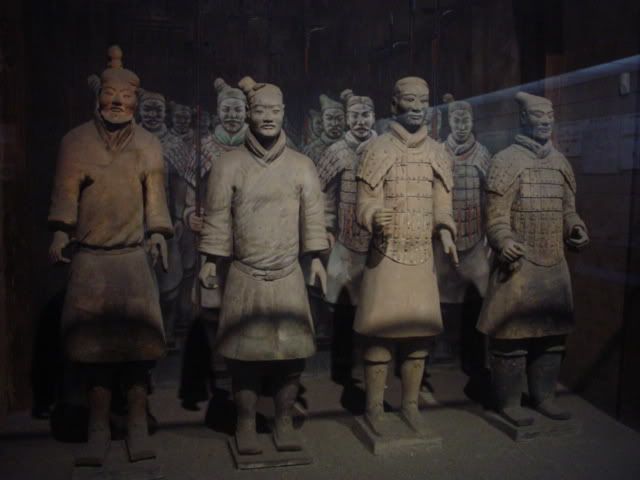
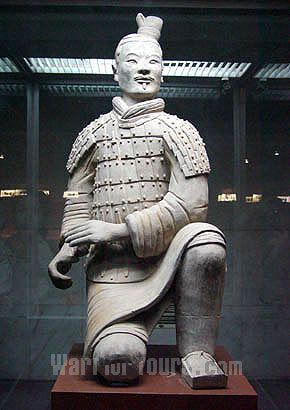
I finally saw the Terracotta Army yesterday, on my third attempt (I am, as previously observed, made of fail). For those of you who don't know the story already: when Qin Shi Huang became king of Qin, at the tender age of 13, he decided he was going to rule everything and live forever. He ordered the construction of an underground replica of his omni-empire, so he could continue to rule the entire world even if he died (and he went to some lengths to avoid that, from visiting supposed mountains of immortality to swallowing anything his doctors promised would preserve his life. Including mercury pills. Which is said to be what killed him, at the age of 49).
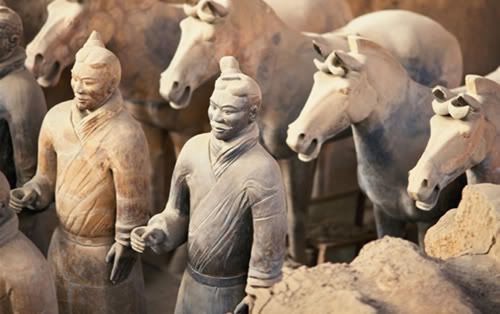
To enforce his eternal rule, he had his underground mini-empire guarded by over 8000 fully-armed terracotta soldiers. He also had terracotta civil servants to keep the place running, and terracotta musicians and acrobats to keep himself amused. I think I read something about terracotta concubines too, but none of them were in the BM exhibit.
The soldiers were a force to be reckoned with; equipped with the best of contemporary weaponry, accompanied by stocky terracotta horses, representing ranks from light infantry and unarmoured archers to generals in elaborate hats. And they represented the ideal of a male warrior's body; they vary in height from 6ft to 6ft 5in (an exaggeration of some 12 inches from the norm in that time and place - and Guan Yu, who lived nearly 500 years later, was said to be 6ft 10in...); none wear helmets, so each face and head can be seen in full, and most have elaborate hairdos with many sleek plaits and an off-centre topknot at their crown; they have thick legs and arms (made, apparently, from drainpipe moulds);
And they're fat.
Of course they're fat - if you're sculpting a soldier who's strong enough to defend your unlife from 210BC until 1974, the last thing you want is an underfed one. Besides, Qin had plenty of food stored in his tomb, so why would anyone look thin? There's a range of shapes on view at the BM exhibit - the only thin one was a barefooted acrobat, raising a finger as if to spin something upon it. The soldiers have podges on the front of their armour; the civil officials and unarmoured troops have thick folds of cloth above their belts, so even if they weren't fat they'd look like they were. The largest of them was another of the acrobats - a strongman, with bulging arm muscles and an obese belly. It was thought his act would involve weightlifting, and maybe throwing the skinny acrobat around. His body was for putting on show. And it's fat. Really fat.
Eternal life at any size. :)
A few photo links - couldn't find one of the fat acrobat, but here's some of the podging armour and whatnot: 1 2 3 4
I finally saw the Terracotta Army yesterday, on my third attempt (I am, as previously observed, made of fail). For those of you who don't know the story already: when Qin Shi Huang became king of Qin, at the tender age of 13, he decided he was going to rule everything and live forever. He ordered the construction of an underground replica of his omni-empire, so he could continue to rule the entire world even if he died (and he went to some lengths to avoid that, from visiting supposed mountains of immortality to swallowing anything his doctors promised would preserve his life. Including mercury pills. Which is said to be what killed him, at the age of 49).
To enforce his eternal rule, he had his underground mini-empire guarded by over 8000 fully-armed terracotta soldiers. He also had terracotta civil servants to keep the place running, and terracotta musicians and acrobats to keep himself amused. I think I read something about terracotta concubines too, but none of them were in the BM exhibit.
The soldiers were a force to be reckoned with; equipped with the best of contemporary weaponry, accompanied by stocky terracotta horses, representing ranks from light infantry and unarmoured archers to generals in elaborate hats. And they represented the ideal of a male warrior's body; they vary in height from 6ft to 6ft 5in (an exaggeration of some 12 inches from the norm in that time and place - and Guan Yu, who lived nearly 500 years later, was said to be 6ft 10in...); none wear helmets, so each face and head can be seen in full, and most have elaborate hairdos with many sleek plaits and an off-centre topknot at their crown; they have thick legs and arms (made, apparently, from drainpipe moulds);
And they're fat.
Of course they're fat - if you're sculpting a soldier who's strong enough to defend your unlife from 210BC until 1974, the last thing you want is an underfed one. Besides, Qin had plenty of food stored in his tomb, so why would anyone look thin? There's a range of shapes on view at the BM exhibit - the only thin one was a barefooted acrobat, raising a finger as if to spin something upon it. The soldiers have podges on the front of their armour; the civil officials and unarmoured troops have thick folds of cloth above their belts, so even if they weren't fat they'd look like they were. The largest of them was another of the acrobats - a strongman, with bulging arm muscles and an obese belly. It was thought his act would involve weightlifting, and maybe throwing the skinny acrobat around. His body was for putting on show. And it's fat. Really fat.
Eternal life at any size. :)
A few photo links - couldn't find one of the fat acrobat, but here's some of the podging armour and whatnot: 1 2 3 4
Friday, January 11, 2008
*headdesk*

[source]
This is, of course, the same Australia that banned incandescent lightbulbs! while remaining the per-capita most polluting nation on earth.
Meanwhile the UK government has joined in with the lightbulb ban, while adding a third runway to Heathrow Airport and building our first new coal-fired power station in decades. Yay, governments care about climate change!
Wednesday, January 09, 2008
why I have the crazies
Sometime last week, when the purple one was clinging to the blue one's legs in the hallway:
he: Is it too early in the morning to get a restraining order?
me: Darling, it's 2pm.
I love these people. But I have been strangely tired and lacking in sleep cycle - I think we all were excepting her purpleness. I felt I was failing at joy because I hadn't the energy. We spent an inordinate amount of time singing silly songs at each other and pretending that we were about to leave the house (no, really, I've got my socks on now, we may even get to Ealing if I can find my hairbrush...)
Some of the silly things we kept on singing: Still Alive (the Portal song), The Mysterious Ticking Noise, They're Taking The Hobbits To Isengard, and everything ever by Weebl (particularly Magical Trevor and the Parsley Boobs intro songs). At one point the blueness sent me a text message, from the next room, saying 'What is that mysterious ticking noise?' I replied 'It's a pipe bomb. Yay!!' and then walked over and tickled him.
But now, something even sillier has come up; I discovered that an old classmate of mine was lately featured in the Telegraph, and the Times, and even the Daily Mail - something that is guaranteed to make you feel grown up - when he got caught trying to spy for the Russians.
Cue much laughter and reminiscing between the blue one and myself. This is doubly hilarious because said classmate is the kind of person who I was indeed expecting to surface in the media eventually - in the Fundies column at PHB. Some of the newspaper coverage mentions that he stood for the Tories in a local election in Pendle (and came fourth, within the safest Tory seat north of Watford. I'm genuinely impressed by that level of incompetence); none mention that he's a former member of the BNP. I had a way back in sixth-form (and I still do) of conversing with people about how they came to their opinions no matter what those opinions are, or how far removed they are from conventional logic. This applied to people ranging from soft Christians to hard Muslims to the resident library anarchist. That 9/11 came less than two weeks after we started lower-sixth exacerbated that. I got to know people that way, friends of a sort, but not the sort I'd lend my LHM to, if you get me (a mistake I only made once, with the Christian). He was one of them. I could loathe him yet still talk to him rather than shun him - it seemed only fair, as I was a loathesome person myself back in those days. (according to some, and me, I became otherwise in 2003).
Two years later, on the day before stand-down, he fell victim to the best prank I have ever been involved in. Needless to say, it wasn't my idea. The blue one stole it of the internets. But it was funny as all fuck. The best part was when the victim approached me, about fifteen minutes after we'd put up the lists (hurrah for mixed-gender prank teams - he could only take down half of them) and asked me (who he perhaps trusted as some sort of friend) if I "knew anything about these posters."
"What posters?"
"You know..."
"No, really, what posters?"
"The ones that...say I like...[here he leaned close and whispered loudly]...anal penetration."
I ran away laughing. Three weeks later, I ran into him after an exam, asked him if he'd fared well, and he complained of lengthy answers and limp wrists, made a fucking horrible hand gesture and said 'I'm starting to act like [the blue one]'. I hit him clean across the face without a moment's thought. It would have been extremely hard not to. I packed my cases and left the Ribble Valley a few days later, and excepting results day, I haven't returned since.
Russia are welcome to him, I am sure, but I'd genuinely love to know how his thought process wound up resetting his political compass from the BNP to the Kremlin. But, the only link I know of between defection and wingnuttery is closeted queerness. M'just saying.
A crazy juxtaposition via Bloglines a few days ago: Ren on the inner 'perfect woman', and zombie z on recovering from an eating disorder. I read them one after another, in that order, and the effect was distinctly good. Also, I think my 'perfect woman' is currently Guan Yu. Really, I think I mean that. (When I was a child my 'perfect woman' was definitely Mara Jade, but that was before she sold out).
he: Is it too early in the morning to get a restraining order?
me: Darling, it's 2pm.
I love these people. But I have been strangely tired and lacking in sleep cycle - I think we all were excepting her purpleness. I felt I was failing at joy because I hadn't the energy. We spent an inordinate amount of time singing silly songs at each other and pretending that we were about to leave the house (no, really, I've got my socks on now, we may even get to Ealing if I can find my hairbrush...)
Some of the silly things we kept on singing: Still Alive (the Portal song), The Mysterious Ticking Noise, They're Taking The Hobbits To Isengard, and everything ever by Weebl (particularly Magical Trevor and the Parsley Boobs intro songs). At one point the blueness sent me a text message, from the next room, saying 'What is that mysterious ticking noise?' I replied 'It's a pipe bomb. Yay!!' and then walked over and tickled him.
But now, something even sillier has come up; I discovered that an old classmate of mine was lately featured in the Telegraph, and the Times, and even the Daily Mail - something that is guaranteed to make you feel grown up - when he got caught trying to spy for the Russians.
Cue much laughter and reminiscing between the blue one and myself. This is doubly hilarious because said classmate is the kind of person who I was indeed expecting to surface in the media eventually - in the Fundies column at PHB. Some of the newspaper coverage mentions that he stood for the Tories in a local election in Pendle (and came fourth, within the safest Tory seat north of Watford. I'm genuinely impressed by that level of incompetence); none mention that he's a former member of the BNP. I had a way back in sixth-form (and I still do) of conversing with people about how they came to their opinions no matter what those opinions are, or how far removed they are from conventional logic. This applied to people ranging from soft Christians to hard Muslims to the resident library anarchist. That 9/11 came less than two weeks after we started lower-sixth exacerbated that. I got to know people that way, friends of a sort, but not the sort I'd lend my LHM to, if you get me (a mistake I only made once, with the Christian). He was one of them. I could loathe him yet still talk to him rather than shun him - it seemed only fair, as I was a loathesome person myself back in those days. (according to some, and me, I became otherwise in 2003).
Two years later, on the day before stand-down, he fell victim to the best prank I have ever been involved in. Needless to say, it wasn't my idea. The blue one stole it of the internets. But it was funny as all fuck. The best part was when the victim approached me, about fifteen minutes after we'd put up the lists (hurrah for mixed-gender prank teams - he could only take down half of them) and asked me (who he perhaps trusted as some sort of friend) if I "knew anything about these posters."
"What posters?"
"You know..."
"No, really, what posters?"
"The ones that...say I like...[here he leaned close and whispered loudly]...anal penetration."
I ran away laughing. Three weeks later, I ran into him after an exam, asked him if he'd fared well, and he complained of lengthy answers and limp wrists, made a fucking horrible hand gesture and said 'I'm starting to act like [the blue one]'. I hit him clean across the face without a moment's thought. It would have been extremely hard not to. I packed my cases and left the Ribble Valley a few days later, and excepting results day, I haven't returned since.
Russia are welcome to him, I am sure, but I'd genuinely love to know how his thought process wound up resetting his political compass from the BNP to the Kremlin. But, the only link I know of between defection and wingnuttery is closeted queerness. M'just saying.
A crazy juxtaposition via Bloglines a few days ago: Ren on the inner 'perfect woman', and zombie z on recovering from an eating disorder. I read them one after another, in that order, and the effect was distinctly good. Also, I think my 'perfect woman' is currently Guan Yu. Really, I think I mean that. (When I was a child my 'perfect woman' was definitely Mara Jade, but that was before she sold out).
Thursday, December 27, 2007
How To Be A Postfeminist In 5 Easy Steps/many many links
Some time ago now Verte began musing on 'postfeminism': I went back to that now because of the way the word is used in the introduction to this book which I am reading. It's a collection of women's Telegraph obits - fun, quirky read so far, but here's how the two editors (both women) used the word 'postfeminism' in the intro:
5-step recap there:
1. We're the Telegraph, dummy. It's like printed Fox News.
2. We want women to continue to be special cases of people rather than people, just as things have always been.
3. We are poutywahwah with everyone who has tried to make the world otherwise, and will make disparaging comments about them at every opportunity.
4. We will make vaguely feminist sentiments - freedom to be mad, bad or dangerous to know - but we will use a magic word to make these sentiments safe rather than challenging to the white guy overlords.
5. This word is 'postfeminism'.
This is just one instance of the word, and an instance with a particularly strong dose of wingnut behind it, but these things are starting to pile up. I've seen Tricia Sullivan's works referred to as 'postfeminist' too. They are not. They are feminist. Perhaps 'third-wave' was the adjective the reviewer was looking for. I do not know. Is postfeminism an attempt to pretend feminism (like punk) never happened?
Now, links: The Debate Link: Why is the Only "Good" Civil Rights Leader a Dead One? makes many interesting points that I think run parallel to the whole postfeminism hoohah in one sense; privileged people desperately trying to deny that the civil rights movement was what it was but at the same time having to give brownie points to what it was because if they didn't, they'd look like the assholes they really are.
Irshad Manji explains why Benazir Bhutto sucked all along.
RenegadeEvolution comes bearing win: Creepy Dudes and
Creepy Chicks.
Qaequam on intellectual property. I love this topic, because it's unusual in human history, completely broken and also the backbone of the popular culture industries. One of my favourite instances of it is the Rider-Waite-Smith Copyright FAQ, which should generate much fun in 2012, but that is by the by.
David Wong et al explain in gruesome detail why we should all pretend 2007 never happened. I for one would cheerfully do that.
And, Erin at projectdownload has found an unexpected happy ending. Which is great but it didn't have to be that miraculous and the only reason it is is because a bunch of cruel, violent assholes with pretend respect for human life decided it should be so.
As they explored new opportunities, some women went a little over the top in their efforts to prove that they could be as good as their male counterparts. [...] The sex war is only a s mall part of the story. With one or two exceptions (notably the splendid battling feminist Bella Abzug) few of these women had time for 60s-style Women's Lib. [...] Almost to a woman our subjects would have been horrified by today's 'victim culture' and would have taken a dim view of introspection. [...] Nor is there any whingeing about male chauvinism, though most of them faced it to a degree that would be almost unimaginable now.
But this collection is not some worthy litany of women's achievements played out to the accompaniment of shattering glass ceilings. In these post-feminist days we can welcome the fact that freedom for women means not only freedom to be good, brave or clever, but freedom to be mad, bad or dangerous to know - sometimes all three. [...]
None of the women whose lives are chronicled here had their careers mapped out for them. They could not follow their fathers into the family regiment - or inherit a title. No rich uncle would take them to his club to introduce them to his contacts in the City. As a consequence their stories often have a free-wheeling, anarchic quality, full of surprises and sudden changes of direction.
5-step recap there:
1. We're the Telegraph, dummy. It's like printed Fox News.
2. We want women to continue to be special cases of people rather than people, just as things have always been.
3. We are poutywahwah with everyone who has tried to make the world otherwise, and will make disparaging comments about them at every opportunity.
4. We will make vaguely feminist sentiments - freedom to be mad, bad or dangerous to know - but we will use a magic word to make these sentiments safe rather than challenging to the white guy overlords.
5. This word is 'postfeminism'.
This is just one instance of the word, and an instance with a particularly strong dose of wingnut behind it, but these things are starting to pile up. I've seen Tricia Sullivan's works referred to as 'postfeminist' too. They are not. They are feminist. Perhaps 'third-wave' was the adjective the reviewer was looking for. I do not know. Is postfeminism an attempt to pretend feminism (like punk) never happened?
Now, links: The Debate Link: Why is the Only "Good" Civil Rights Leader a Dead One? makes many interesting points that I think run parallel to the whole postfeminism hoohah in one sense; privileged people desperately trying to deny that the civil rights movement was what it was but at the same time having to give brownie points to what it was because if they didn't, they'd look like the assholes they really are.
Irshad Manji explains why Benazir Bhutto sucked all along.
RenegadeEvolution comes bearing win: Creepy Dudes and
Creepy Chicks.
Qaequam on intellectual property. I love this topic, because it's unusual in human history, completely broken and also the backbone of the popular culture industries. One of my favourite instances of it is the Rider-Waite-Smith Copyright FAQ, which should generate much fun in 2012, but that is by the by.
David Wong et al explain in gruesome detail why we should all pretend 2007 never happened. I for one would cheerfully do that.
And, Erin at projectdownload has found an unexpected happy ending. Which is great but it didn't have to be that miraculous and the only reason it is is because a bunch of cruel, violent assholes with pretend respect for human life decided it should be so.
Friday, December 21, 2007
circular firing squad: set lasers to 'snark'.
Fact: all internets firing squads are circular. All real arguing tends to happen between people who basically follow the same principles. If you're going at someone you truly disagree with, you're not a firing squad, you're a crack team of snipers.
With that said, this kinda pissed me off.
The whole thing? About stereotype threats etc? Good to see explored and discussed out in bloglandia. But Amanda let her slip show again; she talked of the 'rationalisation' (one of those Freudian words I'm not deadly keen on using in sane conversation) of 'choices made under [patriarchal] oppression'. The post up til then was all about educational stereotypes (azns good; girls suck at maths; you know), so to illustrate what she meant about rationalisation she said...
Amanda isn't even slightly obsessed with breast implants. Not at all. I think it's actually been almost a month since she last told us how 'desperate' women with breast implants are. She did even better last time - she went almost two entire months without criticising the 'painful, expensive advantage' that is breast enhancement surgery. You'd think someone who reminded us of their opinion on the topic on a regular basis would have some kind of personal experience to relate here, but no, Amanda just doesn't like saline and doesn't like any woman who does.
I don't have any personal experience to relate there, so I don't intend to pontificate about it. Instead I tend to prefer listening to what women who do have that experience have to say about it. (And about people who don't listen, too).
But that other thing? The surname thing? That's a me thing. And it's not an Amanda thing - iirc, she doesn't believe in marriage. (My beliefs concerning marriage - and lack thereof - I have yet to discuss here; I may come back to that in a few months). So I've had to face this down in my own life, not because anyone else wants me to but because I had to: I have an appalling non-relationship with my father, I have no mother to tie me to any other family, and I am getting married to the person who walks through the world with me. None of these three things are true for Amanda, and it is likely that none of them ever will be. (well, it's likely she'll one day also be motherless but she'll never be a person who grew up that way).
Commenters chime in to say that any hard emotional/identity work I have to do over this is merely 'cognitive-dissonance reduction', and that any way in which this issue is more fraught for people with father problems is 'irrelevant'. Also, lots of hypothetical, supposedly normal, descriptions of a world which is not the world I live in; a world where name-changing is a "show of love" (that's never been how it is in me-land), where it's an expectation (quite the opposite, if anything - I think he was initially expecting to wind up with my name), where someone in your family has put pressure on you about it (there are eight adults called Ms A____ in his family already and funeral gatherings are getting pretty confusing. And I haven't discussed this with anyone in my family except Kathie, who is confused enough as it is).
And oh, Amanda:
Three paragraphs there. The first involves perfectly simple acceptance of fact; in the conventional world that most people live in, women do not have surnames. They just rent them for a few decades at a time. Surnames are shining lights of masculinity, passed from fathers to sons by uninvolved female hands. You can buck the trend, sure (though Amanda will not do so, because she is childfree - not that that stops her talking about labour pains in that thread, not at all), but the trend is still there. Not even just in your culture, but in most others too.
The second is outright untrue. I said that, too, told her I knew a few men who've done just that. She called these men 'myths' because she hasn't met any, and passing judgement about people you've never met is a big Amanda thing.
And the third....oh fucking hell, where do I begin?
Tina. Freaking. Turner. An abused woman. A (in terms of background) poor woman. A woman of colour. Who made a hard choice about the name thing. Keeping a name given to you by someone who hurt you is a choice non-survivor, middle-class, white Amanda approves of. So she will take this abused, poor woman of colour and say that all people who've had to make this choice should make that choice, because it's the only right choice - Amanda says so, and if one poor abused WOC agrees it must be true for all people in that situation.
A brief step aside; there's this bright spark, zombie z, who talks about how her feelings regarding her name and identity have shifted over the course of her life (a cool read, that - I had the same name-avoidance as a child, and I'm not sure if that's related to trying to get distance from my father or not), and how she's now planning to change her surname in the future to a name of her own choice. I've never come across this person before, and I don't know anything much of her other views and writings, but this one made my brain bleed. Her changing her name is awesome, because she's got this whole story behind it and it's a fitting identity for her! But me changing my name would be bad and would be, as she quotes Amanda saying, 'trying to rob other women the right to own their given names'!
Me. Robbing other people of the right to own their names. Because I spoke up to say that for people who've been slapped around by their fathers, that one is frekking complicated and is not just readable as your name vs your spouse's name - it instead takes you back to that original purpose of surnaming, that denoting of a masculine lineage. (btw, as I am robbing other people of the right to own their names, Amanda is assuring me that the name-changing men I know are mythical, and don't even own their own existences). While it's not the same situation and can't be mapped onto it point for point, I was reminded of a certain Alas post: Q: Since When Is Being Criticized Like Having Your Limbs Blown Off by a Landmine? A: Since That Criticism Came from Someone with Less Privilege Than You.
With that said, this kinda pissed me off.
The whole thing? About stereotype threats etc? Good to see explored and discussed out in bloglandia. But Amanda let her slip show again; she talked of the 'rationalisation' (one of those Freudian words I'm not deadly keen on using in sane conversation) of 'choices made under [patriarchal] oppression'. The post up til then was all about educational stereotypes (azns good; girls suck at maths; you know), so to illustrate what she meant about rationalisation she said...
Like getting breast implants could be considered a rational choice (it improves your social status, which is still mainly based on the good opinion of men), but then the patriarchal blather after the fact about how it’s an improvement to “self-esteem” (as if a woman’s sense of self is not inseparable from her physical body, because in a patriarchy only the latter counts anyway) is actually believed. Or your soon to be husband makes it quite clear that there will be no peace in your marriage unless you take his name, and then after you cave to it, you sincerely and completely believe that it was for the best, and the tradition is a good one. Because it’s easier to believe the nonsense you go along with than constantly feel like you’re the victim of the world.
Amanda isn't even slightly obsessed with breast implants. Not at all. I think it's actually been almost a month since she last told us how 'desperate' women with breast implants are. She did even better last time - she went almost two entire months without criticising the 'painful, expensive advantage' that is breast enhancement surgery. You'd think someone who reminded us of their opinion on the topic on a regular basis would have some kind of personal experience to relate here, but no, Amanda just doesn't like saline and doesn't like any woman who does.
I don't have any personal experience to relate there, so I don't intend to pontificate about it. Instead I tend to prefer listening to what women who do have that experience have to say about it. (And about people who don't listen, too).
But that other thing? The surname thing? That's a me thing. And it's not an Amanda thing - iirc, she doesn't believe in marriage. (My beliefs concerning marriage - and lack thereof - I have yet to discuss here; I may come back to that in a few months). So I've had to face this down in my own life, not because anyone else wants me to but because I had to: I have an appalling non-relationship with my father, I have no mother to tie me to any other family, and I am getting married to the person who walks through the world with me. None of these three things are true for Amanda, and it is likely that none of them ever will be. (well, it's likely she'll one day also be motherless but she'll never be a person who grew up that way).
Commenters chime in to say that any hard emotional/identity work I have to do over this is merely 'cognitive-dissonance reduction', and that any way in which this issue is more fraught for people with father problems is 'irrelevant'. Also, lots of hypothetical, supposedly normal, descriptions of a world which is not the world I live in; a world where name-changing is a "show of love" (that's never been how it is in me-land), where it's an expectation (quite the opposite, if anything - I think he was initially expecting to wind up with my name), where someone in your family has put pressure on you about it (there are eight adults called Ms A____ in his family already and funeral gatherings are getting pretty confusing. And I haven't discussed this with anyone in my family except Kathie, who is confused enough as it is).
And oh, Amanda:
It seems frightful to me to be like, “My father is abusive so I’m losing HIS name and taking THIS GUY’S name,” because you still buy into the idea that women don’t and can’t have names of our own.
I mean, why do I never hear men say, “I dumped my abusive father’s name?” Because as men, they get to say it’s their name, not their fathers.
I prefer the Tina Turner method. My name, wore it, made a name for myself under it, etc. Belongs to no man.
Three paragraphs there. The first involves perfectly simple acceptance of fact; in the conventional world that most people live in, women do not have surnames. They just rent them for a few decades at a time. Surnames are shining lights of masculinity, passed from fathers to sons by uninvolved female hands. You can buck the trend, sure (though Amanda will not do so, because she is childfree - not that that stops her talking about labour pains in that thread, not at all), but the trend is still there. Not even just in your culture, but in most others too.
The second is outright untrue. I said that, too, told her I knew a few men who've done just that. She called these men 'myths' because she hasn't met any, and passing judgement about people you've never met is a big Amanda thing.
And the third....oh fucking hell, where do I begin?
Tina. Freaking. Turner. An abused woman. A (in terms of background) poor woman. A woman of colour. Who made a hard choice about the name thing. Keeping a name given to you by someone who hurt you is a choice non-survivor, middle-class, white Amanda approves of. So she will take this abused, poor woman of colour and say that all people who've had to make this choice should make that choice, because it's the only right choice - Amanda says so, and if one poor abused WOC agrees it must be true for all people in that situation.
A brief step aside; there's this bright spark, zombie z, who talks about how her feelings regarding her name and identity have shifted over the course of her life (a cool read, that - I had the same name-avoidance as a child, and I'm not sure if that's related to trying to get distance from my father or not), and how she's now planning to change her surname in the future to a name of her own choice. I've never come across this person before, and I don't know anything much of her other views and writings, but this one made my brain bleed. Her changing her name is awesome, because she's got this whole story behind it and it's a fitting identity for her! But me changing my name would be bad and would be, as she quotes Amanda saying, 'trying to rob other women the right to own their given names'!
Me. Robbing other people of the right to own their names. Because I spoke up to say that for people who've been slapped around by their fathers, that one is frekking complicated and is not just readable as your name vs your spouse's name - it instead takes you back to that original purpose of surnaming, that denoting of a masculine lineage. (btw, as I am robbing other people of the right to own their names, Amanda is assuring me that the name-changing men I know are mythical, and don't even own their own existences). While it's not the same situation and can't be mapped onto it point for point, I was reminded of a certain Alas post: Q: Since When Is Being Criticized Like Having Your Limbs Blown Off by a Landmine? A: Since That Criticism Came from Someone with Less Privilege Than You.
Monday, December 17, 2007
left, right, left, right, links, invite.
I was watching the snooker on BBC2 with my sister on Sunday night (boring, but Saturday's was good) and because of some comment from the teevee ppl about right-handed and left-handed play, plus a bit of questioning of my super-righty sister, I realised something I'd never known before; I play pool left-handed. I can't imagine doing it the other way, with my right hand behind and my left hand on the table. I didn't know that, but it wasn't a surprise - I instinctively do a lot of things left-handed.
hmm, list:
Writing - right-hand only. I've tried learning to use the left but can't catch the trick of it.
Mouse - right for preference, but I can easily use the left if the right is hurt. (Though I still really want a nice concave foot-mouse. <3 feet!)
Skating, netball, pool - left.
Hockey - left hand above right. I don't know which 'way' that is.
Cartwheels - preferably right hand first, but I can at least try to go with left, and I've heard most people can't bear to throw their heads at the floor in their non-dominant way.
Splits - right foot forward.
Fencing - both; initial preference for left, but often moving to right when tired because my right arm is stronger. I haven't done any LARP in forfeckingever (I way prefer P&P) but with nice light pretend metal, I was one of those aggravating ambi people.
Jilling - left. Right just doesn't feel the same.
I am not good at picking a side and sticking with it. ;_;
Links: Rumble in Gotham: Two Guys in an Asylum, or, The Killing Joke by Alan Moore, or, best. Batman. S_D. ever. I'm not a great Batman geek - I've read hardly any of his canon, just dipped in here or there, mostly on S_D or while browsing bookshops - but I love watching the fandom chatter about him, because a) he's one of we motherless freaks, b) he's a single father,and c) Bats/Supes OTP is, like, canon. These things are part of his iconography. So watching people talk about the dear boy and how crazy he is (or is not), and occasionally derailing such talk, is my win.
The Moonbat explains why Bali is made of fail, Al Gore is full of shit and everything sucks. Today is one of those days when Moonbattery is terrifying to contemplate; if he is right, we are all screwed, and the boy has sure done his sums. I don't know how he remains as optimistic as he is, given all the sums he has done. But doom-prophets are not a new phenomenon.
Invite: The Anti-Christmas Carol Service. I have been a muppet in recent years and never attended the previous version of this event, which was a blatantly illegal, unauthorised protest in favour of Christmas, peace and love that took place in Parliament Square in the week before Christmas. No arrests were ever made because the police seemed to think it was not a protest, so this year a near-identical event is being held, save only that it is a formally registered protest against Christmas.
This year's anti-Christmas protest will, therefore, provide legal clarity to the situation; if this demonstration format (candles, carols, etc) is granted a permit, and thus given the status of a legal protest, all subsequent events with the same format (candles, carols) but without authorisation will be proper illegal protests.
Gordy has promised to repeal the no-protest zone law. Well, he mentioned it a while ago but nothing else has been said since. Humbug.
hmm, list:
Writing - right-hand only. I've tried learning to use the left but can't catch the trick of it.
Mouse - right for preference, but I can easily use the left if the right is hurt. (Though I still really want a nice concave foot-mouse. <3 feet!)
Skating, netball, pool - left.
Hockey - left hand above right. I don't know which 'way' that is.
Cartwheels - preferably right hand first, but I can at least try to go with left, and I've heard most people can't bear to throw their heads at the floor in their non-dominant way.
Splits - right foot forward.
Fencing - both; initial preference for left, but often moving to right when tired because my right arm is stronger. I haven't done any LARP in forfeckingever (I way prefer P&P) but with nice light pretend metal, I was one of those aggravating ambi people.
Jilling - left. Right just doesn't feel the same.
I am not good at picking a side and sticking with it. ;_;
Links: Rumble in Gotham: Two Guys in an Asylum, or, The Killing Joke by Alan Moore, or, best. Batman. S_D. ever. I'm not a great Batman geek - I've read hardly any of his canon, just dipped in here or there, mostly on S_D or while browsing bookshops - but I love watching the fandom chatter about him, because a) he's one of we motherless freaks, b) he's a single father,
The Moonbat explains why Bali is made of fail, Al Gore is full of shit and everything sucks. Today is one of those days when Moonbattery is terrifying to contemplate; if he is right, we are all screwed, and the boy has sure done his sums. I don't know how he remains as optimistic as he is, given all the sums he has done. But doom-prophets are not a new phenomenon.
Invite: The Anti-Christmas Carol Service. I have been a muppet in recent years and never attended the previous version of this event, which was a blatantly illegal, unauthorised protest in favour of Christmas, peace and love that took place in Parliament Square in the week before Christmas. No arrests were ever made because the police seemed to think it was not a protest, so this year a near-identical event is being held, save only that it is a formally registered protest against Christmas.
This year's anti-Christmas protest will, therefore, provide legal clarity to the situation; if this demonstration format (candles, carols, etc) is granted a permit, and thus given the status of a legal protest, all subsequent events with the same format (candles, carols) but without authorisation will be proper illegal protests.
Gordy has promised to repeal the no-protest zone law. Well, he mentioned it a while ago but nothing else has been said since. Humbug.
Saturday, December 15, 2007
Screw. You.
[this is me thinking aloud about drinking, living, and Somebody Else's Problems.]
Yey.
I love this. I'm glad I found it right when I was trying to line up all this stuff in my head. It is Christmas and I have, as recently mentioned, living space issues, I have family issues, and I have, to be specific, other people's alcohol issues. For Christmas I get a special bumper pack of issues tied with a big red ribbon. I am hoping, almost expecting, that this is the last time I will spend Christmas with my father. We don't go to his house - he comes to ours, and he brings his way of life with him (folded up in a suitcase. and he came much sooner than usual, this year, because he is recovering from brain surgery). I hope it's the last time he's ever in the same living space as me, and that's a liberating concept; it means I no longer have to be cold, or cruel, or kind, to this half-infirm old man. He will be in the hands of another soon enough. The success of the surgery has made him happy. I can let that make life easier.
He moved the corkscrew.
The corkscrew lives in the kitchen, because nothing containing alcohol would ever get opened outside the kitchen, unless it's somebody's birthday or the green fairy is here. A corkscrew on the living-room table is bad. It's someone living in a hurtful way, in my house. You know how it is when you can't even stand the smell of someone? When finding their laundry mixed in with yours is just hateful, when you can only feel at home by pretending they're not in your house - preferably by pretending they don't exist?
Alcohol isn't even the most potent part of this mix. It's money. I have seen him drink more money in the last week than I like to spend in a month, on everything. And sometimes money isn't even more potent than symbols. It's a corkscrew, just a corkscrew - a folding one with penknife on the back and a bottle-opening tool on the end. It's not mine. It's like the tin opener or the pastry brush. It's not for getting mashed with and it shouldn't be outside the kitchen drawer.
I've contemplated many improv homicides over the years, with tube lights and pestles and fire, but corkscrew through eyeball has been a favourite mental image since June 2004. The Corkscrew (not the one that lives in the kitchen, the one that lives in my head) looks kinda like this; I've never owned an athame, or particularly wanted to, but if I did.... So my hand starts curling as I walk about the house, imagining horn ridges and a twist of iron that, fortunately, is not there.
And then he said it. Right after I'd got done whining on the phone to the blue person about it all. He'd brought spirits into the house for the first time in a year, literally replacing almost-empty bottles purchased last December; I made some cocoa and added a dash of cointreau, because it was there, commenting that I'd not had any in about three years. And he just said, in the amicable way that many things have been said lately; "I drink too much."
Never happened before, that one. Not outside that couplet, you know the one-
"You drink too much."
"That's your fault - you drive me to it."
-that every kid who ever had an addict in their family knows about. This time, he just said it. (The green one and I got talking a while ago how, in his age group, alcohol abuse is pretty normalised).
I was probably meant to say something kind. Something gentle of the we-love-you-and-want-you-to-get-better type. What I said, and I said it amicably, was was 'Yes, we know, we knew ten years ago, back when we had no one else in the world, but it's different now, we've got our own lives and...' I stopped before the 'and it's not our problem any more, so I. Don't. Care.' Maybe I have a heart after all. Maybe I'm not done untangling 'I care' from 'This is fucking hurtful to me'. Maybe I expect my siblings will be mired in this even after I'm gone - I tend to be the appointed communicator in this failed excuse for a family unit, as she gets too down and he gets too angry when they try to communicate with him. I am half telephone, half human shield. I am the reason she does not have to deal with the reason she's scared of answering the (real) phone. When our father actually asked why the youngest never calls him and does his best to make it impossible for him to be called, I was the one who didn't say 'Why didn't you worry about that five years ago?', and got on with playing intermediary instead.
He said it a couple of days ago, went out to buy more of it yesterday, and nothing more has been said about it.
I haven't drunk alcohol in around 17 years, but I do remember how it goes - and now it's just so much fun to watch Brits self-medicating. Especially at this very special time of year - holly, migraines, in-laws, that bloody partridge up a gum tree, spewing its ring. We work hideously long hours, our weather is getting worse, our savings may be worthless by next Tuesday and our individual debt repayments would each sustain a Latin American state, we are distantly, hopelessly at war, we're tired of God but confused about praying to Dawkins - of course we find it tricky to relax. So we medicate with prescribed medication, we medicate with illegal medication and we chug down a licensed drug that makes the government millions every month. (Lucky coincidence, here - after all, would we ever vote for any of them, if we weren't either mashed or hung over?)
Yey.
I love this. I'm glad I found it right when I was trying to line up all this stuff in my head. It is Christmas and I have, as recently mentioned, living space issues, I have family issues, and I have, to be specific, other people's alcohol issues. For Christmas I get a special bumper pack of issues tied with a big red ribbon. I am hoping, almost expecting, that this is the last time I will spend Christmas with my father. We don't go to his house - he comes to ours, and he brings his way of life with him (folded up in a suitcase. and he came much sooner than usual, this year, because he is recovering from brain surgery). I hope it's the last time he's ever in the same living space as me, and that's a liberating concept; it means I no longer have to be cold, or cruel, or kind, to this half-infirm old man. He will be in the hands of another soon enough. The success of the surgery has made him happy. I can let that make life easier.
He moved the corkscrew.
The corkscrew lives in the kitchen, because nothing containing alcohol would ever get opened outside the kitchen, unless it's somebody's birthday or the green fairy is here. A corkscrew on the living-room table is bad. It's someone living in a hurtful way, in my house. You know how it is when you can't even stand the smell of someone? When finding their laundry mixed in with yours is just hateful, when you can only feel at home by pretending they're not in your house - preferably by pretending they don't exist?
Alcohol isn't even the most potent part of this mix. It's money. I have seen him drink more money in the last week than I like to spend in a month, on everything. And sometimes money isn't even more potent than symbols. It's a corkscrew, just a corkscrew - a folding one with penknife on the back and a bottle-opening tool on the end. It's not mine. It's like the tin opener or the pastry brush. It's not for getting mashed with and it shouldn't be outside the kitchen drawer.
I've contemplated many improv homicides over the years, with tube lights and pestles and fire, but corkscrew through eyeball has been a favourite mental image since June 2004. The Corkscrew (not the one that lives in the kitchen, the one that lives in my head) looks kinda like this; I've never owned an athame, or particularly wanted to, but if I did.... So my hand starts curling as I walk about the house, imagining horn ridges and a twist of iron that, fortunately, is not there.
And then he said it. Right after I'd got done whining on the phone to the blue person about it all. He'd brought spirits into the house for the first time in a year, literally replacing almost-empty bottles purchased last December; I made some cocoa and added a dash of cointreau, because it was there, commenting that I'd not had any in about three years. And he just said, in the amicable way that many things have been said lately; "I drink too much."
Never happened before, that one. Not outside that couplet, you know the one-
"You drink too much."
"That's your fault - you drive me to it."
-that every kid who ever had an addict in their family knows about. This time, he just said it. (The green one and I got talking a while ago how, in his age group, alcohol abuse is pretty normalised).
I was probably meant to say something kind. Something gentle of the we-love-you-and-want-you-to-get-better type. What I said, and I said it amicably, was was 'Yes, we know, we knew ten years ago, back when we had no one else in the world, but it's different now, we've got our own lives and...' I stopped before the 'and it's not our problem any more, so I. Don't. Care.' Maybe I have a heart after all. Maybe I'm not done untangling 'I care' from 'This is fucking hurtful to me'. Maybe I expect my siblings will be mired in this even after I'm gone - I tend to be the appointed communicator in this failed excuse for a family unit, as she gets too down and he gets too angry when they try to communicate with him. I am half telephone, half human shield. I am the reason she does not have to deal with the reason she's scared of answering the (real) phone. When our father actually asked why the youngest never calls him and does his best to make it impossible for him to be called, I was the one who didn't say 'Why didn't you worry about that five years ago?', and got on with playing intermediary instead.
He said it a couple of days ago, went out to buy more of it yesterday, and nothing more has been said about it.
Wednesday, December 12, 2007
'Sacred', innit?
Mandolin at Alas has brought my attention back to that precious right-wing handwringing that says 'human life is sacred!' (Not). Orson Scott Card's exact words on the subject are:
Stating the obvious yet again:
a) Civilisation depends on no such thing, and frequently relies on the opposite.
b) People on the extreme right say human life is sacred when it supports their politics, and say human life is worthless when it that supports their politics instead.
Example: Project Download, which I came across on the M15M LJ yesterday. Project Download is so fucking ridiculous and tiny that I am still crying tears of frustration every time I even think about it. How much pure hate and cruelty does it take to put someone through this? How can you do that, say it's a-okay to inflict that kind of violence against a person's life, for the want of £750 (and I've had overdrafts bigger than that), and still say 'oh, but human life is sacred?' Of course you don't fucking believe that, you'll just say any old crap that keeps you up and everyone else down.
(And no, I don't care if you think Erin is fake; if human life were sacred, she couldn't possibly be a convincing lie.)
Bush never backed down. He had compromised as far as he could, without bending his understanding of the principle of the sanctity of human life that civilization depends on.
Stating the obvious yet again:
a) Civilisation depends on no such thing, and frequently relies on the opposite.
b) People on the extreme right say human life is sacred when it supports their politics, and say human life is worthless when it that supports their politics instead.
Example: Project Download, which I came across on the M15M LJ yesterday. Project Download is so fucking ridiculous and tiny that I am still crying tears of frustration every time I even think about it. How much pure hate and cruelty does it take to put someone through this? How can you do that, say it's a-okay to inflict that kind of violence against a person's life, for the want of £750 (and I've had overdrafts bigger than that), and still say 'oh, but human life is sacred?' Of course you don't fucking believe that, you'll just say any old crap that keeps you up and everyone else down.
(And no, I don't care if you think Erin is fake; if human life were sacred, she couldn't possibly be a convincing lie.)
Subscribe to:
Posts (Atom)