I wrote this in my Deadjournal a few days ago, locked it, and felt it would go nicely here too, because I don't want to lock all the stuff I want to say about dead people. ho di hum.
-have been talking to my aunt (she's not really my aunt) about my mother. She says she feels guilty about drifting out of touch with us in the few years immediately after my mother died. I didn't know til now that Kathie had cancer at that point; she says it was but a scratch (?, if she says so) and shouldn't've been a reason not to call. I told her it didn't matter, because it doesn't; we're all still alive and more or less dealing with shit, and I don't believe she has anything to reproach herself for. But. Life could have been a lot different.
I love knowing Kathie. She's a different corner of the world, a reminder that I won't always mean what I mean now. Like all people three times my age, she knows a lot, and she shares it softly and wisely. (She talks like she writes.) She's my only connection to my mother, and reveals as many mysteries as truths - neither of us even know why she died, how it started, if it's hereditary, anything. She blames the Pill, in its high-dose 1970s incarnation; I'm pretty sure that's not possible, but it's still weird that neither of us have any real clue. I'd ask my father but I don't want him to know that I want to know. I may ask my brother to snoop for me - I know where her death certificate is.
-writing things like this does give me a distinct tremor. I do not think of it often; usually my brain kinda skips over the whole thing, pretends that I'm like everyone else (unlike these poor kids, who I always felt pretty sorry for in that respect), but lately it's been on my mind a lot - even before I started seeing Kath again. Part of me thinks it's a stupid defensive thing - hey, here's something that's not my fault, let's pretend this is why I can't do anything, mm - but mostly I think it's just one of those things. It is death; never far away, always worth a moment of your time, always bleak and impossible, able to raise a shiver of hurt.
I think I haunt Kath a little; she says I look like my mother - and beyond that, she's kept in touch with us for a reason, waited for us to be adults, then spoken, shared. I remember the letter she wrote to us just after my mother died; it was a (retrospectively, predictable) attempt to grasp meaning in our disaster, but she said then that she intended to stay close to us (you may add the words 'meant' and 'wanted' as you choose), and one way or another, it's happened. (In my case, I went several years without seeing her then dropped by her flat unannounced one Friday afternoon and wound up staying almost all night.) Mostly it's because she's a damn fantastic person, and knew exactly how to bribe us as children and seemingly still does. But I imagine we're all still in touch because she needs us as much as we (I) need her. There's something about the way she looks at me sometimes; [here followed an aside about some of the imaginary friends I write stories about]. Damnit, I think I'm dreaming far from home but I'm not, I'm just not looking at it straight.
Throat getting distinctly tight and cloudy now. I'm not in an emotional place right now, I'm just adrift on thoughts and these occasional intruding physical sensations (teeth tickling, ribs the wrong shape); this is physical, a literal heartbreak. It doesn't hurt, not in the sense of doing harm to anyone - it's just there, telling me it's there, that I've lost someone, that I'm still here.
Showing posts with label bereavement. Show all posts
Showing posts with label bereavement. Show all posts
Friday, June 22, 2007

Saturday, May 26, 2007
Destroying The Family.
The Mother's War, which I saw when it was MSTed by Punkass Blog.
Now, I read this new PWOT about atheists and Christians a couple of days ago; being neither, it was more amusing than enlightening for me, but it made the very sensible point that focusing on negative examples makes you stupid. He was speaking of a considerably fouler extremist, Fred Phelps, but I think the point stands;
Smearing all Christians with Phelps' bile is a cheap shot, like saying all atheist schoolkids are potential Columbine shooters. At worst, that kind of stereotyping is dehumanizing and divisive. At best, it's a recipe for mediocrity. I compare myself to the worst so that I don't have to try to be the best. I can spend all day on my sofa, playing Wii Boxing and helping no one, and I'll still be a better man than Phelps. But I think we've got to shoot higher here.
So yes, Vox Day is an extremist, and I won't seek to compare all those who abuse the word 'family' for political purposes to him. However, he is trying to compare all his enemies to me. That traditional nuclear family thing he's talking about, the thing all we foul Europeans (wtf?) hate so very much? I hate it. I don't want to be part of one ever again, and reading such praises of the system made me quite upset. Not because I think it's got some nebulous potential to do harm, but because I know it does harm; it neglects me, excludes me, silences me and forces me to fend for myself. What he says - that children without mothers exist outside civilisation - is hurtful not because it's outright false, but because it's generally true and it's fucking unnecessary and, contrary to his characterisation of things, this championing of the status quo, the wonderful ever-caring mother, causes deep harm to certain children, of which I am one.
Even - I recall this quite distinctly - the evening it happened, I was aware that losing your mother was an extreme anomaly - something that got fetishised in storybooks, not something that actually happened to real children, not something that a family has to be prepared to adapt to, to get on with. I didn't truly believe it for most of the next week; no one had told me that she wasn't getting better, that her immune problems were terminal and she only had at most a couple of years before leukaemia set in anyway. It was a Friday, and I went back to school on Tuesday, where my form tutor told me he was surprised to see me back so soon; I remember telling two older acquaintances who had not heard the news - the way their mouths opened, the tones of voice. I was internalising other people's expressions of horror; my own feelings were a silent clamouring that I didn't know what to do with, no matter how many people tried to offer me a shoulder. (Someone - a friend of my parents' - even gave me a notebook specially, but I wrote stories in it instead, because that was emotionally safer.)
That's not important, that - just me wallowing, which isn't something I do often but reading all this Mother's Day claptrap kinda invites it. Up til then, I'm sure our family would have made Vox Day proud; a mother who ran the household, a father who worked long hours far from home and didn't involve himself other than in providing money and laying down the law, and three pretty well looked-after kids. Is it just me, or is there something inherently unstable about this structure?
I recently (awful timing, the thing had been sitting about waiting to be read for months) read The Cement Garden by Iain McEwan. It's a story about four children who lose their mother, and then enter a dreamlike lifestyle of little responsibility, much secrecy and lots of incest.
Like Vox Day, he gets just enough right to be hurtful without being in the least productive.
-The sheer banality; the fact that the important questions are about who's going to put food on the table, who cares for the youngest, who cleans up after everyone. The fact that 'mother' is such an ingrained answer to this question that when that option is not available, what you get instead is passive-aggressive confusion. I remember the first time our father cooked a meal for us - he became furious at our differing tastes, and has only cooked for us a handful of times since. He didn't dump every chore on his daughters; he did the laundry and some of the washing up, but when you're fixing buttons on your father's shirts when you're behind on your GCSE coursework, and cooking nine meals a week, you get resentful about the things your mother used to do. And you really can wind up aggressively not caring about caring about yourself.
-truancy. Losing someone who's absolutely central to your life crushes every thought you ever had about the future - the places she said she'd take you, the wanting to succeed and to celebrate success with her, even her hoping aloud that she'd have grandchildren one day. You don't just lose what you've got, you lose your future. Why not skip school, especially if you're still getting straight As? What's to lose? That said, we three were occasionally skipping from soon after she began her last hospital stay, about three months before she died. But even then we seemed to feel accountable - we'd tell her, even if we'd avoided letting our father know. After she died there was no stopping us; our father didn't know, or care, so long as we kept pulling the grades. He was always furious when he found out, but that was just another thing to hide from, so it merely fuelled the trend. And my school? It was one of those 'good' state schools, which means they hushed up, did their best to avoid letting it get on the records (straight As kids who go to 'good' schools do not play truant, everyone knows that), asked all the wrong questions, tried to make me scared. Children that rely solely on a mother's care very easily sidestep responsibilities without her; there's no reason not to slide down the path of least resistance. And now? I'm in London, halfheartedly jobhunting, and I feel like a truant again.
-the power struggles and blame games. A father who's always left the family in the hands of his wife while he does more important things has no authority over you, but an awful lot of power. He doesn't know you, and you're not accountable to him - he's just judge, jury and executioner, and every so often he gets drunk and tells you that he never wanted a family anyway, that that 'Let's have another baby!' thing Vox Day harps on about is just woman stuff. I honestly tried to relate to him, to be fond of him, for a while. I can't say he ever returned the gesture. And now he's old and infirm and polite to me, and I feel all kinds of cruel for disliking him so much, but ultimately, I remember why I do. Nemesis and Mnemosyne, m? Anyway; McEwan's grotty kitchen hit a nerve, as did the arguments about whose word was law, the arguments about money and material objects (our mother had always been over-generous with random presents, while our father never offered such kindnesses at all). Our clothes wore out; we never had pocket money, but if we asked infrequently enough, we'd get given spending money for more. We lived in a small village in the Pennines, so accessing anything we needed, material or human, was an awkward process that had to be mediated by our father. I won't live outside cities now.
-the fear of outsiders. My father once, drunkenly, told me his madcap story about how social services wanted to take me and my younger brother away (my sister was too old for that) because they'd noticed the truancy; I've no doubt that this was 99% conspiracy theorising on his part; perhaps it was due to his paranoia that we never received any practical or mental health help over it all, which goes to show what a responsible head of household a non-carer father can be. But the process happens; someone clumsily reaches out, you find reason to push them away. Too-perfect relatives, well-meaning schoolteachers, the church... They make you self-conscious. They make you feel like your problems are the wrong problems, and your feelings and wants are the wrong feelings and wants. Besides, they assume you get over it, which in a limited fashion is true; after a year or so, the crushing grey feeling in your chest fades away, and I think most people know that so they forget to keep being kind. But the other part of it, the having no mother part, is still happening, day in day out. It's there when you're hitchhiking to exams because the public transport is shit and there's no one you dare ask for a lift. It's there when you give up your hobby, don't do your coursework, when you get on a train to Scotland, alone, because you want to see your sister and it doesn't matter if you don't get there in one piece. Strangers are easy compared to acquaintances; being alone is even easier. So you push the outside world away.
So yes, McEwan managed to get in a lot of things that touched on my feelings, but I still felt distinctly uneasy about his writing. I felt exploited, though I had no right to; I felt like someone was digging into lives like mine for salacious details that would sell lots of books, making up the perviest bits out of whole cloth, ignoring the meat and bones of it all. It did get me down that he let his family structure dissolve into incest, because there's a real radical distortion of the family happening there, and it's like he's saying it's not juicy enough to interest him and he'd rather use this opportunity for airing unpleasant truths to talk about sexual oddities instead. (He also demonstrated the traditional literary disdain for the resilience and strong identity of small boys; I don't doubt my brother will find he has troubles to trip over, but he's by far the most emotionally and socially healthy of the three of us, and seems to be more mature and stable than the majority of his peers. Look, writerguys, you can poke at my screwiness as much as you like, but call my kid brother a freak and I'll deck you.)
Now, I have huge issues about family life. I already said, I hate - hate, you know, the cold but irrational stuff that you just cannot put up with? - family structures that place a unique burden on a female caregiver. I hate seeing women referred to as somehow having more responsibility to their families than men do. My relationships are a domestic minefield; I once dumped a boy partly because I made dinner for him and he thanked me in a way I disliked. And god, I feel utterly out of my depth around other people's parents anyway, and with SO's parents I'm even more confused. I don't know what parents are for, why they're necessary for people my age, and I'm dismissive in some ways, jealous in others. I know several people much older than me who have parents, and that just mystifies me entirely...but at the same time, I'm keenly aware that it's me who's the weird one. (I even get told so from time to time, though not by anyone worth speaking to). I probably shouldn't have children myself, if I do, it may well be an unpleasant experience for both me and them.
So I have issues about relationships, huge ones; I also have a bond with my siblings that I believe is unusual, but the paperback writers do not want to know. I felt exploited. Now, I've no right to feel like that; if I want books to reflect my experiences I ought to go write them myself, which I am I'm kinda sorta every-so-often trying in roundabout ways to actually do, but I still felt like this McEwan guy was calling me a freak in order to make himself a large stack of money. I'm sure it's not like that for him really. (Vox Day, however, really is paid for telling children without mothers that they're barbarous and futureless, so I feel justified in pointing and laughing at him and describing the sort of family his good Christian stay-at-home mums are actually creating.).
My sister and I both write (she a lot, I a little) and we both seem to dig into family matters a fair bit; she writes about close but dysfunctional extended clans, people for whom family ties are often painful but ultimately matter. The majority of my characters have no regular family structures at all, and those who do tend to be very distant from them. I don't know what that difference says about us. She's almost five years older than me, and perhaps has a better set of memories. We never talk about it, never talk about our mother at all; the only person I talk about my mother to is my 'aunt' (her best friend). In fact, I think I just decided to not tell the sister about this blog, because I am a coward. I want to talk about it, hence why I just wrote a couple of thousand words about it, but I do not feel able to talk about it with her.
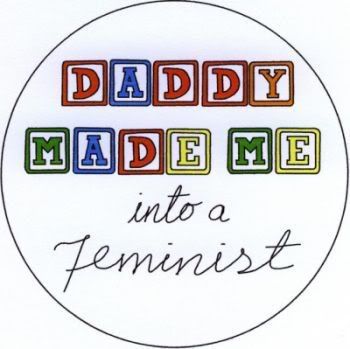
I've never written on the subject at such length before, so it's not much wonder that my original point is getting drowned in a puddle of wangst. (It's been a little over ten years, which is a long time in stored-up whining). I believe I was attempting to say that tilting a burden of responsibility entirely onto only one parent is not a safe way to bring up children, and idolising such a model without discussing its attrition rate is an incitement to neglect. I don't think you need to be one of us evil European feminists to see that (but oh, the badge!) I'd genuinely like to know what Vox Day would say ought to happen to motherless children whose father does not seek to remarry. Iain McEwan was a bit more clear on the point of where he expects uncared-for children to wind up.
Now, I read this new PWOT about atheists and Christians a couple of days ago; being neither, it was more amusing than enlightening for me, but it made the very sensible point that focusing on negative examples makes you stupid. He was speaking of a considerably fouler extremist, Fred Phelps, but I think the point stands;
Smearing all Christians with Phelps' bile is a cheap shot, like saying all atheist schoolkids are potential Columbine shooters. At worst, that kind of stereotyping is dehumanizing and divisive. At best, it's a recipe for mediocrity. I compare myself to the worst so that I don't have to try to be the best. I can spend all day on my sofa, playing Wii Boxing and helping no one, and I'll still be a better man than Phelps. But I think we've got to shoot higher here.
So yes, Vox Day is an extremist, and I won't seek to compare all those who abuse the word 'family' for political purposes to him. However, he is trying to compare all his enemies to me. That traditional nuclear family thing he's talking about, the thing all we foul Europeans (wtf?) hate so very much? I hate it. I don't want to be part of one ever again, and reading such praises of the system made me quite upset. Not because I think it's got some nebulous potential to do harm, but because I know it does harm; it neglects me, excludes me, silences me and forces me to fend for myself. What he says - that children without mothers exist outside civilisation - is hurtful not because it's outright false, but because it's generally true and it's fucking unnecessary and, contrary to his characterisation of things, this championing of the status quo, the wonderful ever-caring mother, causes deep harm to certain children, of which I am one.
Even - I recall this quite distinctly - the evening it happened, I was aware that losing your mother was an extreme anomaly - something that got fetishised in storybooks, not something that actually happened to real children, not something that a family has to be prepared to adapt to, to get on with. I didn't truly believe it for most of the next week; no one had told me that she wasn't getting better, that her immune problems were terminal and she only had at most a couple of years before leukaemia set in anyway. It was a Friday, and I went back to school on Tuesday, where my form tutor told me he was surprised to see me back so soon; I remember telling two older acquaintances who had not heard the news - the way their mouths opened, the tones of voice. I was internalising other people's expressions of horror; my own feelings were a silent clamouring that I didn't know what to do with, no matter how many people tried to offer me a shoulder. (Someone - a friend of my parents' - even gave me a notebook specially, but I wrote stories in it instead, because that was emotionally safer.)
That's not important, that - just me wallowing, which isn't something I do often but reading all this Mother's Day claptrap kinda invites it. Up til then, I'm sure our family would have made Vox Day proud; a mother who ran the household, a father who worked long hours far from home and didn't involve himself other than in providing money and laying down the law, and three pretty well looked-after kids. Is it just me, or is there something inherently unstable about this structure?
I recently (awful timing, the thing had been sitting about waiting to be read for months) read The Cement Garden by Iain McEwan. It's a story about four children who lose their mother, and then enter a dreamlike lifestyle of little responsibility, much secrecy and lots of incest.
Like Vox Day, he gets just enough right to be hurtful without being in the least productive.
-The sheer banality; the fact that the important questions are about who's going to put food on the table, who cares for the youngest, who cleans up after everyone. The fact that 'mother' is such an ingrained answer to this question that when that option is not available, what you get instead is passive-aggressive confusion. I remember the first time our father cooked a meal for us - he became furious at our differing tastes, and has only cooked for us a handful of times since. He didn't dump every chore on his daughters; he did the laundry and some of the washing up, but when you're fixing buttons on your father's shirts when you're behind on your GCSE coursework, and cooking nine meals a week, you get resentful about the things your mother used to do. And you really can wind up aggressively not caring about caring about yourself.
-truancy. Losing someone who's absolutely central to your life crushes every thought you ever had about the future - the places she said she'd take you, the wanting to succeed and to celebrate success with her, even her hoping aloud that she'd have grandchildren one day. You don't just lose what you've got, you lose your future. Why not skip school, especially if you're still getting straight As? What's to lose? That said, we three were occasionally skipping from soon after she began her last hospital stay, about three months before she died. But even then we seemed to feel accountable - we'd tell her, even if we'd avoided letting our father know. After she died there was no stopping us; our father didn't know, or care, so long as we kept pulling the grades. He was always furious when he found out, but that was just another thing to hide from, so it merely fuelled the trend. And my school? It was one of those 'good' state schools, which means they hushed up, did their best to avoid letting it get on the records (straight As kids who go to 'good' schools do not play truant, everyone knows that), asked all the wrong questions, tried to make me scared. Children that rely solely on a mother's care very easily sidestep responsibilities without her; there's no reason not to slide down the path of least resistance. And now? I'm in London, halfheartedly jobhunting, and I feel like a truant again.
-the power struggles and blame games. A father who's always left the family in the hands of his wife while he does more important things has no authority over you, but an awful lot of power. He doesn't know you, and you're not accountable to him - he's just judge, jury and executioner, and every so often he gets drunk and tells you that he never wanted a family anyway, that that 'Let's have another baby!' thing Vox Day harps on about is just woman stuff. I honestly tried to relate to him, to be fond of him, for a while. I can't say he ever returned the gesture. And now he's old and infirm and polite to me, and I feel all kinds of cruel for disliking him so much, but ultimately, I remember why I do. Nemesis and Mnemosyne, m? Anyway; McEwan's grotty kitchen hit a nerve, as did the arguments about whose word was law, the arguments about money and material objects (our mother had always been over-generous with random presents, while our father never offered such kindnesses at all). Our clothes wore out; we never had pocket money, but if we asked infrequently enough, we'd get given spending money for more. We lived in a small village in the Pennines, so accessing anything we needed, material or human, was an awkward process that had to be mediated by our father. I won't live outside cities now.
-the fear of outsiders. My father once, drunkenly, told me his madcap story about how social services wanted to take me and my younger brother away (my sister was too old for that) because they'd noticed the truancy; I've no doubt that this was 99% conspiracy theorising on his part; perhaps it was due to his paranoia that we never received any practical or mental health help over it all, which goes to show what a responsible head of household a non-carer father can be. But the process happens; someone clumsily reaches out, you find reason to push them away. Too-perfect relatives, well-meaning schoolteachers, the church... They make you self-conscious. They make you feel like your problems are the wrong problems, and your feelings and wants are the wrong feelings and wants. Besides, they assume you get over it, which in a limited fashion is true; after a year or so, the crushing grey feeling in your chest fades away, and I think most people know that so they forget to keep being kind. But the other part of it, the having no mother part, is still happening, day in day out. It's there when you're hitchhiking to exams because the public transport is shit and there's no one you dare ask for a lift. It's there when you give up your hobby, don't do your coursework, when you get on a train to Scotland, alone, because you want to see your sister and it doesn't matter if you don't get there in one piece. Strangers are easy compared to acquaintances; being alone is even easier. So you push the outside world away.
So yes, McEwan managed to get in a lot of things that touched on my feelings, but I still felt distinctly uneasy about his writing. I felt exploited, though I had no right to; I felt like someone was digging into lives like mine for salacious details that would sell lots of books, making up the perviest bits out of whole cloth, ignoring the meat and bones of it all. It did get me down that he let his family structure dissolve into incest, because there's a real radical distortion of the family happening there, and it's like he's saying it's not juicy enough to interest him and he'd rather use this opportunity for airing unpleasant truths to talk about sexual oddities instead. (He also demonstrated the traditional literary disdain for the resilience and strong identity of small boys; I don't doubt my brother will find he has troubles to trip over, but he's by far the most emotionally and socially healthy of the three of us, and seems to be more mature and stable than the majority of his peers. Look, writerguys, you can poke at my screwiness as much as you like, but call my kid brother a freak and I'll deck you.)
Now, I have huge issues about family life. I already said, I hate - hate, you know, the cold but irrational stuff that you just cannot put up with? - family structures that place a unique burden on a female caregiver. I hate seeing women referred to as somehow having more responsibility to their families than men do. My relationships are a domestic minefield; I once dumped a boy partly because I made dinner for him and he thanked me in a way I disliked. And god, I feel utterly out of my depth around other people's parents anyway, and with SO's parents I'm even more confused. I don't know what parents are for, why they're necessary for people my age, and I'm dismissive in some ways, jealous in others. I know several people much older than me who have parents, and that just mystifies me entirely...but at the same time, I'm keenly aware that it's me who's the weird one. (I even get told so from time to time, though not by anyone worth speaking to). I probably shouldn't have children myself, if I do, it may well be an unpleasant experience for both me and them.
So I have issues about relationships, huge ones; I also have a bond with my siblings that I believe is unusual, but the paperback writers do not want to know. I felt exploited. Now, I've no right to feel like that; if I want books to reflect my experiences I ought to go write them myself, which I am I'm kinda sorta every-so-often trying in roundabout ways to actually do, but I still felt like this McEwan guy was calling me a freak in order to make himself a large stack of money. I'm sure it's not like that for him really. (Vox Day, however, really is paid for telling children without mothers that they're barbarous and futureless, so I feel justified in pointing and laughing at him and describing the sort of family his good Christian stay-at-home mums are actually creating.).
My sister and I both write (she a lot, I a little) and we both seem to dig into family matters a fair bit; she writes about close but dysfunctional extended clans, people for whom family ties are often painful but ultimately matter. The majority of my characters have no regular family structures at all, and those who do tend to be very distant from them. I don't know what that difference says about us. She's almost five years older than me, and perhaps has a better set of memories. We never talk about it, never talk about our mother at all; the only person I talk about my mother to is my 'aunt' (her best friend). In fact, I think I just decided to not tell the sister about this blog, because I am a coward. I want to talk about it, hence why I just wrote a couple of thousand words about it, but I do not feel able to talk about it with her.
I've never written on the subject at such length before, so it's not much wonder that my original point is getting drowned in a puddle of wangst. (It's been a little over ten years, which is a long time in stored-up whining). I believe I was attempting to say that tilting a burden of responsibility entirely onto only one parent is not a safe way to bring up children, and idolising such a model without discussing its attrition rate is an incitement to neglect. I don't think you need to be one of us evil European feminists to see that (but oh, the badge!) I'd genuinely like to know what Vox Day would say ought to happen to motherless children whose father does not seek to remarry. Iain McEwan was a bit more clear on the point of where he expects uncared-for children to wind up.
Subscribe to:
Posts (Atom)