Showing posts with label posts which mention racism. Show all posts

Monday, April 12, 2010

true things about gender that you can learn from watching Avatar:

(Some of you may have seen this before; it's a belated crosspost of something I said someplace else. To everyone else, hi again! I haven't forgotten you - just not in a bloggy mood atm).


1. No matter how much more experienced, more intelligent and more educated a woman might be than a given guy, he is still going to get more honoured for his accomplishments than she is.

2. If a guy repeatedly nags a woman, oversteps her clearly stated personal barriers and ignores her 'no's and her requests to be left alone, he won't be in any way punished for this. The woman in question may then be forced to give him her time, energy and attention.

3. Women are expected to 'civilise' and to educate men, even if they don't want to.

4. Related: in any mixed-gender officialdom, low-reward educative roles will be disproportionately occupied by women. (Trufax, just ask the next female education rep you see. In any group. Anywhere.)

5a). Also related: if a woman is better/more experienced than a guy at anything, it's only so she can teach him how to be more badass at that thing. She will never be referred to as a 'stone-cold sky hunter' or whatever the hell it was, no matter how many years of experience she has at it. If it's at all technical/athletic/masculine, no one will ever say that she was 'born to' do it, even if she was.
5b). The guy will end up with a more pimping ride than her.

6. Men are expected to choose a woman to pursue from a range of possible partners. Women are then expected to say 'yay' or 'nay'. Everyone is expected to be heterosexual.

7. 'Masculine' feats are easy ways to win public belonging. Even the possibility that you might have a masculine role - a warrior, in Avatar context - offers you potential value in the eyes of the people in control of your life, who are men.

8. So-called anthropologists will ascribe rigid gender binaries to the cultures they study. If the intelligence of non-white women is recognised, it's classed as cultural/religious rather than logical/scientific.

9. You will wind up in the magical data treefridge.


... :/

Ffs.

I am tired of seeing that stupid story over and over. I mean (when I wasn't trying to find a way to get my giant 3d glasses to stay on my face) there were camera angles in that movie that provoked physical-based emotional reactions from me, I was really wanting to get into it, but the fucking fratboy bullshit mentality was so frustrating that, god, I reached this point about 3/4s of the way through where I literally had tears leaking out of my eyes at how stupidly racist and sexist the story was. I was wishing it was a videogame because then I could have wandered about in it and talked to all the NPCs instead of looking 'down' on them camerawise as they sat on the floor and gyrated oh god James Cameron what is wrong with you? however gratuitous and crazy Zhang Yimou is at least he gives the impression of knowing that I exist and that I have a point of view.

...So basically I just switched off after that and started msting it with some of the imaginary people in my head, and had this tremendously eerie, detached moment of looking at the massed flying dino armies, asking 'so what would you do?' and getting that 3 Daft Monkeys line in reply:
Do you think gods hang round in bars and compare armies that they've got?

Mhm.

Monday, October 13, 2008

when he said 'rely on' he meant 'totally f*ing ignore'

I want this election to be over. It seems like the far-right limbo bar is dropping by the day; how low can they go, I ask? Did they reach their limit yesterday? No, they did not! How much further? They have, what, another three weeks in which to remain in the hole and keep digging.

So let me regale you with a quickly-buried weekend news incident, one which sank almost as fast as the Troopergate report. Its timeline goes something like this:

August 15th: in those Rick Warren religious-test-for-public-office interviews of McCain and Obama, McCain and Obama are both asked 'Who are the three wisest people that you know, that you would rely on heavily in an administration?'

McCain names General David Petraeus, John Lewis and Meg Whitman.

October 11th: John Lewis releases this statement:

As one who was a victim of violence and hate during the height of the Civil Rights Movement, I am deeply disturbed by the negative tone of the McCain-Palin campaign. What I am seeing reminds me too much of another destructive period in American history. Sen. McCain and Gov. Palin are sowing the seeds of hatred and division, and there is no need for this hostility in our political discourse.

During another period, in the not too distant past, there was a governor of the state of Alabama named George Wallace who also became a presidential candidate. George Wallace never threw a bomb. He never fired a gun, but he created the climate and the conditions that encouraged vicious attacks against innocent Americans who were simply trying to exercise their constitutional rights. Because of this atmosphere of hate, four little girls were killed on Sunday morning when a church was bombed in Birmingham, Alabama.

As public figures with the power to influence and persuade, Sen. McCain and Gov. Palin are playing with fire, and if they are not careful, that fire will consume us all. They are playing a very dangerous game that disregards the value of the political process and cheapens our entire democracy. We can do better. The American people deserve better.


Here's the McCain response:

Congressman John Lewis’ comments represent a character attack against Governor Sarah Palin and me that is shocking and beyond the pale. The notion that legitimate criticism of Senator Obama’s record and positions could be compared to Governor George Wallace, his segregationist policies and the violence he provoked is unacceptable and has no place in this campaign. I am saddened that John Lewis, a man I’ve always admired, would make such a brazen and baseless attack on my character and the character of the thousands of hardworking Americans who come to our events to cheer for the kind of reform that will put America on the right track.

"I call on Senator Obama to immediately and personally repudiate these outrageous and divisive comments that are so clearly designed to shut down debate 24 days before the election. Our country must return to the important debate about the path forward for America."


And the Obama campaign's response to the McCain response:

Sen. Obama does not believe that John McCain or his policy criticism is in any way comparable to George Wallace or his segregationist policies.

But John Lewis was right to condemn some of the hateful rhetoric that John McCain himself personally rebuked just last night, as well as the baseless and profoundly irresponsible charges from his own running mate that the Democratic nominee for president of the United States 'pals around with terrorists.' As Barack Obama has said himself, the last thing we need from either party is the kind of angry, divisive rhetoric that tears us apart at a time of crisis when we desperately need to come together. That is the kind of campaign Sen. Obama will continue to run in the weeks ahead.


I first read about this on this 538 thread. Several older commenters there said they believed that the comparison between Palin's rallies and Wallace's rallies was a valid one.

Thursday, September 25, 2008

Everything I Just Said, But Better

...was put online by David Wong, like, the day after I posted my version. The complete title of Wong's piece is 6 Brainwashing Techniques They're Using On You Right Now [mildly NSFW] - here are the relevant bits.

#4. Controlling What You Watch and Read:
Studies show the brain is wired to get a quick high from reading things that agree with our point of view. The same studies proved that, strangely, we also get a rush from intentionally dismissing information that disagrees, no matter how well supported it is. Yes, our brain rewards us for being closed-minded dicks.

So with a little prodding, the followers will happily close themselves in the same echo chamber of talk radio, blogs and cable news outlets that give them that little "They agree with ME!" high.

This wouldn't have been possible even 20 years ago. I grew up in the 80s, in a house with three TV stations. Three. We got one newspaper, the local one. You didn't get to pick from the conservative news or liberal news, back in my day you took what you got and you were thankful for what you had, dammit.

Today, I go through that many outlets a day just to get my freaking video game news.

And now, that explosion of the 24-hour cable news stations and, later, the web and blogosphere, has created these parallel universes of Right vs. Left media outlets, complete with their own publishing arms.

And for each, their favorite topic of discussion is how corrupt and ridiculous the other side's media is. They each even have "watchdog" groups that exist purely for the reason of hammering away at each other (the left has FAIR and MediaMatters, the right has the Media Research Center).

Recently Seen:
When an MSNBC interview with candidate John McCain got tense, he responded to the question by openly accusing the reporter of being an operative for the other side:

Just days later the campaign called The New York Times "a pro-Obama advocacy organization."

This technique is relatively new, but you'll see a lot more of it in future elections. The candidate will talk right past the reporter asking the questions and says to his supporters, "These guys work for the enemy, don't believe a word they say. Their lies will only poison your mind."

#1. "Us vs. Them"
...we're hard-wired by evolution to form tribes. The more stress we feel, the more we feel love and attachment to those who look and sound the same as us, and the more we feel hatred to those who don't. It's just an old survival mechanism, since the ancient guys who didn't show that kind of blind loyalty were killed off by the fierce tribes formed by the ones who did.

So today we get that petty dehumanization of everybody outside of our group ("hippies," "rednecks," "fundies," "geeks," "douchebags," "libs", "cons," "fags," "breeders," "infidels," "towel-heads," "honkies," "darkies," "players", "haters").

They can play on those old, primal urges for even the most retarded of results, such as fierce brand loyalty (the PS3 vs. 360 vs. Wii flame wars will make you claw your eyes out).

But to really make this one work, They can't just define your group, but have to define your group as the elite group, a shining beacon in a world full of weak-minded walking turds. The items on this list work best in combination, and you'll see in that the element of mockery and insulation from opposing viewpoints we talked about earlier (why listen to the viewpoints of those lesser sheeple?). Often this is combined with siege terminology ("The whole country has gone to hell, but we've got to stand up for common sense, folks! It's us against the world!")

Recently Seen:

Watch five seconds of an election stump speech. Every side does it.

In Sarah Palin's convention speech she talked about how people from small towns are totally the best ("We grow good people in our small towns, with honesty, sincerity, and dignity"). Earlier in the primaries the Clinton campaign did the same thing, talking about small towns as being the backbone of America where real, honest people are found. Always there is the unspoken reminder that these honest rural folk are under siege from those scary, phony freaks in the city.

When speaking to those city folk, on the other hand, Barack Obama made the infamous reference to those same small town types clinging to guns and religion, talking about them like they were savages to be studied through binoculars from a tower, with some peasant disease that needs cured by the enlightened.

Not only is "Us vs Them" the first and most important one on the list, it's the culmination and end goal of all the others. Drawing you into the right tribe is what They want most, because they can accomplish nothing without tribesmen.


(One thing Wong missed is that the 'small towns' line isn't original to Palin, but is a quotation from a long-dead American facist, Westbrook Pegler. Robert F Kennedy Jr wrote about this on HuffPo. Pelger was talking pretty explicitly about the whiteness of small towns, as opposed to cities inhabited by black Americans, by Jews and by other immigrant groups that were considered less than white at the time he was writing).

Tuesday, September 02, 2008

on privacy: a comment I made elsewhere.

[Elsewhere being Alas, specifically. I'd wondered about making a post about the whole Palin circus, leaned towards 'no' simply because I believe that Bristol Palin, though she is breathing for two, is not a valid recipient of media oxygen other than when the McCain campaign decides to start lighting matches, which I am sure it will. But then Mandolin posted that roundup about privacy and its connection (or lack thereof) to reproductive rights, and I found it a good topic for some thinking out loud.]

One thing I’d say is that Bristol Palin’s privacy is not a reproductive rights issue; she deserves privacy because she’s a young woman who has never asked for the world’s media to be on her doorstep. She deserves privacy for the exact same reason all the other candidates’ children deserve privacy. We do not need to interrogate Bristol Palin, ever. Whenever the McCain campaign makes propaganda use of her, talks about what a wonderful choice she made, we need to interrogate the McCain campaign and slam them for their hypocrisy and their inhuman anti-choice values.

It is interesting to see who gets the privacy and who does not, though. The Obama daughters have been regularly paraded on stage because so many people in the media, and allegedly in the US at large, had a nervy, perverse fascination with the idea of a black first family, and the Obama campaign felt forced to respond to that. Because America is a racially unequal society those young black girls don’t get the right to privacy.

And now there’s a young mother-to-be in the spotlight; I don’t know about you, but I haven’t heard the name of her fiancé, nor read anything related to him. I also don’t know the names of any male children of anyone involved in this election. That Obama and Clinton don’t have any skews that, I’m sure - but I don’t even know if McCain, or Edwards, or most of the VP-possibles have children at all. The only people whose children have been talked about are Obama, Palin, and (to a much lesser extent) single father Biden (and there’s Chelsea Clinton, who was known to us from her father’s time in office. Quick, Britons, what’s the fastest rail route between Bristol and Chelsea?). I haven’t heard the names of Biden’s children. I don’t know anything about McCain’s children, not even how many he has, other than that he has at least one adopted child.

In other words, if you’re a white guy, your family gets more privacy. (Barring extremely odd circumstances like Biden’s - and if I may make an aside, I feel that the single father family I grew up in got too much privacy rather than too little; as Amanda wrote, privacy can be a shield for abuse, and also just for plain poor parenting. Single father families are far interrogated far less than single mother families, even given that they outnumber us by 10 to 1).

Tuesday, August 05, 2008

that one non-post about Wimbledon

Sometimes when you're writing blog post drafts, you realise they're just burying other drafts. This one I abandoned due to pure derailment (more on that in a moment), but I think it deserves to live.

Coverage of women's sport does, as with most coverage of women's anything, suck. Most often it's not there much at all, but then you get blessed lovely Wimbledon, in which it is there and is often cringe-worthy. Last year the blue person (with a wee bit of help from me) made a beautiful collection of the worst of the worst Wimbledon online news (locked away on Livejournal, gah [edit: It's here, so go read]), and I intended to reprise that this year.

Except:
a) many news sites were so turned on by gorgeous, fabulous Rafa that they reverted to Option 1 - not covering the women's game so much.
b) it was genuinely better. For real. I think this is partly because the worst reporting last year was about Marion Bartoli, who had the gall to play in the final in spite of not being thin. This wasn't just mean-spirited of her, but actually affronting to the laws of nature and acres of newsprint were devoted to the question of how it had happened and how it could be prevented in the future.
c) I was derailed by the discovery that by far the most stupid thing said all fortnight was by one of the female players.

Friends, I give you Sveltlana Kuznetsova, the dimmest bulb in the entire box.

...behind her on the players' terrace there is a commotion, as a posse of photographers cluster around Serena Williams. I have heard that she and Serena are good friends, I say. “Yes, we text. We go out sometimes. I have big respect for African (-American) people. I think I was black in a past life, because I feel so much for African culture. I tell Serena that I want her hair, to have corn rows like her. She laughs at me. She says we all wish for what we don't have. But she teaches me some slang, and shows me dance moves.” A delighted laugh. “I can't shake my body like African people.”

Wow.


For what it's worth, here's a few more:

At The Independent, Paul Newmanat has made his tennis article contain as little tennis as possible. Instead, he faithfully regales us with Venus Williams's comments about...get this...food and babies. They are not even comments about eating babies, which would at least have been more entertaining than this trash.

And the Indy crowns itself as my new least favourite sports site with this from Tim Glover:
Equal pay isn't fair play [...] yesterday's winner in the family affair that was Williams v Williams walked away with prize money of £750,000, the sum that will be earned – really earned – by the men's singles champion today. Parity? It's nice work if you can get it, although for most of the time it can hardly be described in the women's game as work.


At The Times, the women's game is 'tame' and Venus and Serena Williams only reached the final because other players 'the top seeds at Wimbledon capitulated one by one and handed the trophy and the prizemoney to the Williams sisters'. [Fact: black women never deserve anything they've fought for. MOW keeps pointing this meme out.] Fortunately two commenters call Nick Pitt on his bullshit; 'didnt the same two guys play the final before. Didn't the women have upsets all through the two weeks. When this happens to the men it's exciting.'; 'Djokovic and Roddick lost early too. Does that mean men's tennis is in "trouble" ? Serve and volley? Few men play it anymore either.'

Over at the Daily Telegraph, Venus Williams is no longer a woman:
Venus' serve alone would have blown a few hats off in the Royal Box, and it was almost like watching the men's final on a Saturday. Not for nothing are they sometimes referred to as the Williams brothers.

More wow.

The Guardian's David Mitchell is brutally honest about the sexualisation of women's tennis, but is oblivious to the crap behind it:

Ana Ivanovic caused quite a stir at Wimbledon before being knocked out, largely because she's pretty. This has a particularly amusing effect on the BBC's ageing male commentators, who struggle to find a way to refer to the fact without saying anything sleazy. Their discomfort is palpable as they struggle with phrases like "very mobile and athletic", "nice dress", "young lady" and even "lights up the court". They're like tremulous uncles, weary and nervous of their own arousal.

They know they've got to mention it, you see - it's good for the business that is women's tennis. So they've got to say something but they know it mustn't be "I, for one, would like to bang her!" or "What's great about a player like Ivanovic is that she attracts a lot of teenage wankers as well as the tennis fans". They don't want metaphorical jizz on everyone's mental centre court but, at the same time, they know that, if the internet's taught us anything, it's not to underestimate the masturbatory pound.


Did you hear that subtext? Yes, yes, straight women don't masturbate. I guess Sue Barker's constant drooling over Roger Federer is representative of some phenomenon unknown to science.

Friday, May 30, 2008

Truth & consequences in the stories we tell.

[Or, a meandering collection of links to stuff about stories, sandboxes, and power.]


Quick, what's the one thing everyone knows about Grand Theft Auto? Keep hold of the answer - we'll be back for it in a moment.


I was never sure how to order this post, or what exactly to include in it. So it's been festering in Dashboard for weeks now. Partly it was sparked off by reading criticisms of Iron Man, which blurred between entirely valid digs at the film's racism and sexism, and a less definable discomfort with the entire genre it's part of. See WOCPhD's brilliant post, where she seems to have lost sight of the fact that she's reviewing an adaptation of a 1963 pulp comic book.

That's pulp, where what is right and just comes way second to what's considered entertaining. That's 1963, the past, where a lot of our current media franchises come from - whether it's those comic book adaptations, or Narnia, or James Bond. Not that the newer franchises are a lot better, but (as I said when it came up on Punkass) characters like Pepper make way more sense in that context. The whole wonderboy-hero, powerful enough to do everything we wish to do, except for those boring things his ever-capable sidekick(s) do(es), makes more sense in that vein of pulp than in the current one. This hero-character is always at the top of the world. Why do we identify with him, when he's got nothing in common with reality at all?

Because we want to. Because we're wishing for his absolute power, and we are vividly interested in what the consequences that power might bring. We play sandbox games for similar reasons - a wish for the absolute ability to choose - and that raises discomforts of its own.

(It's always 'he'. Unless the red one is writing it, it's always 'he'.)


There is something Aishwarya said in the Iron Man thread at Daisy's place; "I really, really wish I could just watch movies where things blow up (because movies where things blow up are excellent) without being constantly alienated by this sort of thing. :("

That alienation is one of the major sources of the criticism of Iron Man; that when we leave ourselves behind and go to places where we have infinite power, and can blow up whatever we like, we're almost always asked to identify with white, heterosexual upper-class men. We want to be Bruce Wayne or James Bond. We wish for their momentum, possessions, power, and their challenges. Why do they all have to look the same?


An aside; Cleolinda is talking about a whole other sort of wishing, in a post about a book series that's aimed at teenage girls. I liked this:

Wish fulfillment: I really cannot stress how important this element is, because I think it's also the reason that Harry Potter grabbed the cultural imagination. You're not a neglected orphan sleeping in a cupboard! You're a wizard! You're the bestest wizard of all and you're also great at sports and you had rich, wizardly parents who loved you so much they died for you (but you've still got their money) and also, we brought you birthday cake! And then you, through Harry, are plunged into this fantastically detailed wizard world. I mean, shit, I'm sold. And I think most things that really grab people are going to tap that "I want to be that person and live in that world" vein. I want to be Elizabeth Swann, I want to be Lyra Belacqua, I want to be the Pevensie kids.


She's talking about the same instinct that makes us love those boys who can do anything they want...and yet everything she says about this sort of wish fulfilment turns me off. I don't much like any of the books and films she's referring to. Some of these are in a middle ground - but I seem to be banging my head against the fact that the wishes I like are usually aimed at (we might even say assumed at) a male audience, and Cleolinda is talking about teenage girls, and women who remember being a teenage girl.


A while ago, Trinity wrote about our discomfort with power and excess in an unrelated context - kink!:

Think about standard criticisms of the rich and opulent. Whether they're criticisms of the nobility, of the bourgeoisie, or other criticisms of the rich and powerful. The idea that these people are decadent, that they wallow in excess, drown themselves in pleasure.

That kind of excess is actually a big turn on for me. The idea of going further and doing more, overflowing with energy, desire, and intensity. It's something I began to have a very hard time with when I got into feminist circles that were also socialist or influenced by socialism.

Because the central idea of that kind of political movement is that some people have too much and some people don't have enough. If that's the material situation of people in the world, and I seek to be committed to some kind of distributive justice that least makes the first step to equalizing some of that, how can I get into bed and touch myself while imagining, sometimes literally, that I'm lord over other people?


While not primarily sexual, wish fulfilment stories seem to hit a similar wall in the liberal press; you can't be fantasising about that, that's too much, too violent, too greedy, too unfair. So onto Cate's GTA article at Shameless:

But the object of the game is still to shoot people and win gang wars, right? I find it hard to fathom why so many intelligent people insist on defending this game, whose major appeal I once heard summarized as, “you can sleep with a prostitute and then shoot her so you don’t have to pay.”

Creative, indeed.


What, is Shameless not so shameless after all? :O Certainly Cate is saying that a virtual world's functionality should contain hard-coded moral limits, rather than simple moral consequences. It is not enough that nothing real can be harmed or lost in the space, or that your virtual self suffers virtual consequences for performing proscribed actions; instead she asks that a line be drawn, and certain evils be rendered impossible. (Something like this exists in Sims 2 - you can't kill a baby or a toddler, can only have sex with adults and elders, and character's genital areas are obscured by pixels. These restrictions have been ripped up by a legion of fanmodders, which demonstrates how practical that approach is, though when choosing nominal imaginary limits, practicality is hardly the point. Worth remembering that it was modders who caused GTA3's Hot Coffee debacle. Ultimately neither lawmakers nor creators can censor the use of game software - it's the users who determine how it is played).

Our species of cyborgs has been wrestling with this problem, of defining our virtual limits, since A Rape In Cyberspace or before.

Dibbell's story touched on one point that has been gaining ground recently; should virtual crimes be subject to real-world consequences? The answer he watched arise from LambdaMOO was a no - those who commit virtual crimes should face justice within the intimacy of the wronged community. Then as now, the internet usually gives its wrongdoers a sentence of exile.

Regina Lynn, writing about a more recent virtual rape, also thinks not. Meanwhile, DailyBits has a list of unexpected real-world spillovers from virtual events; MMO addict deaths and in-game funerals, virtual thefts and real arrests, and a story about a Gunbound player from Brazil that I can barely get my head around.


Last week I read a Cif Arts piece in defence of James Bond that talked about how uncomfortably realistic violence is part of the thrill, when it comes to boy-heroes...and added a few words about consumption and luxury:

Thanks to the cartoon violence of the films it's also easy to forget just how effective the sadism in the novels can be. Fleming's books are creepy and chilling and this graphic cruelty, combined with painstakingly accurate descriptions of high-living, fine eating and the pleasures of quality consumer goods must make Bond a direct ancestor to characters like Patrick Bateman and the unnamed protagonist of Fight Club as much as the promiscuous father of so many lesser pulp-thriller spies. It certainly merits him a place in the canon.


So violence is an intrinsic part of this wishing-ground. Graphic violence, ultimate consumption, extreme adventures - and as the article hints, unlimited access to sex. Sometimes the hero is simply a tireless playboy, but many of these stories include legions of imaginary sex workers.

To my shame, it was only a week ago - and thanks to Chris - that I read the mighty OH JOHN RINGO NO review, which charts an odyssey of violent and misogynistic wish fulfilment. From Hradzka's description, every woman in the series is a sex worker, or described as a potential sex worker; within the fantasy space, all women are perceived as being available for sexual purchase.

Hradzka also mentions a whole aspect to this wish fulfilment thing that I'd never much thought of before:

Once you get past GHOST's initial spleen-venting, the PALADIN OF SHADOWS series falls into a much-maligned, much-loved genre which, for lack of a better name, I call "Man Builds Stuff and Gets Lots of Pussy." This is, quite frankly, what got me reading the series: I am not much for stories of a guy just killing terrorists and getting laid a lot; but let him start building a small kingdom while killing terrorists and getting laid a lot, and I am there. I confess that have a soft spot for these kinds of stories. I suspect that *lots* of men do: even if we don't build things ourselves, we like to *read about* guys building things: castles, weapons, companies, societies. It's really very soothing; it combines the pleasures of fiction with a those of a do-it-yourself manual. The same impulses may explain why a lot of male writers aren't content to have their hero just carrying, say, a 1911 as his sidearm; they have to tell you what make, model, whether it's got an internal or external extractor, what aftermarket parts he's tuned it up with, and who he bought them from, until you know all about his Kimber's Ed Brown slide stop and Wolff springs.

(Curiously, the sex-related parts do not require details of every thrust; if the chapter fades to black with the hero hopping into bed with two nubile wenches, honor is satisfied. John Ringo, alas, often carries honor considerably farther.)


I'd never put a name to that before, but building stuff is definitely a genre I like. I enjoyed this aspect of both Iron Man and Batman Begins...not to mention Metal Gear Solid: Portable Ops, a game in which you have to procure yourself an entire army. (I can think of only one Woman Builds Stuff story - A Town Like Alice by Nevil Shute. While I enjoyed the Woman Builds Stuff part of the book, it seemed rushed and unconvincing compared to the rest of it).


On CiF, Charlie Brooker unwraps the problem, and finds a new one wrapped inside:

The one thing everyone knows about Grand Theft Auto is that you can kill prostitutes in it. That's because it's a "sandbox" game in which you can kill anyone you like. Or you can not kill them. Or you can simply drive around slowly, obeying the traffic lights. If you break the law and the in-game police spot you, they'll hunt you down and nab you. Murdering innocent people is neither a) encouraged, b) free of consequence, or c) any more realistic than a Tex Avery cartoon.


...in other words, the problem is not that you can kill prostitutes, but that prostitutes are a singled-out class of people, neatly prepackaged as a unit by our culture in spite of their great diversity of circumstances, and the killing of this class of people IRL is common and so easy to get away with because of this - so when a game also presents sex workers as a class of people, and just happens to let you kill whoever you like, guess who people get most excited about shooting.


I should add; Brooker's point c) is under dispute. The Slate game review...which is entitled 'It's Not Just About Killing Hookers Any More'...says it's simply not true:

There's a difference this time: The violence is no longer cartoonish. Shoot an innocent bystander, and you see his face contort in agony. He'll clutch at the wound and begin to stagger away, desperately seeking safety. After just scratching the surface of the game—I played for part of a day; it could take 60 hours to complete the whole thing—I felt unnerved. What makes Grand Theft Auto IV so compelling is that, unlike so many video games, it made me reflect on all of the disturbing things I had done.


...and David Wong, in Seven Commandments All Videogames Should Obey (a followup to another wonderful article, A Gamer's Manifesto), devotes an entire page to saying it shouldn't be true:

If we shoot a zombie in the arm, we want his arm to blow off. If we shoot him in the knee, we want him to limp. And if we shoot him in the head, we want his head to explode. We want our bullets to create wounds.

[...]

Sword-fighting games like Oblivion are worse. You can slash the bad guy in the face with your blade and it does nothing. The enemy looks perfectly normal until he finally falls over dead, as if he had a heart attack from the excitement. Why give us a sword if we can't decapitate people? Don't tell us the system can't handle it, we were blowing off zombie limbs in House of the Dead a decade ago.

It's not about our blood thirst (well, not just about that), it's about making us feel like we're accomplishing something as we work our way through hordes of cookie-cutter bad guys. Oh, hey, you know what else we hate?

Filling the game with hordes of cookie-cutter bad guys.

This is another one of those problems that are exacerbated by new-gen graphics. Now that we can do photo-realistic faces, it's suddenly very weird that we're killing hundreds of identical clones.

How hard would it be to randomize facial features and skin tones? That's what we want, to feel like we're killing hundreds of different people. Not a bunch of clones or twins. We want to know, deep down, that there are hundreds of grieving mothers out there, lamenting the terror of our dreaded blade.


And I agree with him, I agree with Slate - we need the effects of our actions to look realistic, and the media queasies have repeatedly demonstrated the reason for this.


The first time I read an article about violence in videogames was almost ten years ago. It was in a library newspaper - probably the Times - and it mentioned several games, but was illustrated with one of Nomura's promotional images for Final Fantasy VII; a game that uses violence, questions it, and at one point devolves into an argument between Cait and Barrett about whether any of the violent things they've been doing are remotely justified.

That was the moment I first realised that I was never going to read anything of value about videogames in a printed newspaper, ever. Why shut up and go away when you can challenge and explore instead?

This is why my least favourite scene in Iron Man was the one that steamrolled over #6 of David Wong's Ultimate War Sim demand list:

Speaking of innocents, I want a war sim where native townsfolk stand shoulder-to-shoulder on every inch of the map and not a single bomb can be dropped without blowing 200 of them into chunks. Forget about the abandoned building wallpaper in games like the Red Alert series. I want to have to choose between sending marines door-to-door to be killed in the streets or leveling the block from afar, Nuns and all. I want to have to choose between 40 dead troops or 400 dead children, and be damned to hell by chubby pundits from the safety of their studios regardless of which way I go.


See, Wong is a gamer kid with a good grip on reality. There exist other gamer kids who think reality is like Iron Man, where magical white people who waltz into other people's countries have the magical power to distinguish between nice, innocent brown people and evil brown people (there are no other kinds, just innocent or evil), remove the latter with pinpoint precision, and go home after a day well saved. These other gamer kids are called the US government.

It's the people who don't want their imaginary violence to be realistic that I worry about. The people who want the details glossed over, who want to make out that it's not as bad as it really is, who want to conceal the fact that it's the least powerful who always suffer first and most.


One last link: Catherine Bennett on GTA. Oh dear god, you must read this:

With a violent and nasty movie, or corrupting literature, the thing is simple. You merely have to buy a ticket for, say, No Country for Old Men, or There Will be Blood, and watch it, with a keen eye for anything that might be violent or nasty. With books, you simply open, then read a copy of The Catcher in the Rye or, to go back a bit, Lady Chatterley's Lover or a bit further, one of those 18th-century courtship novels whose potential to enervate young virgins was discernible, apparently, within just a few minutes of scholarly inspection.

How different for the mature student of Grand Theft Auto IV, who discovers that acquisition of the game, an Xbox 360 and a working television will not be nearly enough to expose the sickening extent of its moral bankruptcy. For that, you need time, skill, dedication and, I suspect, youth. In fact, it would probably be cheaper, and easier, for any averagely underqualified adult who craves the excitement of casual violence in a context of social indifference to make your way to somewhere like Borough Market and snarl: 'Out of the way, bitch' at every double buggy.

[...]

In fact, if a new book on gaming, Grand Theft Childhood: The Surprising Truth about Violent Video Games, is to be believed, there may exist hardly anyone in sound mind who might not, from time to stressful time, benefit from an hour or two of moderately violent gaming. The authors, two Harvard psychiatrists, Lawrence Kutner and Cheryl K Olson, were told by many young players that they played violent games to 'relax' or to 'get my anger out'. Should we not, as a matter of urgency, implore Gordon Brown to escape into GTA IV over the bank holiday? Or would the experience make an already vulnerable and solitary Prime Minister more likely to aim his car, à la Niko, at cyclists such as David Cameron?

Thursday, March 20, 2008

five years.

M is putting a supermarket loyalty card back in his wallet. He pulls his Gamespot trade-in card out and waves it at me. "Do you know what this is?"
"Hmm?"
"A third of a Wii."
(We have recently traded a v. large pile of no-longer-wanted stuff).
"That's good. I think we should measure all currency in game consoles now. Way better than dollars and cents."
"Yeah. Right now the Wii is worth more than the fucking economy."


Today is the Blogswarm Against The War, because we have been doing this for five freaking years now. I am caught up in silence, sadly, but there is one thing connected to the war I wanted to jot down, because it has been bugging me in blogland lately; Ferraro, blah, Steinem, blah, Feldt - especially Feldt. I mean, just look at Feldt:

I credit feminism and feminists for doing many good things, but one thing we have failed miserably at is teaching each succeeding cohort to embrace the power and the responsibility of joining together as a movement to achieve goals that particularly improve the lot of women, just as every other group does and is expected to do.

We progressive women, we feminists who are activists in a thousand worthy social causes, might decide to squander this Moment and justify in a thousand ways why it’s our right to decide as individuals when we choose our candidate.

Well, yes, it is our right. But is it the sum total of our responsibility? Is it enough to really, really like Obama? Is it enough to flee from Hillary Clinton because of, say, one vote we didn’t like (even though her opponent never had to put his vote where his anti-war voice now is)?


Listen, bitchface - if there was any responsibility blah to embrace power blah and join together to particularly improve the lot of blahdy freaking blah, then Hillary would have fucking remembered that when she voted to [make other people] go to Iraq. Those bombs don't just fall on guys, you know? And while the liberties afforded to women in Iraq had been sliding downhill since the first Gulf War, the invasion has given it another good shove.

I think I can safely say that I feel as much 'responsibility' toward this rich lawyer lady as she did for the women of Iraq.


I'm increasingly feeling that if by some great misfortune we don't wind up with a President Obama in November, I will feel like the world has missed a huge opportunity - something far bigger than missing out on expressing blah blah movement goals blah, which really socked one to The Patriarchy when we elected Maggie Thatcher, eh? (My national identity is mixed up this week. I can't vote but if I can I'd like to help out the Obama campaign in November). So, electionish links that everyone must read:

BlackAmazon on how aware of history everyone is!
Daisy on the whole Wright business.

Crap, just past midnight. I tried ;__;

Wednesday, February 27, 2008

Juxtapositianon.


Tradition Eleven: "Our public relations policy is based on attraction rather than promotion; we need always maintain personal anonymity at the level of press, radio, and films."

Tradition Twelve: "Anonymity is the spiritual foundation of all our Traditions, ever reminding us to place principles before personalities."


From the Twelve Traditions of Alcoholics Anonymous, first published 1946.

I think I've whined about this before, but I've never seen any good fiction set on the internets. Gibson's Pattern Recognition is the closest fiction seems to want to come - it's a story about the real world that involves a lot of internetting, but it's not quite there. Nonfiction set on the internet is still way above fiction; no one's made up anything as interesting as A Rape In Cyberspace or The MsScribe Story: An Unauthorised Fandom Biography. (And god, read those if you have the time. The former is a short tale from the early internets; the latter an engrossing epic that occurred in Harry Potter fandom 5ish years ago), And there's no cyberpunk character half so inspired as Anonymous.

People have all sorts of takes on anonymity/public identity on the web. This is how it looks on the Project Chanology wiki, Partyvan:

When internet communities are formed, nearly the first thing that is implemented is to remove anonymity, to make truthful registration as mandatory as possible. This is because of the aptly named Greater Internet Fuckwad Theory*, which observes that rude behavior normally unacceptable in polite society is inversely related to how non-anonymous users are. Not surprisingly, most people assume this means anonymity is a bad thing, and take every step they can to punish users who do not adhere their personal conversation etiquette.

A few people question this conclusion. A very few try out the alternative. So what happens when all censorship, including self-censorship, is removed? Chaos.


*Anonymous reads Penny Arcade.

How the mainstream sees it at the moment; Libby Brooks writing about the non-role of the internets in the Bridgend suicides;

...the unseemly rush to collar social networks only exposes adult ignorance about the integration of technology into young people's lives. Over 90% of UK teenagers belong to a social network like MySpace, Bebo or Facebook, and one-third of those keep at least four separate profiles running at once. The distinction between online and offline relationships has become increasingly indistinct for this generation, and the medium is integral to the way they present themselves and manage peer-group connections. [...] Research shows that most social network contacts are local, based on pre-existing networks... It's partly about perspective: teenagers simply don't adhere to the offline/online binary.


And I read that right after I'd read this old-internets view - David Wong, in Apex Digest, talking about pseudonyms and why his penname is the same as the name of his book's main character:

I started writing as David Wong when I created my first website (pointlesswasteoftime.com) back in 1999. It's just part of internet culture that you don't write as yourself. My friend Mack Leighty would write under the username John Cheese. Both of us would write in the first person, but always as these fictional people, so we wound up creating these characters on the fly.


(Until I read John Dies At The End [OMG] I hadn't clocked that David Wong wasn't a real person. Epic fail. I guess I'd mentally grouped him with the Ents.)

It's at least partly internets generational - not generational in an age sense, but dependent on what the norm was when and where you got involved. (I am still totally weirded out by how different my younger brother's internets is to my internets). Wong is slightly internets-older than I am (I first dipped in in 2000, and by 2002-2003 was a BNF in a small fandom I hope you've never heard of). Then, two-word pseudonyms seemed to be the in thing. (That, or the things concluding in random number streams that got spat out by AOHell). Before that - well, I'm sure we all know of a few pre-WWW internet ents - people like Julian Dibbell, Barbara Mikkelson, or J Brad Hicks, who talk about MUDs or BBs long before Usenet. I'm sure there are some exceptions, but I've yet to come across a still-active Ent who doesn't wear their RL identity on their sleeve. For all I know some of them started out anonymous and have got real since, but these guys are real and have been real for a considerable time now. (And see also The Strange Case Of The Electronic Lover; violations of trust wrt identity - lying online about who and what you were IRL - was taken seriously in [at least part of] the internet world of the late 1980s. In some places, it still is). [This said, I know that there existed an internet generation, a clutch of utopians somewhere between the different waves I've met, that liked to not disclose their gender, let alone any other personal information, because they thought the point of the internet was to dispense with these things. More of that later.]

The Bridgend kids are full-circle - identity out in the open, so all your internets friends will know if you top yourself. For this we can blame Landgon freaking Winner. (FTW.) If objects have politics - if the norms of our civilisation are morphed by the emergence of certain technologies; if you can't imagine what your society would be like without reliable contraception; if we'll do anything, sacrifice anything and anyone, to avoid losing a nuclear war; if we'll fall into whole new habits of communication just because we haz an internets - then software has society, for sure. To compare two juggernauts of internet society; Facebook's architecture/society features exclusion of the pseudonymous, while 2channel mandates full anonymity ("People can only truly discuss something when they don't know each other").

Because of the nature of the physical internet, true online anonymity is often impossible (Compartments has a neat article about how & why she takes care of hers) and that's just as hard-coded as 2channel's compulsory anonymity - more so than AA's forced anonymity. The new RL-centric social networking sites just reinforce what was already there; we're all connected already, and the internet just keeps A plugged in to B. And yet (bloggers hereabouts might remember this incident), in spite of a thorough hunt irl, Anonymous never found Brandon. He is truly one of their own.

From what I recall of internets culture five years ago, 4chan.org was there and Anonymous wasn't. 4chan's big point as a community wasn't the anonymity, it was the anarchy. No limits, no mods or rules to speak of; the anonymity was because 4chan was intended as an English-language alternative to 2channel, with anonymising architecture to suit. Rather than being a 'one', 'legion' Anonymous, a then-friend who was one described /b/tards as being a deliberate non-community; a group of people who browsed the same place (and shared an already notably intricate internet dialect) but perceived themselves as being unconnected.

AA similarly took time to achieve a philosophy of anonymity, the Traditions being ten years younger than the group itself; Daisy recently explained the spiritual and practical purposes of AA anonymity, in a vent on the subject of ______, a person who Daisy is not happy with. [this was on seekrit listmail, qwp, but Daisy also has a fascinating post about legal/illegal drug use here].;

THERE IS A REASON that the Anonymous is in ____Anonymous. The reason is not to protect your sorry ass, but to protect the CONCEPTS and IDEALS.

To wit, if Drew Barrymore, Shannen Doherty and David Crosby (to name three offenders off the top of my head), go around saying "I'm in AA!" and then they go out and get publicly and spectacularly drunk, which all three of them DID, what does that say about AA? Many people will assume AA therefore DOES NOT WORK, and they have therefore hurt the program. Someone who might need it will think, ah, doesn't work.

OR... they will look at ______ and think, EW, I don't want sobriety if it means acting like that asshole.

See?

Please make PRIVATE references to the 12 steps if you want US (fellow members) to know. For instance, use some phrases from the 12 steps, like Richard Pryor did in very dignified ways, "searching and fearless moral inventory"--a way to give US the heads-up, but not everyone. (I felt like he was waving to us, and that was nice.)

But to mention the 12 steps as often as you do, is obnoxious and uncool, and in fact, probably puts as many people off as it attracts people. But since you think you are so fabulous, you won't get that, will you?


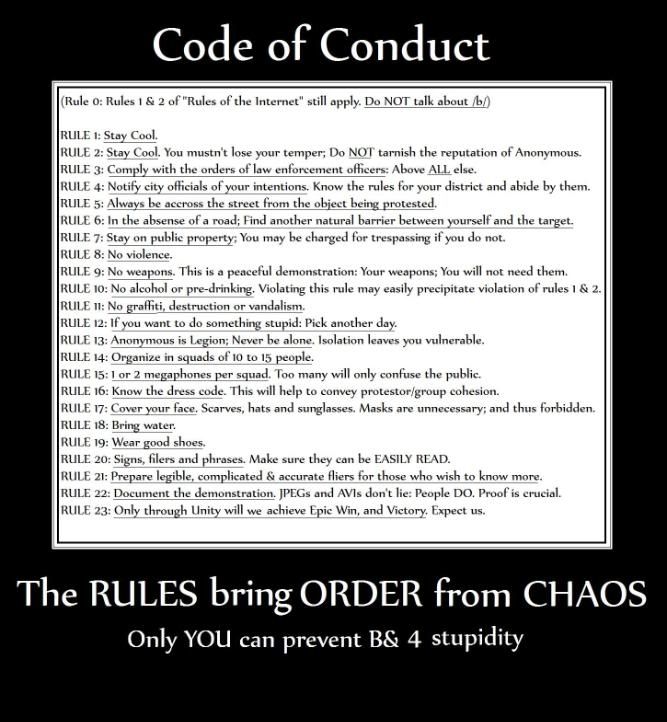
We all know who said that ideas are bulletproof. (also, note the Chanology Code of Conduct that opened with internets rules 1 & 2; do NOT talk about /b/).

And we know what Anonymous looks like, not least from Deathboy's photos and flickr links (I link it again because it is brilliant). The V masks are the thing now but back in 2006 when Anonymous was raiding Habbo, their film character of choice was Jules Winnfield. (But look at the race/racism mock on the ED Habbo page). The suit-and-tie icon has endured. Anonymous is masculine - the February 10th photos indicate that IRL Anonymous is 80%+ male. Said photos also include posters mentioning Lisa McPherson's death (and plugging whyaretheydead.net, a site that opens with her photograph) and the fact that the Co$ forces female Sea Org members to get abortions. Sometimes people use men to symbolise Scientology - Tom Cruise or John Travolta, usually - but never with this narrative of oh noez poor victims. There Anonymous is, in a suit and tie, holding aloft placards begging us to rescue these women.

I mentioned people who didn't disclose gender or race or other physical whatsits because they wanted a utopian internets without privilege? Compare to the one we've got, even once 'the gloves come off'. This isn't about Anonymous nearly so much as the other places we all know it happens - Indymedia most notoriously, Wikipedia, many or most corners of the net that supposedly give everyone a voice. It's the same voice as it was before the internets, with the same skew of volume. And that's in the design, the way the internet is an integrated part of the existing media/communications market. (though some people go quite off the rails about this fact).


So we considered going to the Atlanta Chanology thing, didn't, but that evening we go to the ED Chanology East Coast page and ctrl+f Atlanta, and find this video of what came to pass;


Riot police.

I am, for now, leaving aside the question of why my Georgia tax dollars are being spent on sending a million zillion riot police - with a partyvan! - to scare the internets out of RL, something that didn't happen at any of the other 100+ protests, though believe me I am very keen to get an answer to that. No, I'm blogging this because - just look at them. Riot police. In head-to-toe black, with masked faces, all moving as one.

The beautiful lady has been known to mention her Asshole Theory; it goes 'WHY OH WHY can't everyone be like ME?' Both masks and uniforms can keep that Asshole holding together.

Monday, February 11, 2008

the best links ever:

I have stuff cooking in my head about the whole moving-to-another-continent topic; til then, these are the best links ever.


Proper srs links:

Daisy is asking if we can support the troops without supporting the war, and where classism fits with that.

Vii on interracial dating.

Brad Hicks on lynching as an economic crime.

The entire internets on those racist mid-Superbowl ads that put us right off our cookies.


Sillier links;

Deathboy on Chanology London - omg, read this, or at least look at the pictures.

Saint Gasoline has a comic strip on How To Be An Asshole With Mathematics.

Punkass on that bit where Mitt Romney said that voting Democrat is surrendering to terrorism.

Aishwarya on the suicidal, sex-obsessed Hobbits who sneaked into her house.

Friday, September 28, 2007

telephone calls from on high/rangoonery.

I always answer the phone. It's usually either telemarketers, which she hates, or relatives, who aren't related to him (he's left for the frozen northern wastes now anyway), and some of whom stress her out, so I always try to get there first. I thought this was a telemarketer - there was that silence-then-fuzz thing, and I almost hung up halfway through the first sentence, but didn't. It was 'This is a recorded message from the Labour Party.'

Election on November 1st? You betcha. The message system (clearly I should write a ranty post about why the recorded voices are always women) asked who I was going to vote for in 'the next general election', no timeframe specified, (I pushed 4, 'don't know'), and then whether I'd ever voted Labour in the past (no). I'm now wondering if I should've lied to fuck the system, because it would be great fun if this exercise left them falsely confident and they wound up going to the country and hanging it, but hey.


A thing I should not have to rant about, but do; Aung San Suu Kyi/gender. This is not the 1950s and should not still be a fucking issue. I feel almost as if I am being petty about it but I am not; they are. After reading the abovelinked post, I then later caught this from the Beeb;

"What can we bring Daw Aung?" we asked the contact who had set up the meeting in Rangoon. "Oh, she wants supplies and reading matter!" was the reply.

I had assumed she wanted the latest edition of the Amnesty International Almanac or perhaps Nelson Mandela's memoirs. Supplies, I assumed, meant batteries or light bulbs.

What she did in fact want were the last four editions of Vogue, perhaps a Marie Claire or two and a few jars of face cream. This was utterly reassuring.

Aung San Suu Kyi has an Oxford degree and was married to Michael, an Oxford academic and a leading authority on Buddhism.

She has given her life to her people and needs to prove to no-one the seriousness of her intent. But this woman, who also happens to be exceptionally beautiful, wanted to preserve a degree of normality and dignity under very abnormal circumstances.

We handed over the gifts, she prepared delicious curry for my cameraman and me, and then we conducted a tough interview about how she could actually run a country as ethnically divided and brutalised as Burma, if she ever got the chance. Her answers were humble but firm. There is steel behind the jasmine scent.


*looks around for something to bang head against* Well. Definitely not me who's obsessed with Suu Kyi's gender. Where to start? That it is reassuring that a female political figure reads Vogue and Marie Claire? That it is 'normal'? - I seriously, honest-to-god, haven't known any woman who reads that stuff since I was at sixth-form. This is not to say that it is a bad thing, only that that form of gender performance is a minority interest and it being seen as 'normal' and 'reassuring' says a lot more about the moran who wrote this shit than it does about Aung San Suu Kyi. The 'ohh-we-must-ponder-whether-she-is-tough-and-srs-because-she's-a-GIRL' stuff is piling moranity upon moranity.


A thing that made me laugh.

A thing that made me cry.

Might go into both of those more later, not sure. I have a new copy of Neuromancer so expect cracky rants about Gibson and the Virgin Mary soon. I could also whine about hating Microsoft (wtF @ everything about the new Hotmail), Yahoo (stupid fucks buy up Musicmatch then wreck it) and Google (why is Blogger talking to me only in Dutch? Or is 'Tastaturkürzel: drücken Sie Strg zusammen mit' German? Wtf is this setting and how do I change it?)