
Three quick gamer links here, because I hope to get my groove back (though, as followers of my deadjournal may have noticed, I am slightly obsessed with a certain videogame right now, so who knows?):
a) From VorpalBunnyRanch, a great look at how the nature of violence in videogames is skewed by the protagonist's gender. In a brief follow-up it's noted how survival horror breaks the general rules regarding women and violence/action - this genre also stands out among films, something noted by Randall Monroe here in Two Female Leads.
Perhaps the more a story blurs the lines between violent heroes (or villains) and victims of violence, the more likely it is to have active female characters? I am, inevitably, thinking about how that works in Metal Gear, a game series in which women frequently commit acts of violence, but generally bloodlessly, or from a distance - with the exception of that one group of villain/victims/survival horror exhibits in MGS4. *le sigh*
b) From the Beeb, a survey of MMO players; 40% are female, they're more likely to put hardcore time into it than male gamers are, and - get this - female gamers are 5x more likely to be bisexual than the general population. (My guess: bisexuality is massively underreported in the 'general population', and if you did something as simple as matching gamers with non-gamers by age and perhaps social class, the difference would close significantly. Another possible explanation is that game design is inimical to straight female desires and makes straight women slightly less likely to play MMOs than gay women - gee, I wonder how that might have happened?)
[addendum:: see also some scepticism from Kotaku: "...these are the results of a voluntary study in which participants received a free in-game item for participating, so I can't really see how they can even begin to pretend that they tallied accurate results. If I was told to complete a study in order to receive a free in-game item, I'd complete that puppy so fast that I might have wound up one of those hardcore bisexual raider women. Think about that before you start fantasizing about that hot wood elf you saw running about Qeynos."]
c) Merry Christmas from VGCats!
Showing posts with label gender. Show all posts
Showing posts with label gender. Show all posts
Tuesday, December 23, 2008

Thursday, November 06, 2008
squees, lies, videogames.

Erm, okay, I may have lied about no more election stuff. I was seduced into giving more election links by this amazing photo-series. Just keep hitting 'show more images', it's lovely. But I have gamer-girl stuff to share too, I promise!
A little over eight months ago, Michelle Obama said to a crowd of her husband's supporters, "For the first time in my adult life, I am really proud of my country." She took a lot of flak for that statement, and was called unpatriotic, 'ungrateful', and generally accused of being a nasty strident Sapphire who didn't know her place. Yesterday two good friends of mine each said pretty well exactly that, a third (who lives abroad) said that she no longer feels ashamed when people realise she's American, and Kyrias, a long-standing US resident, is considering filing for citizenship. A lot of people at Feministe are also echoing Michelle's remarks.
With provisional and absentee ballots to sort, the last calls are still being made; Georgia was finally settled for McCain earlier today, but I'm not sure if the Senate call (it will be a runoff election, because the Libertarians prevented anyone getting 50% of the vote) has been formalised. North Carolina went for Obama by 14000 votes, again due to those pesky Libertarians; Missouri is likely McCain but still to be called - on Super Tuesday it was prematurely called for Clinton but the final count flipped it to Obama, so I guess they're trying not to make a mistake again this time. The only other outstanding presidential count is in the city of Omaha, custodian of one of Nebraska's five votes; they're busy opening the last 15000 ballots, and it's relatively likely that Obama will eke out a tiny win. This would be the first time either of the splitting states - Maine and Nebraska - have actually split their votes; personally I think it would be more fun, and lead to more engagement, if all states split their votes by congressional district.
They're also still counting in the Alaska senate race, where seven-times felon Ted Stevens has probably pulled out a win. (Nate has a post about how Alaska skewed dramatically away from pre-election opinion polls, with the Republicans overperforming by +12% in all election races, not just the Senate). If so, he will be thrown out of the Senate and Alaska will join Georgia in having a December 2nd special; I fear the seat is Ms Hun's if she wants it. It's a shame because this was the one real chance of getting a left-wing Alaskan into the Senate. :/ The Oregon Senate race has been belatedly called for the Democrats, but Minnesota is in the throes of a full recount.
Saxby Chambliss, btw, did manage to find time to get even lower and shittier right before the election. Also, I am linking this just for one great sentence: "Nate Silver taught numbers how to fuck."
Now, gamer shit: if there's one videogame movie the world really doesn't need, it's this one.
This blog post contains a PDF file of the best gaming article I've ever read. It's about people who still play Pac-Man and other old arcade games competitively, and it contains the phrases 'meditative states' and 'gamer ontologies'. I thought I was the only person in the world who cared about gamer ontologies and I am so not. That article is very long but it made me so very happy.
The one thing I found off about it is that it framed classic gaming as being so completely a matter of male homosociality. This puzzles me because one of my housemates is a classic gamer - an obsessive Dr Mario player - and I often find myself sat drinking coffee while hypnotised by her arrays of primary-coloured pills. She is not an 'adept', and rarely squeaks past level 23, and is not part of any gamer club that I know of. And I like watching people play games, even ones I suck at (especially ones I suck at). I also know a person with a basement full of consoles from long ago - Ataris and the like. Yep, she's a chick. I don't know any men who still play classic games, only these two women. The article only mentions one woman among the many gamers it discusses, adepts and audience members both, and prefers to put women in the background caring for the gamers in their lives but not partaking. I suspect that this is an old idea at work - that what men do with their free time is serious, worthy, even sacred, but women have only their tasks and their fripperies. It's not true IRL obv, only in the media.
And here at Vorpal Bunny Ranch (which truly is the best-named website ever) is another wonderful article marred by the assumption of male homosociality. It's about the role of the dandy as a male stereotype in videogames, and it has Balthier in it just to make me happy:
It is a common stereotype that we have come to expect--if a man is not muscular and cannot save the day through his forceful body or strength, then he has to be crafty, making him either a man of questionable morals or a villain himself.
... You cannot trust the man who does not use his hands for physical labor and counts on magic and deceit to achieve his goals--how loathsome.
Is it that surprising that this happens in videogames? Not at all. Consider that, in general, the dandy is a male who is considered feminized by his opposition to the male principle of power through strength.
That post makes some great points but I think it's slightly crippled by comparing men only to other men, when electric culture is really way more level about gender; it talks about Balthier as a dandy, and yes he does have a claymore-swinging foil whose story is about grappling with the male principle of power through strength...and that person is Ashe, a chick, so there you go.
Also speaking of chicks, Nintendo have been surveying DS players in Osaka. The biggest user block of all is boys aged 10-12, but the second biggest is women in their early 30s. At most ages, women are more likely than men to use a DS.
Did any of you hear about the Little Big Planet recall? A classic case of oversensitivity at work; songwriter Toumani Diabate, a Malian Muslim, included two lines from the Koran in a song he wrote for the game - something that's apparently common in Mali's music culture. When Sony realised this they went apeshit and recalled the game. M. Zuhdi Jasser, head of the American Islamic Forum for Democracy, has no idea what their fucking problem was: "The fact that the music writer is a devout Muslim should highlight that at the core of this issue is not about offending 'all Muslims', but only about freedom of expression and the free market." Tycho, meanwhile, points out that Little Big Planet is a game centred on user-generated content, which - as I said re. the Hot Coffee mod a while ago - is inevitably going to cross every line the designers, censors and raters attempt to draw. It's the end user who chooses the content, not you.
No matter what this song contained, rated by some universal standard for blasphemy, the things you could do with the included toolset would make any scholar of Islam beg for the days when the holy scriptures were merely set to a jaunty beat. [...]
No-one was watching when modding became something like a gamer's right. Now, the mainstream perches in every high corner, shifting its weight like Poe's raven, positively starved for evidence that this incredible medium bears within it the dissolution of a generation.
This is why Microsoft doesn't want to get within ten miles of this shit.
Tuesday, September 30, 2008
1s, 0s, Xs, Ys
Drama tiem: truly epic internets delivered by the central clique of Wikipedia. If you want a cosier telling of the story, one of the chief victims of the associated flamewars tells their story here.
Short version: 19 different Wikipedians, including several moderators and administrators at several different Wikipedia-related projects (Wikiquote, Wikisource, Wikinfo, Wikipedia Review), turn out to be all the same person [link goes to ED, you know it's not worksafe, or any other sort of safe]. Yay sockpuppeting, and added drama because;
a) the most major sock wrote on a lot of sex-related topics, and was heavily involved in 'Wipipedia', a fetish wiki I'd never heard of before now;
b) many of the socks used photographs of very attractive, often scantily-clad, women to represent their identity, something which had apparently bought favour in previous edit wars;
c) the IRLer who runs these socks presents as a cisgender guy. His sockpuppets got caught out due to complaints from the partner of one of the women whose photos he was using.
h/t Seth Finkelstein.
What Seth sees as the key thing here is the collision between the perceived significance of the work the Wikipedia social circle is doing - the Shiny Happy Website - and the very human drama it's spawned. The same applies to a lot of online enterprises, especially the ones which make embarrassingly large stacks of money from human beings socialising with other human beings; they give us a place to put words, and we use words to build places, homes, stages for ourselves, and these places are not reliably honest, they are fragile to destruction from a large number of threats, and are never owned and governed as common public spaces. (People on Brad Hicks's site are talking lately about how MMOs are starting to dispense with public forums, which makes it hard for users to pass on complaints and suggestions. I am sure they do this because people are impossible).
But, couple of other things jumped out of me:
Gender variance is, as ever, being punished. It's that image of gender as being some mile-high wall that must be patrolled rigorously because for someone to walk straight through it as if it's not really there would be simply the most awful thing ever. It's the idea of gender variance as being an act of 'deception'. [edit: Lisa Harney, in comments, points out that I am conflating trans people with gender-variant people in this post, when IRL the two are different categories. I suck at framing things about how much other people make sucky assumptions.]
The person who instigated this drama lives a day-to-day life as a man, but usually presented on the internet as a woman. To be misled, especially by someone you've personally placed an emotional stake in and supported in times of trouble when you would not have done if you'd known more, is very hurtful. But that's not what happened on the Wikipedia Review site. I am so not linking, but I read a few pages of their reaction to all this, and they are referring to this person as 'thing' and 'it'. I've heard this one before. It's not genuine upset, it's personal embarrassment (and I don't even get why it's embarrassing, but hey, I bat for both sides so what would I know?) of a form which we know can be easily turned into murderous hatred, and which is already speaking the language of that hatred. It is transphobia.
Back when I first blogged a bit about anonymity and identities on the internet I mentioned The Strange Case Of The Electronic Lover. This was another instance of someone who lived as a man presenting online as a woman, and engaging in flirtatious and sexual behaviour online before being 'found out'. Joan/Alex, unlike the socks in the Wikipedia drama, sought out women as partners rather than men. There is a temptation to regard the upset of the people who believed they were building a sexual connection online with a cisgendered woman differently when they're women to when they're men. Partly it's because of the whiny strictures of 'masculinity'; the twinned homophobia & transphobia, the bullshit insistence that sexual contact with something other than a cis woman is a breaking of those strictures, makes a man weak, a target for ridicule - that's the supposed reason that wall between genders must be maintained.
And partly it's because women are accustomed to fearing sexual assault by men.
At Wikipedia Review, there is some talk of the 'real victims' - the women whose intimate photos the sock made use of. Nothing has been heard from them personally about how they feel about this violation. There's a wonderful recent Shameless post called Private Parts vs Private Places that notes that the dangers you attract when you put personal information on the internet are framed as threats of theft and trespass if you're a man, threats of beatings and sexual assaults if you're a woman.
This is crappy media framing. Most media trepidations about the truths we tell on the internet are. The real dangers on the internet are the same as the real dangers IRL - you can waste your time, break your heart, lose your soul, hit a rut, meet God amid the ones and zeroes, quit caring, or move on. In a purely physical sense it's safer than IRL. And yet, that media bias Shameless is writing about is also reflective of the way women really are treated on the internet. Like these women whose bodies were appropriated by this mad puppeteer. Shit, back when I was a bbs mod we once had to deal with a stalker who was posting topless photographs of one of our female members.
Then there's this, which happened to me about a year ago (click image to see it in a readable size):

Perhaps I've been lucky, but it was only time this has happened to me since I was a 15-year-old AOLer. I'd say it's not so much down to chance as architecture - I shared the lulz with some other folks online, and one (a straight cis guy...as far as I know) said that he'd been hassled for netsex by men on Limewire; perhaps filesharing and chatrooming lend themselves to solicitation more than other forms of online communication. Soulseek's profile settings serve to make it chattier than other such programs; the twunt originally said he'd IMed me because I'd listed the Nine Inch Nails under 'I like'. (I deleted that immediately after).
I reacted to all this in a predictable fashion; became both pissed-off and very amused, and sought Revenge. I screencapped the lulz; I banned him from downloading from me; and I went to Soulseek's FAQ to see if there was any comment on how to report abuse and annoyance. There wasn't. Sure, each internet banana republic creates its own standards, but having no harassment policy is the sort of oversight that may not be so common if they weren't all run by guys. It's due to Wikipedia's poor response to abuse reports that it took two years from the first complaint about that sock's use of intimate pictures of unconsenting women until this ban, now; they simply have no system in place to respond to this problem.
Short version: 19 different Wikipedians, including several moderators and administrators at several different Wikipedia-related projects (Wikiquote, Wikisource, Wikinfo, Wikipedia Review), turn out to be all the same person [link goes to ED, you know it's not worksafe, or any other sort of safe]. Yay sockpuppeting, and added drama because;
a) the most major sock wrote on a lot of sex-related topics, and was heavily involved in 'Wipipedia', a fetish wiki I'd never heard of before now;
b) many of the socks used photographs of very attractive, often scantily-clad, women to represent their identity, something which had apparently bought favour in previous edit wars;
c) the IRLer who runs these socks presents as a cisgender guy. His sockpuppets got caught out due to complaints from the partner of one of the women whose photos he was using.
h/t Seth Finkelstein.
What Seth sees as the key thing here is the collision between the perceived significance of the work the Wikipedia social circle is doing - the Shiny Happy Website - and the very human drama it's spawned. The same applies to a lot of online enterprises, especially the ones which make embarrassingly large stacks of money from human beings socialising with other human beings; they give us a place to put words, and we use words to build places, homes, stages for ourselves, and these places are not reliably honest, they are fragile to destruction from a large number of threats, and are never owned and governed as common public spaces. (People on Brad Hicks's site are talking lately about how MMOs are starting to dispense with public forums, which makes it hard for users to pass on complaints and suggestions. I am sure they do this because people are impossible).
But, couple of other things jumped out of me:
Gender variance is, as ever, being punished. It's that image of gender as being some mile-high wall that must be patrolled rigorously because for someone to walk straight through it as if it's not really there would be simply the most awful thing ever. It's the idea of gender variance as being an act of 'deception'. [edit: Lisa Harney, in comments, points out that I am conflating trans people with gender-variant people in this post, when IRL the two are different categories. I suck at framing things about how much other people make sucky assumptions.]
The person who instigated this drama lives a day-to-day life as a man, but usually presented on the internet as a woman. To be misled, especially by someone you've personally placed an emotional stake in and supported in times of trouble when you would not have done if you'd known more, is very hurtful. But that's not what happened on the Wikipedia Review site. I am so not linking, but I read a few pages of their reaction to all this, and they are referring to this person as 'thing' and 'it'. I've heard this one before. It's not genuine upset, it's personal embarrassment (and I don't even get why it's embarrassing, but hey, I bat for both sides so what would I know?) of a form which we know can be easily turned into murderous hatred, and which is already speaking the language of that hatred. It is transphobia.
Back when I first blogged a bit about anonymity and identities on the internet I mentioned The Strange Case Of The Electronic Lover. This was another instance of someone who lived as a man presenting online as a woman, and engaging in flirtatious and sexual behaviour online before being 'found out'. Joan/Alex, unlike the socks in the Wikipedia drama, sought out women as partners rather than men. There is a temptation to regard the upset of the people who believed they were building a sexual connection online with a cisgendered woman differently when they're women to when they're men. Partly it's because of the whiny strictures of 'masculinity'; the twinned homophobia & transphobia, the bullshit insistence that sexual contact with something other than a cis woman is a breaking of those strictures, makes a man weak, a target for ridicule - that's the supposed reason that wall between genders must be maintained.
And partly it's because women are accustomed to fearing sexual assault by men.
At Wikipedia Review, there is some talk of the 'real victims' - the women whose intimate photos the sock made use of. Nothing has been heard from them personally about how they feel about this violation. There's a wonderful recent Shameless post called Private Parts vs Private Places that notes that the dangers you attract when you put personal information on the internet are framed as threats of theft and trespass if you're a man, threats of beatings and sexual assaults if you're a woman.
This is crappy media framing. Most media trepidations about the truths we tell on the internet are. The real dangers on the internet are the same as the real dangers IRL - you can waste your time, break your heart, lose your soul, hit a rut, meet God amid the ones and zeroes, quit caring, or move on. In a purely physical sense it's safer than IRL. And yet, that media bias Shameless is writing about is also reflective of the way women really are treated on the internet. Like these women whose bodies were appropriated by this mad puppeteer. Shit, back when I was a bbs mod we once had to deal with a stalker who was posting topless photographs of one of our female members.
Then there's this, which happened to me about a year ago (click image to see it in a readable size):
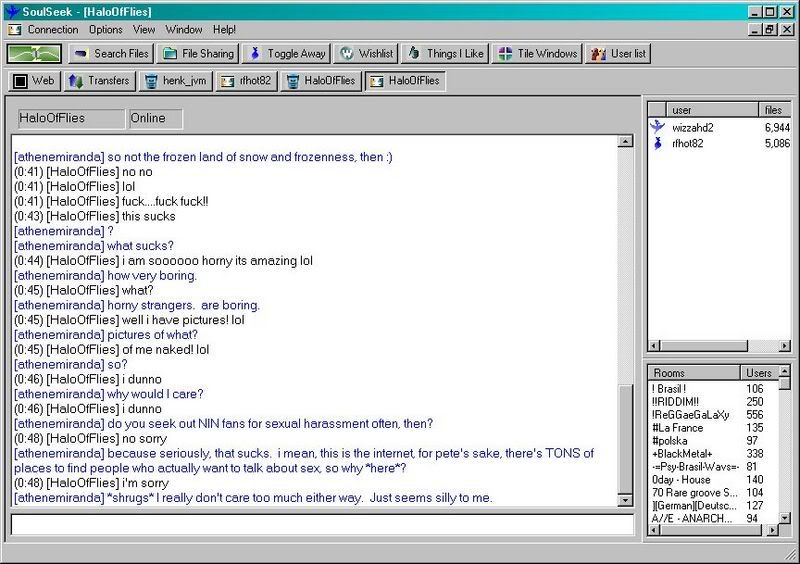
Perhaps I've been lucky, but it was only time this has happened to me since I was a 15-year-old AOLer. I'd say it's not so much down to chance as architecture - I shared the lulz with some other folks online, and one (a straight cis guy...as far as I know) said that he'd been hassled for netsex by men on Limewire; perhaps filesharing and chatrooming lend themselves to solicitation more than other forms of online communication. Soulseek's profile settings serve to make it chattier than other such programs; the twunt originally said he'd IMed me because I'd listed the Nine Inch Nails under 'I like'. (I deleted that immediately after).
I reacted to all this in a predictable fashion; became both pissed-off and very amused, and sought Revenge. I screencapped the lulz; I banned him from downloading from me; and I went to Soulseek's FAQ to see if there was any comment on how to report abuse and annoyance. There wasn't. Sure, each internet banana republic creates its own standards, but having no harassment policy is the sort of oversight that may not be so common if they weren't all run by guys. It's due to Wikipedia's poor response to abuse reports that it took two years from the first complaint about that sock's use of intimate pictures of unconsenting women until this ban, now; they simply have no system in place to respond to this problem.
Saturday, August 16, 2008
more about the olympics
I think what really got the goat this time was the story about the switch-up between the two girls for the opening ceremony. Supposedly Lin Miaoke was more attractive than Yan Peiyi, so Lin Miaoke mimed the song “ode to the motherland” for the opening ceremony whilst the real singing voice was recorded by Yang Peiyi.
[...] What I think is truly despicable about the whole thing, regardless of how Yang Peiyi feels about it — is that this makes a farce of the modern concept of the Olympics.
Athletes gathered here from around the world to participate in competitions to see who is the best. This is a gathering designed, not only to see who is the best, but to give recognition to the best.
For me, the idea of not giving due recognition to someone at the Olympics just goes against the grain.
Kyrias, as promised.
Recently our expectations of coverage of women have been lowered, nullified; we have become used to seeing that strange category - celebrity women - pictured constantly, relentlessly, their image before us for no other reason than that they happen to have headed out for a pint of milk with their makeup on skew-whiff. At Beijing we have seen the antithesis of that - we have been treated to the sight of ordinary women reaching extraordinary heights. The women we have been thrilling to aren't in our eyeline because they happen to be the offspring of some 1970s rocker, or because they've bagged a multimillionaire boyfriend. They aren't on screen because they have starved themselves to a size zero - instead, their bodies are a celebration of strength.
From the Grauniad - h/t to the red one: it's a great article, one that meanders through sport and media and celebrity culture, and you all should go read. Viv.id disagrees:
A couple of years ago, Tigtog posted about athletlcs uniforms and the trend toward sexified, midriff-baring, underwear-style women’s uniforms. ...Minute increases in performance cannot account for this difference, otherwise the men would be in skintight clothing also.Viv.id have comparison photos of male and female team costumes for various sports - and prove that the difference was not marked in the 1980s. h/t to a comment at Shameless. (false advertising: that Shameless post is totally not shameless. But thanks for that photo!)
No. It’s not about faster, higher, stronger. Women in sports are promoted as sexualised bodies for ogling; men are promoted as performers.
Also, Ren brings the boycandy.
Tuesday, August 05, 2008
that one non-post about Wimbledon
Sometimes when you're writing blog post drafts, you realise they're just burying other drafts. This one I abandoned due to pure derailment (more on that in a moment), but I think it deserves to live.
Coverage of women's sport does, as with most coverage of women's anything, suck. Most often it's not there much at all, but then you get blessed lovely Wimbledon, in which it is there and is often cringe-worthy. Last year the blue person (with a wee bit of help from me) made a beautiful collection of the worst of the worst Wimbledon online news (locked away on Livejournal, gah [edit: It's here, so go read]), and I intended to reprise that this year.
Except:
a) many news sites were so turned on by gorgeous, fabulous Rafa that they reverted to Option 1 - not covering the women's game so much.
b) it was genuinely better. For real. I think this is partly because the worst reporting last year was about Marion Bartoli, who had the gall to play in the final in spite of not being thin. This wasn't just mean-spirited of her, but actually affronting to the laws of nature and acres of newsprint were devoted to the question of how it had happened and how it could be prevented in the future.
c) I was derailed by the discovery that by far the most stupid thing said all fortnight was by one of the female players.
Friends, I give you Sveltlana Kuznetsova, the dimmest bulb in the entire box.
Wow.
For what it's worth, here's a few more:
At The Independent, Paul Newmanat has made his tennis article contain as little tennis as possible. Instead, he faithfully regales us with Venus Williams's comments about...get this...food and babies. They are not even comments about eating babies, which would at least have been more entertaining than this trash.
And the Indy crowns itself as my new least favourite sports site with this from Tim Glover:
At The Times, the women's game is 'tame' and Venus and Serena Williams only reached the final because other players 'the top seeds at Wimbledon capitulated one by one and handed the trophy and the prizemoney to the Williams sisters'. [Fact: black women never deserve anything they've fought for. MOW keeps pointing this meme out.] Fortunately two commenters call Nick Pitt on his bullshit; 'didnt the same two guys play the final before. Didn't the women have upsets all through the two weeks. When this happens to the men it's exciting.'; 'Djokovic and Roddick lost early too. Does that mean men's tennis is in "trouble" ? Serve and volley? Few men play it anymore either.'
Over at the Daily Telegraph, Venus Williams is no longer a woman:
More wow.
The Guardian's David Mitchell is brutally honest about the sexualisation of women's tennis, but is oblivious to the crap behind it:
Did you hear that subtext? Yes, yes, straight women don't masturbate. I guess Sue Barker's constant drooling over Roger Federer is representative of some phenomenon unknown to science.
Coverage of women's sport does, as with most coverage of women's anything, suck. Most often it's not there much at all, but then you get blessed lovely Wimbledon, in which it is there and is often cringe-worthy. Last year the blue person (with a wee bit of help from me) made a beautiful collection of the worst of the worst Wimbledon online news (locked away on Livejournal, gah [edit: It's here, so go read]), and I intended to reprise that this year.
Except:
a) many news sites were so turned on by gorgeous, fabulous Rafa that they reverted to Option 1 - not covering the women's game so much.
b) it was genuinely better. For real. I think this is partly because the worst reporting last year was about Marion Bartoli, who had the gall to play in the final in spite of not being thin. This wasn't just mean-spirited of her, but actually affronting to the laws of nature and acres of newsprint were devoted to the question of how it had happened and how it could be prevented in the future.
c) I was derailed by the discovery that by far the most stupid thing said all fortnight was by one of the female players.
Friends, I give you Sveltlana Kuznetsova, the dimmest bulb in the entire box.
...behind her on the players' terrace there is a commotion, as a posse of photographers cluster around Serena Williams. I have heard that she and Serena are good friends, I say. “Yes, we text. We go out sometimes. I have big respect for African (-American) people. I think I was black in a past life, because I feel so much for African culture. I tell Serena that I want her hair, to have corn rows like her. She laughs at me. She says we all wish for what we don't have. But she teaches me some slang, and shows me dance moves.” A delighted laugh. “I can't shake my body like African people.”
Wow.
For what it's worth, here's a few more:
At The Independent, Paul Newmanat has made his tennis article contain as little tennis as possible. Instead, he faithfully regales us with Venus Williams's comments about...get this...food and babies. They are not even comments about eating babies, which would at least have been more entertaining than this trash.
And the Indy crowns itself as my new least favourite sports site with this from Tim Glover:
Equal pay isn't fair play [...] yesterday's winner in the family affair that was Williams v Williams walked away with prize money of £750,000, the sum that will be earned – really earned – by the men's singles champion today. Parity? It's nice work if you can get it, although for most of the time it can hardly be described in the women's game as work.
At The Times, the women's game is 'tame' and Venus and Serena Williams only reached the final because other players 'the top seeds at Wimbledon capitulated one by one and handed the trophy and the prizemoney to the Williams sisters'. [Fact: black women never deserve anything they've fought for. MOW keeps pointing this meme out.] Fortunately two commenters call Nick Pitt on his bullshit; 'didnt the same two guys play the final before. Didn't the women have upsets all through the two weeks. When this happens to the men it's exciting.'; 'Djokovic and Roddick lost early too. Does that mean men's tennis is in "trouble" ? Serve and volley? Few men play it anymore either.'
Over at the Daily Telegraph, Venus Williams is no longer a woman:
Venus' serve alone would have blown a few hats off in the Royal Box, and it was almost like watching the men's final on a Saturday. Not for nothing are they sometimes referred to as the Williams brothers.
More wow.
The Guardian's David Mitchell is brutally honest about the sexualisation of women's tennis, but is oblivious to the crap behind it:
Ana Ivanovic caused quite a stir at Wimbledon before being knocked out, largely because she's pretty. This has a particularly amusing effect on the BBC's ageing male commentators, who struggle to find a way to refer to the fact without saying anything sleazy. Their discomfort is palpable as they struggle with phrases like "very mobile and athletic", "nice dress", "young lady" and even "lights up the court". They're like tremulous uncles, weary and nervous of their own arousal.
They know they've got to mention it, you see - it's good for the business that is women's tennis. So they've got to say something but they know it mustn't be "I, for one, would like to bang her!" or "What's great about a player like Ivanovic is that she attracts a lot of teenage wankers as well as the tennis fans". They don't want metaphorical jizz on everyone's mental centre court but, at the same time, they know that, if the internet's taught us anything, it's not to underestimate the masturbatory pound.
Did you hear that subtext? Yes, yes, straight women don't masturbate. I guess Sue Barker's constant drooling over Roger Federer is representative of some phenomenon unknown to science.
Tuesday, July 08, 2008
Christmas IV [more videogame blogging] & some Christians
So in a new MMO, Age of Conan, female characters are up to 35% less effective than male ones, and this is not mentioned anywhere in the character development process. Why?
Short answer: the game designers did not intend this, it's not like they're misogynists or anything like that - they just decided that there would be attack animations and you could only select a new attack once an animation had finished. Then they allowed the misogynist animators to get obsessed with lengthy boobie shots, thus making the female characters exist to be looked at while the male characters got on with shredding things. For some mysterious reason that we couldn't possibly guess at, the designers did not seek to fix the problem until gamers started complaining.
Long answer:
Short version of long answer: boobies. FFS.
h/t Dee.
One thought I didn't add to my last gaming post - I'm playing a female PC in the NWN2 xpac, and (because of plotty plot things) this causes the Red Woman, and later Safiya, to allude to Delicious Genderqueer Subtext With Lesbian Overtones. (Um, I guess you can only fathom this bit of my rant if you've played the game, sry).
My first thought: there is no way, from the moment they'd thought up the game's background, that Akachi was going to be anything other than male, or the Red Woman anything other than female. It's only the female PC, if you have one, who is framed as perhaps being genderqueer. I cannot believe that a game plot would ever make a nod to a story's queer subtext if you chose to take a male PC, while not possessing this subtext if you choose a female PC. I think the same root sexism - the fear of women - explains why Akachi (male) in the xpac is framed as having far more to do with you than Gith (female) in the base game is.
(That's when they even refer to Gith as being female, which is about twice ever in all three of the videogames I've played that allude to her. Gith is an icon, and her various legacies have remained among the brightest plotspots in the AD&D canon since her invention in 1981; none of the 3ed manuals mention that she is female, and I had no idea myself til I played NWN2 earlier this year. Floored me, that.)
What both these things reveal is something I've known for a long time; videogames are far more conservative than reality. They're also far more conservative than any other form of storytelling. I wonder if conservatism is perhaps proportionate to the cost of entry into a medium; games are huge projects with slim profit margins at best, and each one has the power to destroy a studio. That means that, you know, the basic variety and tolerance you find out in the real world has to be nixed.
Now, Christians! Anglican ones. Who have decided that yes there will be women bishops, and no they won't be mollycoddling anyone who thinks this is a bad idea. For, mm, a reason I can't possibly fathom, not all Christians are happy about this. Libellum, LJ, qwp:
And that's not all! Combatqueer brings more:
Combatqueer is also wondering why the Vatican's opinion is newsworthy. Go read!
Short answer: the game designers did not intend this, it's not like they're misogynists or anything like that - they just decided that there would be attack animations and you could only select a new attack once an animation had finished. Then they allowed the misogynist animators to get obsessed with lengthy boobie shots, thus making the female characters exist to be looked at while the male characters got on with shredding things. For some mysterious reason that we couldn't possibly guess at, the designers did not seek to fix the problem until gamers started complaining.
Long answer:
Let me begin with saying “yes, we here at Funcom agree with you; this is an unacceptable bug”. We never intended for any character to be stronger/weaker than another based on its gender, and we have been working on making the necessary adjustments to correct this issue for quite some time already.
Now, in our game, we have two primary sources of damage; ‘normal’ damage, commonly referred to as “white damage”, and ‘combo’ damage. Making the white damage equal for both Male and Female characters is, in this context, a fairly simple task and something we’ve already done and which should already have been patched out to Live.
For future reference, when I say that it was a fairly simple task to fix it, we’re still talking about modifying, either through actually having an animator work on the animation resource itself or by having a BCC designer adjust the speed-scaling of said animation resource, of more than 150 unique animations. In addition, these animations are fairly “simple”; by which I mean that they are your ordinary attacks and don’t contain any flourishes, sequential blows or other “complicated” stuff.
However, if we move onto ‘combo’ damage, which is what is causing the notable part of this issue, there are suddenly several factors that come into play when determining the final damage. I won’t be wasting too much time in this update to go into detail about every factor, but to quickly list a few they would be stat/modifier/multiplier (which in turn depends on class, level and weapon equipped), length of animation and, although irrelevant to this exact issue any longer, amount of steps in a combo sequence.
The main reason for the discrepancy in damage output that you’re seeing is that the length of an animation isn’t equal for both Male and Female characters in many cases. This is what we’re currently fixing, but there’s roughly 800 to 1000 animations in total that are involved here, and that they are significantly more “complex” than the ‘white damage’ animations mentioned above this naturally takes a lot more time.
Short version of long answer: boobies. FFS.
h/t Dee.
One thought I didn't add to my last gaming post - I'm playing a female PC in the NWN2 xpac, and (because of plotty plot things) this causes the Red Woman, and later Safiya, to allude to Delicious Genderqueer Subtext With Lesbian Overtones. (Um, I guess you can only fathom this bit of my rant if you've played the game, sry).
My first thought: there is no way, from the moment they'd thought up the game's background, that Akachi was going to be anything other than male, or the Red Woman anything other than female. It's only the female PC, if you have one, who is framed as perhaps being genderqueer. I cannot believe that a game plot would ever make a nod to a story's queer subtext if you chose to take a male PC, while not possessing this subtext if you choose a female PC. I think the same root sexism - the fear of women - explains why Akachi (male) in the xpac is framed as having far more to do with you than Gith (female) in the base game is.
(That's when they even refer to Gith as being female, which is about twice ever in all three of the videogames I've played that allude to her. Gith is an icon, and her various legacies have remained among the brightest plotspots in the AD&D canon since her invention in 1981; none of the 3ed manuals mention that she is female, and I had no idea myself til I played NWN2 earlier this year. Floored me, that.)
What both these things reveal is something I've known for a long time; videogames are far more conservative than reality. They're also far more conservative than any other form of storytelling. I wonder if conservatism is perhaps proportionate to the cost of entry into a medium; games are huge projects with slim profit margins at best, and each one has the power to destroy a studio. That means that, you know, the basic variety and tolerance you find out in the real world has to be nixed.
Now, Christians! Anglican ones. Who have decided that yes there will be women bishops, and no they won't be mollycoddling anyone who thinks this is a bad idea. For, mm, a reason I can't possibly fathom, not all Christians are happy about this. Libellum, LJ, qwp:
What I'm currently furious about is a quote further down the article from the Bishop of Fulham, the Right Reverend John Broadhurst, saying that the decision will cause a schism in the church because "I think a lot of us have made it quite clear if there isn't proper provision for us to live in dignity, inevitably we're driven out. It's not a case of walking away."
So allowing women equality makes it impossible for men to "live in dignity"? This is the problem. This. Right here.
For shame, Right Reverend John Broadhurst, you possessive, petty, overprivileged misogynist waste of space. As I understand it, Christ taught that all you need to live in dignity is humility and love. People like you make me glad I left the Anglican communion. A decision, by the way, which I am happy to accept personal responsibility for, unlike your craven whinging about being "driven out" as if you had no will or voice of your own. You have more status and power than most people in this country. You have no damn idea what it's like to not be able to live in dignity. Being driven out, not living in dignity - that's what happens to refugees. What you're having is a tantrum, and I'm disappointed in the BBC for bothering to print it.
And that's not all! Combatqueer brings more:
I know, I know, it seems impossible, but somehow the Vatican has become upset over something that isn't any of its business. [...]
As my Congregationalist grandma once told me, a church fight is like a divorce between five hundred people. Ugly.
Combatqueer is also wondering why the Vatican's opinion is newsworthy. Go read!
Thursday, June 26, 2008
Christmas The Third
[For your recollection, the first two NWN/gender posts are at Always Christmas And and Still Always Christmas.]
It was doing so well up til then.
I've been loving the hell out of the NWN2 xpac. Like Hordes Of The Underdark was to the original Neverwinter Nights, I think it's the project the writers were working on while the tech team wrote the script for the base game. Somehow this one ended up with everything the base game lacked - good writing, genuine plot that twists when you prod it (virtually all quests have multiple endings, and these often affect later events), voice actors that you don't want to see taken out and shot, and some vestiges of originality, albeit within the cliché-eating-cliché that is Forgotten Realms.
And there's far more female visibility. I guess this is a product of the better writing, rather than a cause. The story happens to be set in one of Faerun's canonical matriarchies; aside from that, there's a lot more women around to talk to and get help and advice from. There are even, saints preserve us, women who organise with other women for purposes all their own.
In other words, it was doing pretty well up until we got to what Okku said to Kazimika Vadoi. Kazimika is one of the aforementioned matriarchs, though not their leader, and she didn't like us, for quite sensible reasons. This is what Okku [who is a beary spirit of bears and bearness] did to bring her into line:
This is where I stop playing the game and and start throwing things at the wall behind my desk. Hello, it's the sex work trope again, and this time it's being explicitly used to disempower a previously significant female character, and to shame her, and to silence her objections towards you, no matter that it has nothing the fuck to do with those objections. Congrats, Kazimika, you're up there with Molly Millions and Catwoman in the hall of Awesomely Powerful Female SF Characters Whose History Of Sex Work Is Used Against Them By The Author Who Made That History Up In The First Place.
This is why male SF writers need to stop writing about sex work, unless, you know, they've done it themselves. Because male writers are going to keep building women up then using their own fantasies about sex work to knock them down again. In their hands, the trope is invariably hammer-shaped, and women look like nails.
[I just made an FMT tag, so's not to lose track. For fairness, see the two longest threads on this I've seen elsewhere, in which many people disagree with me; the recent FSF one and the older Alas one.]
It was doing so well up til then.
I've been loving the hell out of the NWN2 xpac. Like Hordes Of The Underdark was to the original Neverwinter Nights, I think it's the project the writers were working on while the tech team wrote the script for the base game. Somehow this one ended up with everything the base game lacked - good writing, genuine plot that twists when you prod it (virtually all quests have multiple endings, and these often affect later events), voice actors that you don't want to see taken out and shot, and some vestiges of originality, albeit within the cliché-eating-cliché that is Forgotten Realms.
And there's far more female visibility. I guess this is a product of the better writing, rather than a cause. The story happens to be set in one of Faerun's canonical matriarchies; aside from that, there's a lot more women around to talk to and get help and advice from. There are even, saints preserve us, women who organise with other women for purposes all their own.
In other words, it was doing pretty well up until we got to what Okku said to Kazimika Vadoi. Kazimika is one of the aforementioned matriarchs, though not their leader, and she didn't like us, for quite sensible reasons. This is what Okku [who is a beary spirit of bears and bearness] did to bring her into line:
I remember the prayers of the dockside girl, before she donned her mask. I remember how she begged the spirits to make her pretty, so that the sailors might whistle at her...might even pay for her company...
This is where I stop playing the game and and start throwing things at the wall behind my desk. Hello, it's the sex work trope again, and this time it's being explicitly used to disempower a previously significant female character, and to shame her, and to silence her objections towards you, no matter that it has nothing the fuck to do with those objections. Congrats, Kazimika, you're up there with Molly Millions and Catwoman in the hall of Awesomely Powerful Female SF Characters Whose History Of Sex Work Is Used Against Them By The Author Who Made That History Up In The First Place.
This is why male SF writers need to stop writing about sex work, unless, you know, they've done it themselves. Because male writers are going to keep building women up then using their own fantasies about sex work to knock them down again. In their hands, the trope is invariably hammer-shaped, and women look like nails.
[I just made an FMT tag, so's not to lose track. For fairness, see the two longest threads on this I've seen elsewhere, in which many people disagree with me; the recent FSF one and the older Alas one.]
Friday, May 30, 2008
Truth & consequences in the stories we tell.
[Or, a meandering collection of links to stuff about stories, sandboxes, and power.]
Quick, what's the one thing everyone knows about Grand Theft Auto? Keep hold of the answer - we'll be back for it in a moment.
I was never sure how to order this post, or what exactly to include in it. So it's been festering in Dashboard for weeks now. Partly it was sparked off by reading criticisms of Iron Man, which blurred between entirely valid digs at the film's racism and sexism, and a less definable discomfort with the entire genre it's part of. See WOCPhD's brilliant post, where she seems to have lost sight of the fact that she's reviewing an adaptation of a 1963 pulp comic book.
That's pulp, where what is right and just comes way second to what's considered entertaining. That's 1963, the past, where a lot of our current media franchises come from - whether it's those comic book adaptations, or Narnia, or James Bond. Not that the newer franchises are a lot better, but (as I said when it came up on Punkass) characters like Pepper make way more sense in that context. The whole wonderboy-hero, powerful enough to do everything we wish to do, except for those boring things his ever-capable sidekick(s) do(es), makes more sense in that vein of pulp than in the current one. This hero-character is always at the top of the world. Why do we identify with him, when he's got nothing in common with reality at all?
Because we want to. Because we're wishing for his absolute power, and we are vividly interested in what the consequences that power might bring. We play sandbox games for similar reasons - a wish for the absolute ability to choose - and that raises discomforts of its own.
(It's always 'he'. Unless the red one is writing it, it's always 'he'.)
There is something Aishwarya said in the Iron Man thread at Daisy's place; "I really, really wish I could just watch movies where things blow up (because movies where things blow up are excellent) without being constantly alienated by this sort of thing. :("
That alienation is one of the major sources of the criticism of Iron Man; that when we leave ourselves behind and go to places where we have infinite power, and can blow up whatever we like, we're almost always asked to identify with white, heterosexual upper-class men. We want to be Bruce Wayne or James Bond. We wish for their momentum, possessions, power, and their challenges. Why do they all have to look the same?
An aside; Cleolinda is talking about a whole other sort of wishing, in a post about a book series that's aimed at teenage girls. I liked this:
She's talking about the same instinct that makes us love those boys who can do anything they want...and yet everything she says about this sort of wish fulfilment turns me off. I don't much like any of the books and films she's referring to. Some of these are in a middle ground - but I seem to be banging my head against the fact that the wishes I like are usually aimed at (we might even say assumed at) a male audience, and Cleolinda is talking about teenage girls, and women who remember being a teenage girl.
A while ago, Trinity wrote about our discomfort with power and excess in an unrelated context - kink!:
While not primarily sexual, wish fulfilment stories seem to hit a similar wall in the liberal press; you can't be fantasising about that, that's too much, too violent, too greedy, too unfair. So onto Cate's GTA article at Shameless:
What, is Shameless not so shameless after all? :O Certainly Cate is saying that a virtual world's functionality should contain hard-coded moral limits, rather than simple moral consequences. It is not enough that nothing real can be harmed or lost in the space, or that your virtual self suffers virtual consequences for performing proscribed actions; instead she asks that a line be drawn, and certain evils be rendered impossible. (Something like this exists in Sims 2 - you can't kill a baby or a toddler, can only have sex with adults and elders, and character's genital areas are obscured by pixels. These restrictions have been ripped up by a legion of fanmodders, which demonstrates how practical that approach is, though when choosing nominal imaginary limits, practicality is hardly the point. Worth remembering that it was modders who caused GTA3's Hot Coffee debacle. Ultimately neither lawmakers nor creators can censor the use of game software - it's the users who determine how it is played).
Our species of cyborgs has been wrestling with this problem, of defining our virtual limits, since A Rape In Cyberspace or before.
Dibbell's story touched on one point that has been gaining ground recently; should virtual crimes be subject to real-world consequences? The answer he watched arise from LambdaMOO was a no - those who commit virtual crimes should face justice within the intimacy of the wronged community. Then as now, the internet usually gives its wrongdoers a sentence of exile.
Regina Lynn, writing about a more recent virtual rape, also thinks not. Meanwhile, DailyBits has a list of unexpected real-world spillovers from virtual events; MMO addict deaths and in-game funerals, virtual thefts and real arrests, and a story about a Gunbound player from Brazil that I can barely get my head around.
Last week I read a Cif Arts piece in defence of James Bond that talked about how uncomfortably realistic violence is part of the thrill, when it comes to boy-heroes...and added a few words about consumption and luxury:
So violence is an intrinsic part of this wishing-ground. Graphic violence, ultimate consumption, extreme adventures - and as the article hints, unlimited access to sex. Sometimes the hero is simply a tireless playboy, but many of these stories include legions of imaginary sex workers.
To my shame, it was only a week ago - and thanks to Chris - that I read the mighty OH JOHN RINGO NO review, which charts an odyssey of violent and misogynistic wish fulfilment. From Hradzka's description, every woman in the series is a sex worker, or described as a potential sex worker; within the fantasy space, all women are perceived as being available for sexual purchase.
Hradzka also mentions a whole aspect to this wish fulfilment thing that I'd never much thought of before:
I'd never put a name to that before, but building stuff is definitely a genre I like. I enjoyed this aspect of both Iron Man and Batman Begins...not to mention Metal Gear Solid: Portable Ops, a game in which you have to procure yourself an entire army. (I can think of only one Woman Builds Stuff story - A Town Like Alice by Nevil Shute. While I enjoyed the Woman Builds Stuff part of the book, it seemed rushed and unconvincing compared to the rest of it).
On CiF, Charlie Brooker unwraps the problem, and finds a new one wrapped inside:
...in other words, the problem is not that you can kill prostitutes, but that prostitutes are a singled-out class of people, neatly prepackaged as a unit by our culture in spite of their great diversity of circumstances, and the killing of this class of people IRL is common and so easy to get away with because of this - so when a game also presents sex workers as a class of people, and just happens to let you kill whoever you like, guess who people get most excited about shooting.
I should add; Brooker's point c) is under dispute. The Slate game review...which is entitled 'It's Not Just About Killing Hookers Any More'...says it's simply not true:
...and David Wong, in Seven Commandments All Videogames Should Obey (a followup to another wonderful article, A Gamer's Manifesto), devotes an entire page to saying it shouldn't be true:
And I agree with him, I agree with Slate - we need the effects of our actions to look realistic, and the media queasies have repeatedly demonstrated the reason for this.
The first time I read an article about violence in videogames was almost ten years ago. It was in a library newspaper - probably the Times - and it mentioned several games, but was illustrated with one of Nomura's promotional images for Final Fantasy VII; a game that uses violence, questions it, and at one point devolves into an argument between Cait and Barrett about whether any of the violent things they've been doing are remotely justified.
That was the moment I first realised that I was never going to read anything of value about videogames in a printed newspaper, ever. Why shut up and go away when you can challenge and explore instead?
This is why my least favourite scene in Iron Man was the one that steamrolled over #6 of David Wong's Ultimate War Sim demand list:
See, Wong is a gamer kid with a good grip on reality. There exist other gamer kids who think reality is like Iron Man, where magical white people who waltz into other people's countries have the magical power to distinguish between nice, innocent brown people and evil brown people (there are no other kinds, just innocent or evil), remove the latter with pinpoint precision, and go home after a day well saved. These other gamer kids are called the US government.
It's the people who don't want their imaginary violence to be realistic that I worry about. The people who want the details glossed over, who want to make out that it's not as bad as it really is, who want to conceal the fact that it's the least powerful who always suffer first and most.
One last link: Catherine Bennett on GTA. Oh dear god, you must read this:
Quick, what's the one thing everyone knows about Grand Theft Auto? Keep hold of the answer - we'll be back for it in a moment.
I was never sure how to order this post, or what exactly to include in it. So it's been festering in Dashboard for weeks now. Partly it was sparked off by reading criticisms of Iron Man, which blurred between entirely valid digs at the film's racism and sexism, and a less definable discomfort with the entire genre it's part of. See WOCPhD's brilliant post, where she seems to have lost sight of the fact that she's reviewing an adaptation of a 1963 pulp comic book.
That's pulp, where what is right and just comes way second to what's considered entertaining. That's 1963, the past, where a lot of our current media franchises come from - whether it's those comic book adaptations, or Narnia, or James Bond. Not that the newer franchises are a lot better, but (as I said when it came up on Punkass) characters like Pepper make way more sense in that context. The whole wonderboy-hero, powerful enough to do everything we wish to do, except for those boring things his ever-capable sidekick(s) do(es), makes more sense in that vein of pulp than in the current one. This hero-character is always at the top of the world. Why do we identify with him, when he's got nothing in common with reality at all?
Because we want to. Because we're wishing for his absolute power, and we are vividly interested in what the consequences that power might bring. We play sandbox games for similar reasons - a wish for the absolute ability to choose - and that raises discomforts of its own.
(It's always 'he'. Unless the red one is writing it, it's always 'he'.)
There is something Aishwarya said in the Iron Man thread at Daisy's place; "I really, really wish I could just watch movies where things blow up (because movies where things blow up are excellent) without being constantly alienated by this sort of thing. :("
That alienation is one of the major sources of the criticism of Iron Man; that when we leave ourselves behind and go to places where we have infinite power, and can blow up whatever we like, we're almost always asked to identify with white, heterosexual upper-class men. We want to be Bruce Wayne or James Bond. We wish for their momentum, possessions, power, and their challenges. Why do they all have to look the same?
An aside; Cleolinda is talking about a whole other sort of wishing, in a post about a book series that's aimed at teenage girls. I liked this:
Wish fulfillment: I really cannot stress how important this element is, because I think it's also the reason that Harry Potter grabbed the cultural imagination. You're not a neglected orphan sleeping in a cupboard! You're a wizard! You're the bestest wizard of all and you're also great at sports and you had rich, wizardly parents who loved you so much they died for you (but you've still got their money) and also, we brought you birthday cake! And then you, through Harry, are plunged into this fantastically detailed wizard world. I mean, shit, I'm sold. And I think most things that really grab people are going to tap that "I want to be that person and live in that world" vein. I want to be Elizabeth Swann, I want to be Lyra Belacqua, I want to be the Pevensie kids.
She's talking about the same instinct that makes us love those boys who can do anything they want...and yet everything she says about this sort of wish fulfilment turns me off. I don't much like any of the books and films she's referring to. Some of these are in a middle ground - but I seem to be banging my head against the fact that the wishes I like are usually aimed at (we might even say assumed at) a male audience, and Cleolinda is talking about teenage girls, and women who remember being a teenage girl.
A while ago, Trinity wrote about our discomfort with power and excess in an unrelated context - kink!:
Think about standard criticisms of the rich and opulent. Whether they're criticisms of the nobility, of the bourgeoisie, or other criticisms of the rich and powerful. The idea that these people are decadent, that they wallow in excess, drown themselves in pleasure.
That kind of excess is actually a big turn on for me. The idea of going further and doing more, overflowing with energy, desire, and intensity. It's something I began to have a very hard time with when I got into feminist circles that were also socialist or influenced by socialism.
Because the central idea of that kind of political movement is that some people have too much and some people don't have enough. If that's the material situation of people in the world, and I seek to be committed to some kind of distributive justice that least makes the first step to equalizing some of that, how can I get into bed and touch myself while imagining, sometimes literally, that I'm lord over other people?
While not primarily sexual, wish fulfilment stories seem to hit a similar wall in the liberal press; you can't be fantasising about that, that's too much, too violent, too greedy, too unfair. So onto Cate's GTA article at Shameless:
But the object of the game is still to shoot people and win gang wars, right? I find it hard to fathom why so many intelligent people insist on defending this game, whose major appeal I once heard summarized as, “you can sleep with a prostitute and then shoot her so you don’t have to pay.”
Creative, indeed.
What, is Shameless not so shameless after all? :O Certainly Cate is saying that a virtual world's functionality should contain hard-coded moral limits, rather than simple moral consequences. It is not enough that nothing real can be harmed or lost in the space, or that your virtual self suffers virtual consequences for performing proscribed actions; instead she asks that a line be drawn, and certain evils be rendered impossible. (Something like this exists in Sims 2 - you can't kill a baby or a toddler, can only have sex with adults and elders, and character's genital areas are obscured by pixels. These restrictions have been ripped up by a legion of fanmodders, which demonstrates how practical that approach is, though when choosing nominal imaginary limits, practicality is hardly the point. Worth remembering that it was modders who caused GTA3's Hot Coffee debacle. Ultimately neither lawmakers nor creators can censor the use of game software - it's the users who determine how it is played).
Our species of cyborgs has been wrestling with this problem, of defining our virtual limits, since A Rape In Cyberspace or before.
Dibbell's story touched on one point that has been gaining ground recently; should virtual crimes be subject to real-world consequences? The answer he watched arise from LambdaMOO was a no - those who commit virtual crimes should face justice within the intimacy of the wronged community. Then as now, the internet usually gives its wrongdoers a sentence of exile.
Regina Lynn, writing about a more recent virtual rape, also thinks not. Meanwhile, DailyBits has a list of unexpected real-world spillovers from virtual events; MMO addict deaths and in-game funerals, virtual thefts and real arrests, and a story about a Gunbound player from Brazil that I can barely get my head around.
Last week I read a Cif Arts piece in defence of James Bond that talked about how uncomfortably realistic violence is part of the thrill, when it comes to boy-heroes...and added a few words about consumption and luxury:
Thanks to the cartoon violence of the films it's also easy to forget just how effective the sadism in the novels can be. Fleming's books are creepy and chilling and this graphic cruelty, combined with painstakingly accurate descriptions of high-living, fine eating and the pleasures of quality consumer goods must make Bond a direct ancestor to characters like Patrick Bateman and the unnamed protagonist of Fight Club as much as the promiscuous father of so many lesser pulp-thriller spies. It certainly merits him a place in the canon.
So violence is an intrinsic part of this wishing-ground. Graphic violence, ultimate consumption, extreme adventures - and as the article hints, unlimited access to sex. Sometimes the hero is simply a tireless playboy, but many of these stories include legions of imaginary sex workers.
To my shame, it was only a week ago - and thanks to Chris - that I read the mighty OH JOHN RINGO NO review, which charts an odyssey of violent and misogynistic wish fulfilment. From Hradzka's description, every woman in the series is a sex worker, or described as a potential sex worker; within the fantasy space, all women are perceived as being available for sexual purchase.
Hradzka also mentions a whole aspect to this wish fulfilment thing that I'd never much thought of before:
Once you get past GHOST's initial spleen-venting, the PALADIN OF SHADOWS series falls into a much-maligned, much-loved genre which, for lack of a better name, I call "Man Builds Stuff and Gets Lots of Pussy." This is, quite frankly, what got me reading the series: I am not much for stories of a guy just killing terrorists and getting laid a lot; but let him start building a small kingdom while killing terrorists and getting laid a lot, and I am there. I confess that have a soft spot for these kinds of stories. I suspect that *lots* of men do: even if we don't build things ourselves, we like to *read about* guys building things: castles, weapons, companies, societies. It's really very soothing; it combines the pleasures of fiction with a those of a do-it-yourself manual. The same impulses may explain why a lot of male writers aren't content to have their hero just carrying, say, a 1911 as his sidearm; they have to tell you what make, model, whether it's got an internal or external extractor, what aftermarket parts he's tuned it up with, and who he bought them from, until you know all about his Kimber's Ed Brown slide stop and Wolff springs.
(Curiously, the sex-related parts do not require details of every thrust; if the chapter fades to black with the hero hopping into bed with two nubile wenches, honor is satisfied. John Ringo, alas, often carries honor considerably farther.)
I'd never put a name to that before, but building stuff is definitely a genre I like. I enjoyed this aspect of both Iron Man and Batman Begins...not to mention Metal Gear Solid: Portable Ops, a game in which you have to procure yourself an entire army. (I can think of only one Woman Builds Stuff story - A Town Like Alice by Nevil Shute. While I enjoyed the Woman Builds Stuff part of the book, it seemed rushed and unconvincing compared to the rest of it).
On CiF, Charlie Brooker unwraps the problem, and finds a new one wrapped inside:
The one thing everyone knows about Grand Theft Auto is that you can kill prostitutes in it. That's because it's a "sandbox" game in which you can kill anyone you like. Or you can not kill them. Or you can simply drive around slowly, obeying the traffic lights. If you break the law and the in-game police spot you, they'll hunt you down and nab you. Murdering innocent people is neither a) encouraged, b) free of consequence, or c) any more realistic than a Tex Avery cartoon.
...in other words, the problem is not that you can kill prostitutes, but that prostitutes are a singled-out class of people, neatly prepackaged as a unit by our culture in spite of their great diversity of circumstances, and the killing of this class of people IRL is common and so easy to get away with because of this - so when a game also presents sex workers as a class of people, and just happens to let you kill whoever you like, guess who people get most excited about shooting.
I should add; Brooker's point c) is under dispute. The Slate game review...which is entitled 'It's Not Just About Killing Hookers Any More'...says it's simply not true:
There's a difference this time: The violence is no longer cartoonish. Shoot an innocent bystander, and you see his face contort in agony. He'll clutch at the wound and begin to stagger away, desperately seeking safety. After just scratching the surface of the game—I played for part of a day; it could take 60 hours to complete the whole thing—I felt unnerved. What makes Grand Theft Auto IV so compelling is that, unlike so many video games, it made me reflect on all of the disturbing things I had done.
...and David Wong, in Seven Commandments All Videogames Should Obey (a followup to another wonderful article, A Gamer's Manifesto), devotes an entire page to saying it shouldn't be true:
If we shoot a zombie in the arm, we want his arm to blow off. If we shoot him in the knee, we want him to limp. And if we shoot him in the head, we want his head to explode. We want our bullets to create wounds.
[...]
Sword-fighting games like Oblivion are worse. You can slash the bad guy in the face with your blade and it does nothing. The enemy looks perfectly normal until he finally falls over dead, as if he had a heart attack from the excitement. Why give us a sword if we can't decapitate people? Don't tell us the system can't handle it, we were blowing off zombie limbs in House of the Dead a decade ago.
It's not about our blood thirst (well, not just about that), it's about making us feel like we're accomplishing something as we work our way through hordes of cookie-cutter bad guys. Oh, hey, you know what else we hate?
Filling the game with hordes of cookie-cutter bad guys.
This is another one of those problems that are exacerbated by new-gen graphics. Now that we can do photo-realistic faces, it's suddenly very weird that we're killing hundreds of identical clones.
How hard would it be to randomize facial features and skin tones? That's what we want, to feel like we're killing hundreds of different people. Not a bunch of clones or twins. We want to know, deep down, that there are hundreds of grieving mothers out there, lamenting the terror of our dreaded blade.
And I agree with him, I agree with Slate - we need the effects of our actions to look realistic, and the media queasies have repeatedly demonstrated the reason for this.
The first time I read an article about violence in videogames was almost ten years ago. It was in a library newspaper - probably the Times - and it mentioned several games, but was illustrated with one of Nomura's promotional images for Final Fantasy VII; a game that uses violence, questions it, and at one point devolves into an argument between Cait and Barrett about whether any of the violent things they've been doing are remotely justified.
That was the moment I first realised that I was never going to read anything of value about videogames in a printed newspaper, ever. Why shut up and go away when you can challenge and explore instead?
This is why my least favourite scene in Iron Man was the one that steamrolled over #6 of David Wong's Ultimate War Sim demand list:
Speaking of innocents, I want a war sim where native townsfolk stand shoulder-to-shoulder on every inch of the map and not a single bomb can be dropped without blowing 200 of them into chunks. Forget about the abandoned building wallpaper in games like the Red Alert series. I want to have to choose between sending marines door-to-door to be killed in the streets or leveling the block from afar, Nuns and all. I want to have to choose between 40 dead troops or 400 dead children, and be damned to hell by chubby pundits from the safety of their studios regardless of which way I go.
See, Wong is a gamer kid with a good grip on reality. There exist other gamer kids who think reality is like Iron Man, where magical white people who waltz into other people's countries have the magical power to distinguish between nice, innocent brown people and evil brown people (there are no other kinds, just innocent or evil), remove the latter with pinpoint precision, and go home after a day well saved. These other gamer kids are called the US government.
It's the people who don't want their imaginary violence to be realistic that I worry about. The people who want the details glossed over, who want to make out that it's not as bad as it really is, who want to conceal the fact that it's the least powerful who always suffer first and most.
One last link: Catherine Bennett on GTA. Oh dear god, you must read this:
With a violent and nasty movie, or corrupting literature, the thing is simple. You merely have to buy a ticket for, say, No Country for Old Men, or There Will be Blood, and watch it, with a keen eye for anything that might be violent or nasty. With books, you simply open, then read a copy of The Catcher in the Rye or, to go back a bit, Lady Chatterley's Lover or a bit further, one of those 18th-century courtship novels whose potential to enervate young virgins was discernible, apparently, within just a few minutes of scholarly inspection.
How different for the mature student of Grand Theft Auto IV, who discovers that acquisition of the game, an Xbox 360 and a working television will not be nearly enough to expose the sickening extent of its moral bankruptcy. For that, you need time, skill, dedication and, I suspect, youth. In fact, it would probably be cheaper, and easier, for any averagely underqualified adult who craves the excitement of casual violence in a context of social indifference to make your way to somewhere like Borough Market and snarl: 'Out of the way, bitch' at every double buggy.
[...]
In fact, if a new book on gaming, Grand Theft Childhood: The Surprising Truth about Violent Video Games, is to be believed, there may exist hardly anyone in sound mind who might not, from time to stressful time, benefit from an hour or two of moderately violent gaming. The authors, two Harvard psychiatrists, Lawrence Kutner and Cheryl K Olson, were told by many young players that they played violent games to 'relax' or to 'get my anger out'. Should we not, as a matter of urgency, implore Gordon Brown to escape into GTA IV over the bank holiday? Or would the experience make an already vulnerable and solitary Prime Minister more likely to aim his car, à la Niko, at cyclists such as David Cameron?
Saturday, February 16, 2008
still always Christmas:
[this post contains very small spoilers for Part II of Neverwinter Nights 2]
Thinking about gendered space in game worlds is fiddly because each player brings their own gender with them. I'll do the gamer drag thing later, I guess, but for now I can only hazard guesses about how much more welcoming the NWN2 gameworld would look to a male PC.
I am, as I am getting tired of being when it comes to gender, more vigilant than I'd like; I know that in games like this male is the default, for NPCs as well as PCs; women like Kana, Brelaina and Torio feel hopelessly token because the public spaces in the game are overwhelmingly gendered 'male'. I'd love to not be distracted by this point, but it's there. There's very little female visibility in the gameworld.
I'm just into Part III (of III) of this game, and how many female temple officiaries have I met? None. The only two female religious types around are playable characters; no other druids or clerics we've seen are women. How about the smiths and other merchants you rely on to keep your inventory turning over? Offhand I can think of only one woman among them, Nya in Port Llast, who is also a sweet soft plot hook due to her rustic paranoia over necromancers. Watchmen? This is where Brelaina looks really token; she's their leader, apparently, and she's also the only one with boobs except for my player character. Yes, having named female NPCs in important plot roles is an improvement on where we were in BG1, maybe, with just evil priestesses and the odd crazy wizardess/diviner. It also just makes it look even more weird that the rest of the world is overwhelmingly male. Where are all the missing women? Is there some genetic quirk of this world that makes 75% of useful, interactable characters male, or what?
(Oh, and Kana? Slanted-eyed person who talks about 'the Way' and says you couldn't understand because it's so totally Other? Not even slightly Orientalist, is it? Fuckssake.)
Then there's the Neverwinter Nine, Nasher's very favourite hired killers. The only female one we've met so far, Melia, has this SEKRIT IDENTITY because for some reason that's better than her just being one of the Nine poncing about in the cute blue outfit in the same way Callum and Nevalle are, owning the same public space as they do. You will never, ever, guess what her sekrit identity is. Ever. It's something that has never been worked into the story of a prominent female sci-fi character ever, ever, ever before.
*groans*
Above and beyond wondering what it is about guys who write sci-fi and their obsession with collectives of whores - and why (with few exceptions; Galvena in BG2 was one) in sci-fi, male pimps/leaders of whores are evil and female ones are good, as if somehow happy hookers are more easily defensible as happy hookers if their pimp/leader (Ann-Hari, Nandi, Mrs Palm, Ophala, Gail) is a woman rather than a man, when in reality all this crud is authored by men anyway - why do so many prominent tough-women-in-sci-fi have sex work as part of their personal journey? Men never do. But we've got Ann-Hari, Molly Millions (and Mona), Mitsuko Souma...
Here, Torio makes the unsurprising admission that she was once a bar performer - singing and dancing, something which is given distinct gendered overtones, not least because there is totally not a rampantly gendered cliché about women fucking themselves into positions of political power (and other jobs, see Kaylee freaking Frye).
One thing I find quite positive is a change they've made in the voiceovers; previous AD&D RPGs have often had some voiced dialogue, some not, and have formerly gone into great linguistic contortions to keep those voiced lines gender-neutral. NWN2 instead frequently makes such lines gender-specific, so clearly they've gone to the minuscule data expense of recording two versions of each such line. And seeing as they've gone to the trouble, I'm going to be ruining their day by looking for slip-ups. Thus far I've hit only one - Daerred called me 'he' this one time. I'll be doing another playthrough sometime, not least because part I has two different routes and I want to see both; it'll be interesting to see if there are any slips in the opposite direction. (There was one such error in BG2, made by Jaheira in the Galverey estate; I swear blind she says 'she' in place of a 'they' that appears in the text, even if you're fronting as a guy).
Thus far into the game (unlike the last one), there has been little romance. Just Casavir and Bishop taking turns to sulk at me. But I know what NWN1 was like and I keep wondering if Shandra's really hitting on me or if that was just my dykey imagination; is any of her dialogue (particularly during the vigil) different if you're playing a man, or differently charged, or leading to different moments later? I guess I'll find out if I come back here in a few months time, but my guess is that the dialogue is the same but the male version gets more romantically charged later - as if (within eternally heteronormative gamespace) you can address men and women as being exactly the same and yet only really mean it if you're fronting male. (If anyone out there's played this game with a male PC, please let me know about this).
I do rather like Shandra, but, that twee little speech she gave later about HOW VERY AWFUL it must be to suffer maternal bereavement when you're young? Urgh. As if I've not heard enough of that sick fetishisation IRL.
It's a fun game, even a fun story once you're out of the dire tutorial and part I, but I could wish I didn't have to put up with this crap to get my fun stories.
[also, hello to a certain red person who has been reading my blog from her workplace lately. *beams*]
Thinking about gendered space in game worlds is fiddly because each player brings their own gender with them. I'll do the gamer drag thing later, I guess, but for now I can only hazard guesses about how much more welcoming the NWN2 gameworld would look to a male PC.
I am, as I am getting tired of being when it comes to gender, more vigilant than I'd like; I know that in games like this male is the default, for NPCs as well as PCs; women like Kana, Brelaina and Torio feel hopelessly token because the public spaces in the game are overwhelmingly gendered 'male'. I'd love to not be distracted by this point, but it's there. There's very little female visibility in the gameworld.
I'm just into Part III (of III) of this game, and how many female temple officiaries have I met? None. The only two female religious types around are playable characters; no other druids or clerics we've seen are women. How about the smiths and other merchants you rely on to keep your inventory turning over? Offhand I can think of only one woman among them, Nya in Port Llast, who is also a sweet soft plot hook due to her rustic paranoia over necromancers. Watchmen? This is where Brelaina looks really token; she's their leader, apparently, and she's also the only one with boobs except for my player character. Yes, having named female NPCs in important plot roles is an improvement on where we were in BG1, maybe, with just evil priestesses and the odd crazy wizardess/diviner. It also just makes it look even more weird that the rest of the world is overwhelmingly male. Where are all the missing women? Is there some genetic quirk of this world that makes 75% of useful, interactable characters male, or what?
(Oh, and Kana? Slanted-eyed person who talks about 'the Way' and says you couldn't understand because it's so totally Other? Not even slightly Orientalist, is it? Fuckssake.)
Then there's the Neverwinter Nine, Nasher's very favourite hired killers. The only female one we've met so far, Melia, has this SEKRIT IDENTITY because for some reason that's better than her just being one of the Nine poncing about in the cute blue outfit in the same way Callum and Nevalle are, owning the same public space as they do. You will never, ever, guess what her sekrit identity is. Ever. It's something that has never been worked into the story of a prominent female sci-fi character ever, ever, ever before.
*groans*
Above and beyond wondering what it is about guys who write sci-fi and their obsession with collectives of whores - and why (with few exceptions; Galvena in BG2 was one) in sci-fi, male pimps/leaders of whores are evil and female ones are good, as if somehow happy hookers are more easily defensible as happy hookers if their pimp/leader (Ann-Hari, Nandi, Mrs Palm, Ophala, Gail) is a woman rather than a man, when in reality all this crud is authored by men anyway - why do so many prominent tough-women-in-sci-fi have sex work as part of their personal journey? Men never do. But we've got Ann-Hari, Molly Millions (and Mona), Mitsuko Souma...
Here, Torio makes the unsurprising admission that she was once a bar performer - singing and dancing, something which is given distinct gendered overtones, not least because there is totally not a rampantly gendered cliché about women fucking themselves into positions of political power (and other jobs, see Kaylee freaking Frye).
One thing I find quite positive is a change they've made in the voiceovers; previous AD&D RPGs have often had some voiced dialogue, some not, and have formerly gone into great linguistic contortions to keep those voiced lines gender-neutral. NWN2 instead frequently makes such lines gender-specific, so clearly they've gone to the minuscule data expense of recording two versions of each such line. And seeing as they've gone to the trouble, I'm going to be ruining their day by looking for slip-ups. Thus far I've hit only one - Daerred called me 'he' this one time. I'll be doing another playthrough sometime, not least because part I has two different routes and I want to see both; it'll be interesting to see if there are any slips in the opposite direction. (There was one such error in BG2, made by Jaheira in the Galverey estate; I swear blind she says 'she' in place of a 'they' that appears in the text, even if you're fronting as a guy).
Thus far into the game (unlike the last one), there has been little romance. Just Casavir and Bishop taking turns to sulk at me. But I know what NWN1 was like and I keep wondering if Shandra's really hitting on me or if that was just my dykey imagination; is any of her dialogue (particularly during the vigil) different if you're playing a man, or differently charged, or leading to different moments later? I guess I'll find out if I come back here in a few months time, but my guess is that the dialogue is the same but the male version gets more romantically charged later - as if (within eternally heteronormative gamespace) you can address men and women as being exactly the same and yet only really mean it if you're fronting male. (If anyone out there's played this game with a male PC, please let me know about this).
I do rather like Shandra, but, that twee little speech she gave later about HOW VERY AWFUL it must be to suffer maternal bereavement when you're young? Urgh. As if I've not heard enough of that sick fetishisation IRL.
It's a fun game, even a fun story once you're out of the dire tutorial and part I, but I could wish I didn't have to put up with this crap to get my fun stories.
[also, hello to a certain red person who has been reading my blog from her workplace lately. *beams*]
Tuesday, October 09, 2007
Piffle About Gender Identity
I think I am in love with this blog. Mostly just for articulating this in a way I never could;
I've never lived in that sort of queer community (that most of my close friends are queer is more of a disparate, happy coincidence), but this applies well to many heterosexual situations I've seen, or been involved with. It also chimes with a phenomena I've nattered to Drew (Newfoundland separatist, PETA enemy and the nicest MRA in the whole wide world) about; the way young men are seen, and portrayed in the media, as being 'riskier', less stable, less adult, than young women. In some places - New York City and the UK as a whole are two - women in their 20s earn, on average, more than men of the same age. It doesn't outweigh the income plunge that begins in the 30s, but it's real. Another odd effect is that men who take arts degrees earn less than men who do not go to university at all. One could speculate that the man who goes to university for the same reasons many women go to university - transferable skills, learning for the sake of learning, a little freedom without too much responsibility - become that media stereotype of the wasted student who never gets up before noon. Meanwhile 20y/o men who are in a trade, or a career that doesn't require a degree, are considered to have passed The Great Masculinity Test and can be rewarded with man$s.
Marriage has a way of conferring adulthood on a man, and conferring responsibility for another life on a woman.
I have quoted SCUM on the subject of gender identity before now, on Deadjournal, but there is no harm in doing it again;
(It's worth mentioning that the manifesto also supports asexual supremacy; Solanas is pretty clear about the fact that she'd had relationships with men and with women before settling into asexuality.)
As I've said before, that passage isn't about gender, it's about privilege and power. Any person with agency will exhibit those 'female characteristics', and any person without will exhibit the 'male' ones. (Like being a player character in life rather than an NPC.) It's as if Solanas is describing the shock of seeing women sailing under their own steam. What does this have to do with 'Wendying'? Simply that asking someone to be your supportive, empathic Wendy is going to steal from their objectivity, integrity and assertiveness in relation to you, while all the while allowing you to be frivolous and weak (not that those are bad things) through them, without ever facing up to it yourself. Wendying is that public relations job Solanas is writing about.
Wendying is also my worst nightmare, biggest heterosexual headache, and a skill base I possess that I insist on using only on my own terms. I fail at queer identity, really I do; I look very femmy ('Earth mother' more than anything, much as I loathe the concept), but I'm far more drawn to butch ethics/dynamics, esp. in relation to other queer women. I'm that girl who'll stay awake while you nap, or offer you her shawl when you're cold, or listen without getting empathically sucked into your problems, or being responsible for them in any way. I bake a lot and repair or mod my own clothes; I also love videogames, repel wasp/spider incursions for my insect-phobic flatmates, hitch-hike, enthusiastically do basic electrical repairs, and loudly lambast the (many, many) people who address me as male on CiF. I tend to admire butch women and fancy femme ones (but not always). I should possibly make a post about how I [emotionally/spiritually] get off on being hospitable, and why, and why it may be extremely fucked up.
I also, as ever, have giant issues with the way my father Wendied (wendyed?) me when I was a teenager and will take a metaphorical knife to the metaphorical bollocks of anyone who tries to do the same, except that I can't, for I am butch and thus fundamentally bad & passive at negotiating with my own problems. Back to RadMasc;
-that [excepting the difficulties of visible queerness - I get the much more benign, but sometimes suffocating, difficulties of invisible biness instead] is the kind of ideal I have for the sort of lifestyle I'd like to lead. (I am made of fail, so atm not, but it's what I'm after and I'd be mildly surprised if I don't wind up there sooner rather than later).
One last thought; the other place I've encountered that 'butch woman', unable to reach out for help, but good at supporting others, emotional persona is in descriptions of the general behaviour pattern of the abuse survivor. I am reluctant when it comes to claiming that my teenage life involved emotional abuse, except that by most definitions it did. I like to think that I would've been like this anyway, but better at it.
A term coined by a good friend of mine is "Wendying", which is the process by which a masculine-identified person expects a femme (or a small group of femmes) to deal with hir problems and take care of hir without hir ever having to confront hir issues or actually acknowledge their roots. This ties in with the Peter Pan idea of not having to grow up, and the communal expectation that femmes will get masculine-identified people to settle down and become responsible adults. Which, of course, places the burden of encouraging adult behavior on femmes, assumes that all masculine-identified people are interested in femmes as partners, and that all femmes are interested in masculine-identified people as partners.
I've never lived in that sort of queer community (that most of my close friends are queer is more of a disparate, happy coincidence), but this applies well to many heterosexual situations I've seen, or been involved with. It also chimes with a phenomena I've nattered to Drew (Newfoundland separatist, PETA enemy and the nicest MRA in the whole wide world) about; the way young men are seen, and portrayed in the media, as being 'riskier', less stable, less adult, than young women. In some places - New York City and the UK as a whole are two - women in their 20s earn, on average, more than men of the same age. It doesn't outweigh the income plunge that begins in the 30s, but it's real. Another odd effect is that men who take arts degrees earn less than men who do not go to university at all. One could speculate that the man who goes to university for the same reasons many women go to university - transferable skills, learning for the sake of learning, a little freedom without too much responsibility - become that media stereotype of the wasted student who never gets up before noon. Meanwhile 20y/o men who are in a trade, or a career that doesn't require a degree, are considered to have passed The Great Masculinity Test and can be rewarded with man$s.
Marriage has a way of conferring adulthood on a man, and conferring responsibility for another life on a woman.
I have quoted SCUM on the subject of gender identity before now, on Deadjournal, but there is no harm in doing it again;
Being an incomplete female, the male spends his life attempting to complete himself, to become female. He attempts to do this by constantly seeking out, fraternizing with and trying to live through and fuse with the female, and by claiming as his own all female characteristics - emotional strength and independence, forcefulness, dynamism, decisiveness, coolness, objectivity, assertiveness, courage, integrity, vitality, intensity, depth of character, grooviness, etc. - and projecting onto women all male traits - vanity, frivolity, triviality, weakness, etc. It should be said though, that the male has one glaring area of superiority over the female - public relations. (He has done a brilliant job of convincing millions of women that men are women and women are men.)
(It's worth mentioning that the manifesto also supports asexual supremacy; Solanas is pretty clear about the fact that she'd had relationships with men and with women before settling into asexuality.)
As I've said before, that passage isn't about gender, it's about privilege and power. Any person with agency will exhibit those 'female characteristics', and any person without will exhibit the 'male' ones. (Like being a player character in life rather than an NPC.) It's as if Solanas is describing the shock of seeing women sailing under their own steam. What does this have to do with 'Wendying'? Simply that asking someone to be your supportive, empathic Wendy is going to steal from their objectivity, integrity and assertiveness in relation to you, while all the while allowing you to be frivolous and weak (not that those are bad things) through them, without ever facing up to it yourself. Wendying is that public relations job Solanas is writing about.
Wendying is also my worst nightmare, biggest heterosexual headache, and a skill base I possess that I insist on using only on my own terms. I fail at queer identity, really I do; I look very femmy ('Earth mother' more than anything, much as I loathe the concept), but I'm far more drawn to butch ethics/dynamics, esp. in relation to other queer women. I'm that girl who'll stay awake while you nap, or offer you her shawl when you're cold, or listen without getting empathically sucked into your problems, or being responsible for them in any way. I bake a lot and repair or mod my own clothes; I also love videogames, repel wasp/spider incursions for my insect-phobic flatmates, hitch-hike, enthusiastically do basic electrical repairs, and loudly lambast the (many, many) people who address me as male on CiF. I tend to admire butch women and fancy femme ones (but not always). I should possibly make a post about how I [emotionally/spiritually] get off on being hospitable, and why, and why it may be extremely fucked up.
I also, as ever, have giant issues with the way my father Wendied (wendyed?) me when I was a teenager and will take a metaphorical knife to the metaphorical bollocks of anyone who tries to do the same, except that I can't, for I am butch and thus fundamentally bad & passive at negotiating with my own problems. Back to RadMasc;
This idea that masculine folk take care of others to the exclusion of themselves goes far beyond sex. The stereotype is definitely of someone who does not openly express emotions, does not go to others for help with hir problems, and is protecting others to the exclusion of protecting hirself. In fact, the archetype of a butch is of someone who is a guardian of the community, has a job that enables hir to support others (despite the realities that many masculine butch and/or trans folk face intense job discrimination for being visibly queer and gender variant), shrugs off emotional and physical pain without complaining or asking for help, and in general giving constant support without ever needing any of hir own.
-that [excepting the difficulties of visible queerness - I get the much more benign, but sometimes suffocating, difficulties of invisible biness instead] is the kind of ideal I have for the sort of lifestyle I'd like to lead. (I am made of fail, so atm not, but it's what I'm after and I'd be mildly surprised if I don't wind up there sooner rather than later).
One last thought; the other place I've encountered that 'butch woman', unable to reach out for help, but good at supporting others, emotional persona is in descriptions of the general behaviour pattern of the abuse survivor. I am reluctant when it comes to claiming that my teenage life involved emotional abuse, except that by most definitions it did. I like to think that I would've been like this anyway, but better at it.
Wednesday, October 03, 2007
Micah Is My Hero/a roundup of curiosities.
I'm just keeping up with Heroes on BBC2 - ie, only halfway through season 1, not nearly far enough to do a complete Heroes/gender lambast, but I do want to say that oh dear god do I love Micah this evening. Because he won't let single-daddy off the hook. Micah is a small boy who used to live with single-mummy, Niki, and now lives with single-daddy, DL (which I am still disappointed is not spelt properly, ie Dalziel, but hey). Transcript stolen from Shadow Anthology:
DL: It's not my fault you can't keep track of your own stuff.
MICAH: Mom always put my lunch in my backpack every single morning.
DL: Well, I'm not your mom.
MICAH: Yeah, that's for sure.
DL: Micah, this isn't easy.
MICAH: Well, it wasn't easy for Mom either.
Next, some extremely old news I only just stumbled across; an FAC complaint about the practically Aristotelian approach the BBFC has toward the female body. (Text-only, but NSFW). Censorship; it means that if you want to know something about a woman's sex life, you have to ask the BBFC, because women aren't allowed to make films about how it really is. It's a familar story.
I keep meaning to say a few words about a completely different thing that also has to do with governments not giving a shit about women's experiences; Form DS-157 (link is an evil, vile PDF). It should be familiar to anyone who's ever applied for a US work visa. It's included in every batch of paperwork the embassies send out for such ends; it asks if you've ever been in a combat zone, and if you've ever been a victim of war. It asks if you have specialised training in the use of firearms or explosives. This form is given to all applicants, but completed versions are only accepted from men. While I'm aware this is all weed-out-the-terrorists stuff, it's beyond odd to be asked such questions then, twice now, told 'nope, don't give a shit, you're a chick'; I'd imagine it would be odder if I had any 'yes' answers to offer, as many female applicants must.
If you didn't read The Monkeysphere the first time around, the Wong has relaunched it elsewhere. I've not a fucking clue how well it fits with Proper Primatology, but it's a concept I sometimes like to bear in mind; I think it does seem helpful to assume that one can only really be aware of 150 other human souls. Sendalin (the imaginary enemy/shadow side whatsit) says one should keep it to 149 at most, so there's always a clear place in your awareness for that someone you might meet on the highroad. (Sendalin also says that being sensible about love is like being turquoise about puppies, and that he likes his coffee desperate with two spoons of melodrama, so how much stock to put in his ideas is up to you.)
My last-but-one post lied, btw; the green person has told me she reads Marie Claire sometimes! I FAIL .__. But I can still find it creepy & misogynistic that Mr Moran says it's 'reassuring' that Suu Kyi reads it, right?
And the only thing worth reading that has ever been printed about Madeline McCann, ever.
DL: It's not my fault you can't keep track of your own stuff.
MICAH: Mom always put my lunch in my backpack every single morning.
DL: Well, I'm not your mom.
MICAH: Yeah, that's for sure.
DL: Micah, this isn't easy.
MICAH: Well, it wasn't easy for Mom either.
Next, some extremely old news I only just stumbled across; an FAC complaint about the practically Aristotelian approach the BBFC has toward the female body. (Text-only, but NSFW). Censorship; it means that if you want to know something about a woman's sex life, you have to ask the BBFC, because women aren't allowed to make films about how it really is. It's a familar story.
I keep meaning to say a few words about a completely different thing that also has to do with governments not giving a shit about women's experiences; Form DS-157 (link is an evil, vile PDF). It should be familiar to anyone who's ever applied for a US work visa. It's included in every batch of paperwork the embassies send out for such ends; it asks if you've ever been in a combat zone, and if you've ever been a victim of war. It asks if you have specialised training in the use of firearms or explosives. This form is given to all applicants, but completed versions are only accepted from men. While I'm aware this is all weed-out-the-terrorists stuff, it's beyond odd to be asked such questions then, twice now, told 'nope, don't give a shit, you're a chick'; I'd imagine it would be odder if I had any 'yes' answers to offer, as many female applicants must.
If you didn't read The Monkeysphere the first time around, the Wong has relaunched it elsewhere. I've not a fucking clue how well it fits with Proper Primatology, but it's a concept I sometimes like to bear in mind; I think it does seem helpful to assume that one can only really be aware of 150 other human souls. Sendalin (the imaginary enemy/shadow side whatsit) says one should keep it to 149 at most, so there's always a clear place in your awareness for that someone you might meet on the highroad. (Sendalin also says that being sensible about love is like being turquoise about puppies, and that he likes his coffee desperate with two spoons of melodrama, so how much stock to put in his ideas is up to you.)
My last-but-one post lied, btw; the green person has told me she reads Marie Claire sometimes! I FAIL .__. But I can still find it creepy & misogynistic that Mr Moran says it's 'reassuring' that Suu Kyi reads it, right?
And the only thing worth reading that has ever been printed about Madeline McCann, ever.
Subscribe to:
Posts (Atom)


