Showing posts with label sex. Show all posts

Tuesday, September 30, 2008

1s, 0s, Xs, Ys

Drama tiem: truly epic internets delivered by the central clique of Wikipedia. If you want a cosier telling of the story, one of the chief victims of the associated flamewars tells their story here.

Short version: 19 different Wikipedians, including several moderators and administrators at several different Wikipedia-related projects (Wikiquote, Wikisource, Wikinfo, Wikipedia Review), turn out to be all the same person [link goes to ED, you know it's not worksafe, or any other sort of safe]. Yay sockpuppeting, and added drama because;
a) the most major sock wrote on a lot of sex-related topics, and was heavily involved in 'Wipipedia', a fetish wiki I'd never heard of before now;
b) many of the socks used photographs of very attractive, often scantily-clad, women to represent their identity, something which had apparently bought favour in previous edit wars;
c) the IRLer who runs these socks presents as a cisgender guy. His sockpuppets got caught out due to complaints from the partner of one of the women whose photos he was using.

h/t Seth Finkelstein.


What Seth sees as the key thing here is the collision between the perceived significance of the work the Wikipedia social circle is doing - the Shiny Happy Website - and the very human drama it's spawned. The same applies to a lot of online enterprises, especially the ones which make embarrassingly large stacks of money from human beings socialising with other human beings; they give us a place to put words, and we use words to build places, homes, stages for ourselves, and these places are not reliably honest, they are fragile to destruction from a large number of threats, and are never owned and governed as common public spaces. (People on Brad Hicks's site are talking lately about how MMOs are starting to dispense with public forums, which makes it hard for users to pass on complaints and suggestions. I am sure they do this because people are impossible).


But, couple of other things jumped out of me:

Gender variance is, as ever, being punished. It's that image of gender as being some mile-high wall that must be patrolled rigorously because for someone to walk straight through it as if it's not really there would be simply the most awful thing ever. It's the idea of gender variance as being an act of 'deception'. [edit: Lisa Harney, in comments, points out that I am conflating trans people with gender-variant people in this post, when IRL the two are different categories. I suck at framing things about how much other people make sucky assumptions.]

The person who instigated this drama lives a day-to-day life as a man, but usually presented on the internet as a woman. To be misled, especially by someone you've personally placed an emotional stake in and supported in times of trouble when you would not have done if you'd known more, is very hurtful. But that's not what happened on the Wikipedia Review site. I am so not linking, but I read a few pages of their reaction to all this, and they are referring to this person as 'thing' and 'it'. I've heard this one before. It's not genuine upset, it's personal embarrassment (and I don't even get why it's embarrassing, but hey, I bat for both sides so what would I know?) of a form which we know can be easily turned into murderous hatred, and which is already speaking the language of that hatred. It is transphobia.

Back when I first blogged a bit about anonymity and identities on the internet I mentioned The Strange Case Of The Electronic Lover. This was another instance of someone who lived as a man presenting online as a woman, and engaging in flirtatious and sexual behaviour online before being 'found out'. Joan/Alex, unlike the socks in the Wikipedia drama, sought out women as partners rather than men. There is a temptation to regard the upset of the people who believed they were building a sexual connection online with a cisgendered woman differently when they're women to when they're men. Partly it's because of the whiny strictures of 'masculinity'; the twinned homophobia & transphobia, the bullshit insistence that sexual contact with something other than a cis woman is a breaking of those strictures, makes a man weak, a target for ridicule - that's the supposed reason that wall between genders must be maintained.

And partly it's because women are accustomed to fearing sexual assault by men.

At Wikipedia Review, there is some talk of the 'real victims' - the women whose intimate photos the sock made use of. Nothing has been heard from them personally about how they feel about this violation. There's a wonderful recent Shameless post called Private Parts vs Private Places that notes that the dangers you attract when you put personal information on the internet are framed as threats of theft and trespass if you're a man, threats of beatings and sexual assaults if you're a woman.

This is crappy media framing. Most media trepidations about the truths we tell on the internet are. The real dangers on the internet are the same as the real dangers IRL - you can waste your time, break your heart, lose your soul, hit a rut, meet God amid the ones and zeroes, quit caring, or move on. In a purely physical sense it's safer than IRL. And yet, that media bias Shameless is writing about is also reflective of the way women really are treated on the internet. Like these women whose bodies were appropriated by this mad puppeteer. Shit, back when I was a bbs mod we once had to deal with a stalker who was posting topless photographs of one of our female members.

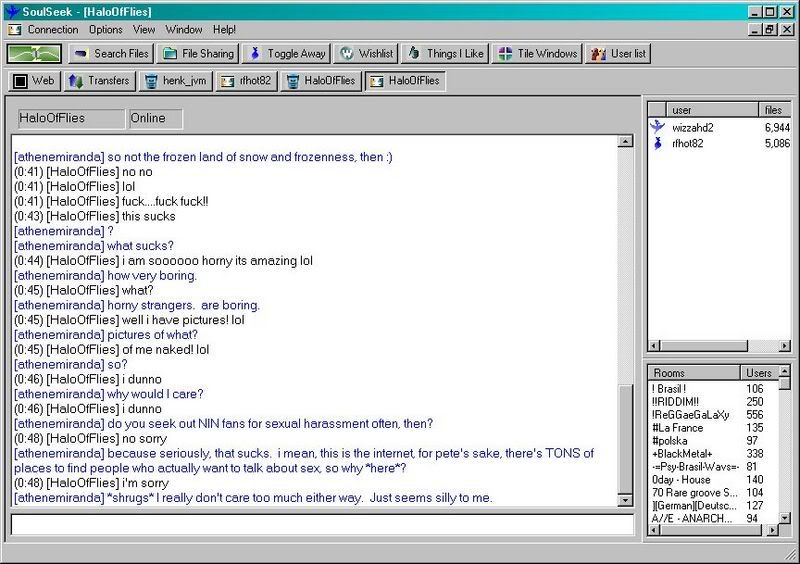
Then there's this, which happened to me about a year ago (click image to see it in a readable size):


Perhaps I've been lucky, but it was only time this has happened to me since I was a 15-year-old AOLer. I'd say it's not so much down to chance as architecture - I shared the lulz with some other folks online, and one (a straight cis guy...as far as I know) said that he'd been hassled for netsex by men on Limewire; perhaps filesharing and chatrooming lend themselves to solicitation more than other forms of online communication. Soulseek's profile settings serve to make it chattier than other such programs; the twunt originally said he'd IMed me because I'd listed the Nine Inch Nails under 'I like'. (I deleted that immediately after).

I reacted to all this in a predictable fashion; became both pissed-off and very amused, and sought Revenge. I screencapped the lulz; I banned him from downloading from me; and I went to Soulseek's FAQ to see if there was any comment on how to report abuse and annoyance. There wasn't. Sure, each internet banana republic creates its own standards, but having no harassment policy is the sort of oversight that may not be so common if they weren't all run by guys. It's due to Wikipedia's poor response to abuse reports that it took two years from the first complaint about that sock's use of intimate pictures of unconsenting women until this ban, now; they simply have no system in place to respond to this problem.

Friday, September 26, 2008

FMT: an intriguing new fail.

As I've already said, at great length, I take great exception to the way male sf/f/h writers get so hung up on sex work. And if most or all of the women in their story are sex workers, that's a really bad sign. But this, this is interesting, I dare say not good, but at least original in the realms of failure.

[Both the links in the next paragraph rate a warning for talk about rape/SA in abstract & imaginary situations.]

io9.com has this piece up on what it describes as 'zombie feminism'. Basically it's a horror movie trend that's very like r&r in 80s fantasy fiction. They've written about three zombie films with unusual implications for women, but it's the second that pinged the FMT radar - Zombie Strippers:

This flick features porn star Jenna Jameson as a stripper bitten by a zombie infected by a government drug to keep soldiers fighting after they die. The more zombie-fied she gets, the more the clientele goes crazy for her. Even when she drags men into the back room and rips their throats out and bites their dicks off. Soon, the other strippers are begging to be infected too, so they can make more in tips.

Before long, nearly all the strippers are infected, and they've got a giant basement room full of all the reanimated, mutilated men they've been gnawing on. None of these strippers are being raped or murdered by men — they're just dealing with standard-issue stuff like objectification and the dangers of working in the sex industry. And yet it's hard not to see their undeaths as a kind of revenge on men who treat women like objects. These guys come to the strip club to "get some meat," and then they're turned into meat themselves.

The problem here is that the men actually like it. Their favorite strippers are the zombies, and the women have gained "power" only by becoming monsters. Just as our girl in Deadgirl can only fight back because she's a monster. So is the message of zombie feminism that a strong women is always a monster? That she must die and return as a ghoul in order to fight back against rape and less violent forms of sexism?

Friday, May 30, 2008

Truth & consequences in the stories we tell.

[Or, a meandering collection of links to stuff about stories, sandboxes, and power.]


Quick, what's the one thing everyone knows about Grand Theft Auto? Keep hold of the answer - we'll be back for it in a moment.


I was never sure how to order this post, or what exactly to include in it. So it's been festering in Dashboard for weeks now. Partly it was sparked off by reading criticisms of Iron Man, which blurred between entirely valid digs at the film's racism and sexism, and a less definable discomfort with the entire genre it's part of. See WOCPhD's brilliant post, where she seems to have lost sight of the fact that she's reviewing an adaptation of a 1963 pulp comic book.

That's pulp, where what is right and just comes way second to what's considered entertaining. That's 1963, the past, where a lot of our current media franchises come from - whether it's those comic book adaptations, or Narnia, or James Bond. Not that the newer franchises are a lot better, but (as I said when it came up on Punkass) characters like Pepper make way more sense in that context. The whole wonderboy-hero, powerful enough to do everything we wish to do, except for those boring things his ever-capable sidekick(s) do(es), makes more sense in that vein of pulp than in the current one. This hero-character is always at the top of the world. Why do we identify with him, when he's got nothing in common with reality at all?

Because we want to. Because we're wishing for his absolute power, and we are vividly interested in what the consequences that power might bring. We play sandbox games for similar reasons - a wish for the absolute ability to choose - and that raises discomforts of its own.

(It's always 'he'. Unless the red one is writing it, it's always 'he'.)


There is something Aishwarya said in the Iron Man thread at Daisy's place; "I really, really wish I could just watch movies where things blow up (because movies where things blow up are excellent) without being constantly alienated by this sort of thing. :("

That alienation is one of the major sources of the criticism of Iron Man; that when we leave ourselves behind and go to places where we have infinite power, and can blow up whatever we like, we're almost always asked to identify with white, heterosexual upper-class men. We want to be Bruce Wayne or James Bond. We wish for their momentum, possessions, power, and their challenges. Why do they all have to look the same?


An aside; Cleolinda is talking about a whole other sort of wishing, in a post about a book series that's aimed at teenage girls. I liked this:

Wish fulfillment: I really cannot stress how important this element is, because I think it's also the reason that Harry Potter grabbed the cultural imagination. You're not a neglected orphan sleeping in a cupboard! You're a wizard! You're the bestest wizard of all and you're also great at sports and you had rich, wizardly parents who loved you so much they died for you (but you've still got their money) and also, we brought you birthday cake! And then you, through Harry, are plunged into this fantastically detailed wizard world. I mean, shit, I'm sold. And I think most things that really grab people are going to tap that "I want to be that person and live in that world" vein. I want to be Elizabeth Swann, I want to be Lyra Belacqua, I want to be the Pevensie kids.


She's talking about the same instinct that makes us love those boys who can do anything they want...and yet everything she says about this sort of wish fulfilment turns me off. I don't much like any of the books and films she's referring to. Some of these are in a middle ground - but I seem to be banging my head against the fact that the wishes I like are usually aimed at (we might even say assumed at) a male audience, and Cleolinda is talking about teenage girls, and women who remember being a teenage girl.


A while ago, Trinity wrote about our discomfort with power and excess in an unrelated context - kink!:

Think about standard criticisms of the rich and opulent. Whether they're criticisms of the nobility, of the bourgeoisie, or other criticisms of the rich and powerful. The idea that these people are decadent, that they wallow in excess, drown themselves in pleasure.

That kind of excess is actually a big turn on for me. The idea of going further and doing more, overflowing with energy, desire, and intensity. It's something I began to have a very hard time with when I got into feminist circles that were also socialist or influenced by socialism.

Because the central idea of that kind of political movement is that some people have too much and some people don't have enough. If that's the material situation of people in the world, and I seek to be committed to some kind of distributive justice that least makes the first step to equalizing some of that, how can I get into bed and touch myself while imagining, sometimes literally, that I'm lord over other people?


While not primarily sexual, wish fulfilment stories seem to hit a similar wall in the liberal press; you can't be fantasising about that, that's too much, too violent, too greedy, too unfair. So onto Cate's GTA article at Shameless:

But the object of the game is still to shoot people and win gang wars, right? I find it hard to fathom why so many intelligent people insist on defending this game, whose major appeal I once heard summarized as, “you can sleep with a prostitute and then shoot her so you don’t have to pay.”

Creative, indeed.


What, is Shameless not so shameless after all? :O Certainly Cate is saying that a virtual world's functionality should contain hard-coded moral limits, rather than simple moral consequences. It is not enough that nothing real can be harmed or lost in the space, or that your virtual self suffers virtual consequences for performing proscribed actions; instead she asks that a line be drawn, and certain evils be rendered impossible. (Something like this exists in Sims 2 - you can't kill a baby or a toddler, can only have sex with adults and elders, and character's genital areas are obscured by pixels. These restrictions have been ripped up by a legion of fanmodders, which demonstrates how practical that approach is, though when choosing nominal imaginary limits, practicality is hardly the point. Worth remembering that it was modders who caused GTA3's Hot Coffee debacle. Ultimately neither lawmakers nor creators can censor the use of game software - it's the users who determine how it is played).

Our species of cyborgs has been wrestling with this problem, of defining our virtual limits, since A Rape In Cyberspace or before.

Dibbell's story touched on one point that has been gaining ground recently; should virtual crimes be subject to real-world consequences? The answer he watched arise from LambdaMOO was a no - those who commit virtual crimes should face justice within the intimacy of the wronged community. Then as now, the internet usually gives its wrongdoers a sentence of exile.

Regina Lynn, writing about a more recent virtual rape, also thinks not. Meanwhile, DailyBits has a list of unexpected real-world spillovers from virtual events; MMO addict deaths and in-game funerals, virtual thefts and real arrests, and a story about a Gunbound player from Brazil that I can barely get my head around.


Last week I read a Cif Arts piece in defence of James Bond that talked about how uncomfortably realistic violence is part of the thrill, when it comes to boy-heroes...and added a few words about consumption and luxury:

Thanks to the cartoon violence of the films it's also easy to forget just how effective the sadism in the novels can be. Fleming's books are creepy and chilling and this graphic cruelty, combined with painstakingly accurate descriptions of high-living, fine eating and the pleasures of quality consumer goods must make Bond a direct ancestor to characters like Patrick Bateman and the unnamed protagonist of Fight Club as much as the promiscuous father of so many lesser pulp-thriller spies. It certainly merits him a place in the canon.


So violence is an intrinsic part of this wishing-ground. Graphic violence, ultimate consumption, extreme adventures - and as the article hints, unlimited access to sex. Sometimes the hero is simply a tireless playboy, but many of these stories include legions of imaginary sex workers.

To my shame, it was only a week ago - and thanks to Chris - that I read the mighty OH JOHN RINGO NO review, which charts an odyssey of violent and misogynistic wish fulfilment. From Hradzka's description, every woman in the series is a sex worker, or described as a potential sex worker; within the fantasy space, all women are perceived as being available for sexual purchase.

Hradzka also mentions a whole aspect to this wish fulfilment thing that I'd never much thought of before:

Once you get past GHOST's initial spleen-venting, the PALADIN OF SHADOWS series falls into a much-maligned, much-loved genre which, for lack of a better name, I call "Man Builds Stuff and Gets Lots of Pussy." This is, quite frankly, what got me reading the series: I am not much for stories of a guy just killing terrorists and getting laid a lot; but let him start building a small kingdom while killing terrorists and getting laid a lot, and I am there. I confess that have a soft spot for these kinds of stories. I suspect that *lots* of men do: even if we don't build things ourselves, we like to *read about* guys building things: castles, weapons, companies, societies. It's really very soothing; it combines the pleasures of fiction with a those of a do-it-yourself manual. The same impulses may explain why a lot of male writers aren't content to have their hero just carrying, say, a 1911 as his sidearm; they have to tell you what make, model, whether it's got an internal or external extractor, what aftermarket parts he's tuned it up with, and who he bought them from, until you know all about his Kimber's Ed Brown slide stop and Wolff springs.

(Curiously, the sex-related parts do not require details of every thrust; if the chapter fades to black with the hero hopping into bed with two nubile wenches, honor is satisfied. John Ringo, alas, often carries honor considerably farther.)


I'd never put a name to that before, but building stuff is definitely a genre I like. I enjoyed this aspect of both Iron Man and Batman Begins...not to mention Metal Gear Solid: Portable Ops, a game in which you have to procure yourself an entire army. (I can think of only one Woman Builds Stuff story - A Town Like Alice by Nevil Shute. While I enjoyed the Woman Builds Stuff part of the book, it seemed rushed and unconvincing compared to the rest of it).


On CiF, Charlie Brooker unwraps the problem, and finds a new one wrapped inside:

The one thing everyone knows about Grand Theft Auto is that you can kill prostitutes in it. That's because it's a "sandbox" game in which you can kill anyone you like. Or you can not kill them. Or you can simply drive around slowly, obeying the traffic lights. If you break the law and the in-game police spot you, they'll hunt you down and nab you. Murdering innocent people is neither a) encouraged, b) free of consequence, or c) any more realistic than a Tex Avery cartoon.


...in other words, the problem is not that you can kill prostitutes, but that prostitutes are a singled-out class of people, neatly prepackaged as a unit by our culture in spite of their great diversity of circumstances, and the killing of this class of people IRL is common and so easy to get away with because of this - so when a game also presents sex workers as a class of people, and just happens to let you kill whoever you like, guess who people get most excited about shooting.


I should add; Brooker's point c) is under dispute. The Slate game review...which is entitled 'It's Not Just About Killing Hookers Any More'...says it's simply not true:

There's a difference this time: The violence is no longer cartoonish. Shoot an innocent bystander, and you see his face contort in agony. He'll clutch at the wound and begin to stagger away, desperately seeking safety. After just scratching the surface of the game—I played for part of a day; it could take 60 hours to complete the whole thing—I felt unnerved. What makes Grand Theft Auto IV so compelling is that, unlike so many video games, it made me reflect on all of the disturbing things I had done.


...and David Wong, in Seven Commandments All Videogames Should Obey (a followup to another wonderful article, A Gamer's Manifesto), devotes an entire page to saying it shouldn't be true:

If we shoot a zombie in the arm, we want his arm to blow off. If we shoot him in the knee, we want him to limp. And if we shoot him in the head, we want his head to explode. We want our bullets to create wounds.

[...]

Sword-fighting games like Oblivion are worse. You can slash the bad guy in the face with your blade and it does nothing. The enemy looks perfectly normal until he finally falls over dead, as if he had a heart attack from the excitement. Why give us a sword if we can't decapitate people? Don't tell us the system can't handle it, we were blowing off zombie limbs in House of the Dead a decade ago.

It's not about our blood thirst (well, not just about that), it's about making us feel like we're accomplishing something as we work our way through hordes of cookie-cutter bad guys. Oh, hey, you know what else we hate?

Filling the game with hordes of cookie-cutter bad guys.

This is another one of those problems that are exacerbated by new-gen graphics. Now that we can do photo-realistic faces, it's suddenly very weird that we're killing hundreds of identical clones.

How hard would it be to randomize facial features and skin tones? That's what we want, to feel like we're killing hundreds of different people. Not a bunch of clones or twins. We want to know, deep down, that there are hundreds of grieving mothers out there, lamenting the terror of our dreaded blade.


And I agree with him, I agree with Slate - we need the effects of our actions to look realistic, and the media queasies have repeatedly demonstrated the reason for this.


The first time I read an article about violence in videogames was almost ten years ago. It was in a library newspaper - probably the Times - and it mentioned several games, but was illustrated with one of Nomura's promotional images for Final Fantasy VII; a game that uses violence, questions it, and at one point devolves into an argument between Cait and Barrett about whether any of the violent things they've been doing are remotely justified.

That was the moment I first realised that I was never going to read anything of value about videogames in a printed newspaper, ever. Why shut up and go away when you can challenge and explore instead?

This is why my least favourite scene in Iron Man was the one that steamrolled over #6 of David Wong's Ultimate War Sim demand list:

Speaking of innocents, I want a war sim where native townsfolk stand shoulder-to-shoulder on every inch of the map and not a single bomb can be dropped without blowing 200 of them into chunks. Forget about the abandoned building wallpaper in games like the Red Alert series. I want to have to choose between sending marines door-to-door to be killed in the streets or leveling the block from afar, Nuns and all. I want to have to choose between 40 dead troops or 400 dead children, and be damned to hell by chubby pundits from the safety of their studios regardless of which way I go.


See, Wong is a gamer kid with a good grip on reality. There exist other gamer kids who think reality is like Iron Man, where magical white people who waltz into other people's countries have the magical power to distinguish between nice, innocent brown people and evil brown people (there are no other kinds, just innocent or evil), remove the latter with pinpoint precision, and go home after a day well saved. These other gamer kids are called the US government.

It's the people who don't want their imaginary violence to be realistic that I worry about. The people who want the details glossed over, who want to make out that it's not as bad as it really is, who want to conceal the fact that it's the least powerful who always suffer first and most.


One last link: Catherine Bennett on GTA. Oh dear god, you must read this:

With a violent and nasty movie, or corrupting literature, the thing is simple. You merely have to buy a ticket for, say, No Country for Old Men, or There Will be Blood, and watch it, with a keen eye for anything that might be violent or nasty. With books, you simply open, then read a copy of The Catcher in the Rye or, to go back a bit, Lady Chatterley's Lover or a bit further, one of those 18th-century courtship novels whose potential to enervate young virgins was discernible, apparently, within just a few minutes of scholarly inspection.

How different for the mature student of Grand Theft Auto IV, who discovers that acquisition of the game, an Xbox 360 and a working television will not be nearly enough to expose the sickening extent of its moral bankruptcy. For that, you need time, skill, dedication and, I suspect, youth. In fact, it would probably be cheaper, and easier, for any averagely underqualified adult who craves the excitement of casual violence in a context of social indifference to make your way to somewhere like Borough Market and snarl: 'Out of the way, bitch' at every double buggy.

[...]

In fact, if a new book on gaming, Grand Theft Childhood: The Surprising Truth about Violent Video Games, is to be believed, there may exist hardly anyone in sound mind who might not, from time to stressful time, benefit from an hour or two of moderately violent gaming. The authors, two Harvard psychiatrists, Lawrence Kutner and Cheryl K Olson, were told by many young players that they played violent games to 'relax' or to 'get my anger out'. Should we not, as a matter of urgency, implore Gordon Brown to escape into GTA IV over the bank holiday? Or would the experience make an already vulnerable and solitary Prime Minister more likely to aim his car, à la Niko, at cyclists such as David Cameron?

Thursday, March 13, 2008

A few words about sex education.

So a few days ago some cleverdick figured out that a quarter of American teenage girls has an STD. (Why did they only test girls? And how did they choose their participants, anyway?) The TV news prompted a lively household argument, with much differing opinion about what sex education actually was, never mind what it should be. (My housemates' experiences indicate that in the late 80s/early 90s, sex ed in American public education was actually sex ed, but it withered about 10 years ago. The sex ed I got was clinical, quite thorough in the limited realm of devices and widgets, entirely centred on PIV, and, at 15, far too late.)

One of said housemates - the one who'd had sex ed at the end of the 80s - said the STD epidemics shouldn't be blamed on poor education. That parents are meant to be responsible for these things, not schools.

Um. I guess that might work if we lived in a magical world where all teenagers are parented. They're not. I wasn't. All the information about sex I got outside school was from dubious girly magazines and from bad sf/f books. If you think schools shouldn't be responsible for sex ed, then...what do you think should happen to children with little or no parenting? Is it right to expose us to a health crisis because of something the parenting we never had didn't provide? Do we deserve that?

This strongly reminded me of the people who say single-parent families are A Bad Thing that creates Evil People; yeah, and what are kids who don't have two parents meant to do about that? Suck it up?


This comes at a time of iiinteresting state education wanks in the UK news; apparently 'school is the last moral force'. This is less wanky when you realise the headline-makers have said 'moral' when they really mean 'social':

They now sometimes had to teach social skills such as eating a meal together.

"Schools have a much stronger role in bringing up children than in previous years," Dr Dunford said.

In his speech, Dr Dunford told heads and senior staff that for too many children, school was the "only solid bedrock in their lives".

He highlighted how schools were now expected to set rules about basic behaviour which once would have been the responsibility of parents and the wider community.


Having bedrock is not about morality. (Though it reminds me of she who said that sin is when you treat people as things; we've built a world that puts people last). It's about society, and about what structures are going to catch those of us that have been tossed down the cracks.

Meanwhile, schools absolutely have to prevent children from being fat. Anything but fat. As many STDs as your Daily Fail sexphobic rhetoric can provide, but not fat!

Monday, February 04, 2008

Castor, Achilles, Euryalus, Aretaeus, Alexander, Dubreuil

And Orestes.

[Or, to get into the spirit of the thing: Orestes and.]


I have a long memory - the kind where a good book can lodge for years, with me dropping by its cubbyhole every so often to continue our ongoing conversation. I've got broad tastes; encounters with the current mainstream are generally disastrous, and I tend to go home to sf/f eventually, but I wind up with a lot of isolated loves. Les Misérables is one of them. I don't know the first thing about other literature of the time and the place; it has no context for me, and if I want to grok all its obscurities, I grok alone.

After years of intermittent obsessing, I think I'm finally done talking to this one beautiful passage. It comes close to the end of Part 3, Book 4, Chapter 1: A Group Which Almost Became Historic, and it describes the connexion between Enjolras and Grantaire.

There are men who seem born to be the opposite, the reverse, the counterpoint. They are Pollux, Patroclus, Nisus, Eudamidas, Hephaestion, Pechméja. They live only upon condition of leaning on another; their names are continuations, and are only written preceded by the conjunction 'and'; their existence is not their own; it is the other side of a destiny which is not theirs. Grantaire was one of these men. He was the reverse of Enjolras.

We might almost say that affinities commence with the letters of the alphabet. In the series, O and P are inseparable. You can, as you choose, pronounce O and P, or Orestes and Pylades.

Grantaire, a true satellite of Enjolras, lived in this circle of young people; he dwelt in it; he took pleasure only in it; he followed them everywhere. His delight was to see these forms coming and going in the fumes of the wine. He was tolerated for his good-humour.

Enjolras, being a believer, disdained this sceptic, and being sober, scorned this drunkard. He granted him a little haughty pity. Grantaire was an unaccepted Pylades. Always rudely treated by Enjolras, harshly repelled, rejected, yet returning, he said of Enjolras; 'What a fine statue!'


Let's get our priorities straight (ha!) here; the slash, is it canon?

See, that's a totally incommensurable question to begin with. Hugo was writing before queer, before 'homosexual' was a word, let alone a rights movement; I can only guess at what he was trying to say about these two men, but he's left me a few hints. Seven, to be precise. Seven people who belong with seven other people.

Castor and Pollux are twins hatched from the same swan-egg, brothers of Helen of Troy; one mortal, the other divine but generous enough to see eternal life as worth sharing.

Achilles and Patroclus - is there anyone left who hasn't read Troy In 15 Minutes? Because, um, they were totally cousins. Totally. <3<3 Cleolinda.

Nisus, Euryalus? Even Wikipedia isn't quite sure about those two. Lovers for sure, but sexually? Maybe, maybe not.

Eudamidas is a character of 2nd-century satire; given the way people wrote at the time, I can't decide if it's more likely that he was fictional, or a vaguely real gossip-piece. He perhaps got himself on Hugo's radar via The Testament Of Eudamidas, a painting Nicolas Poussin made in 1643 about the guy and his testament, based on the original story by Lucian. This unusual document allegedly willed away not just Eudamidas's meagre possessions, but also his daughter and his mother. From the original Lucian:

Mnesippus. Eudamidas of Corinth, though he was himself in very narrow circumstances, had two friends who were well-to-do, Aretaeus his fellow townsman, and Charixenus of Sicyon. When Eudamidas died, he left a will behind him which I dare say would excite most people's ridicule: but what the generous Toxaris, with his respect for friendship and his ambition to secure its highest honours for his country, may think of the matter, is another question. The terms of the will--but first I should explain that Eudamidas left behind him an aged mother and a daughter of marriageable years;--the will, then, was as follows: To Aretaeus I bequeath my mother, to tend and to cherish in her old age: and to Charixenus my daughter, to give in marriage with such dowry as his circumstances will admit of: and should anything befall either of the legatees, then let his portion pass to the survivor. The reading of this will caused some merriment among the hearers, who knew of Eudamidas's poverty, but did not know anything of the friendship existing between him and his heirs. They went off much tickled at the handsome legacy that Aretaeus and Charixenus (lucky dogs!) had come in for: 'Eudamidas,' as they expressed it, 'was apparently to have a death-interest in the property of the legatees.' However, the latter had no sooner heard the will read, than they proceeded to execute the testator's intentions. Charixenus only survived Eudamidas by five days: but Aretaeus, most generous of heirs, accepted the double bequest, is supporting the aged mother at this day, and has only lately given the daughter in marriage, allowing to her and to his own daughter portions of 500 each, out of his whole property of 1,250; the two marriages were arranged to take place on the same day. What do you think of him, Toxaris? This is something like friendship, is it not,--to accept such a bequest as this, and to show such respect for a friend's last wishes? May we pass this as one of my five?

Toxaris. Excellent as was the behaviour of Aretaeus, I admire still more Eudamidas's confidence in his friends. It shows that he would have done as much for them; even if nothing had been said about it in their wills, he would have been the first to come forward and claim the inheritance as natural heir.


Lucian explicitly connected Eudamidas with Pylades. He was writing about two characters having a rhetorical competition over whether Greeks or Scythians had the best friendships. (Lucian himself wrote in Greek but is believed to have been Syrian). The contest begins with Toxaris, the Scythian, telling Mnesippus why Scythians make sacrifices to Orestes and Pylades; "We honour Orestes and Pylades, then, because they excelled in the Scythian virtue of loyalty, which we place above all others; and it is for this that we have bestowed on them the name of Coraci, which in our language means spirits of friendship."

Passing briefly over Alexander and Hephaestion as being too damn famous and Hollywood and canonslashy and all that: the only source I've ever, ever found on Pechméja also refers directly to Orestes and Pylades. (Male Friendship In Pre-Revolutionary France by Jeffrey Merrick, which you can read if you have the right login. I don't, but the blue person is magical like that). Jean Pechméja and Jean Baptiste Léon Dubreuil were both born in the early 1740s in the same small town in Aveyron, but after leaving said small town didn't encounter each other again til the 1770s. By then Dubreuil was a doctor, Pechmeja a writer - their friendship resumed when Pechméja fell ill and Dubreuil moved to the outskirts of Paris to care for him; in return, Merrick tells us, Pechméja dedicated a classical-themed book to Dubreuil with '"respect, affection, gratitude" (le respect, la tendresse, la reconnaissance) for his "austere virtue, generous friendship, and preservative power" (la vertu austère . . . l’amitié généreuse . . . la puissance conservatrice).' The book is about how male friendship is way better than marriage because marriage involves all that complicated sex stuff which just makes people confused and miserable. [Here you may insert your own rant about how much Brokeback Mountain sucked for drawing teh queer as being an idyllic escape from the real-life responsibilities women and children put on a guy, as if queer was somehow the opposite of being a proper grownup who cares for/belongs to a family. Go on. I'll wait here til you're done.]

Here's Merrick's word on the O and the P, if not the intervening T:

According to their contemporaries, Pechméja and Dubreuil enjoyed "the most intimate friendship" (l’amitié la plus intime) and resembled the mythological companions Orestes and Pylades. [...] Inseparable from each other, as if married to each other, Pechméja and Dubreuil shared everything: "dwelling, social circles, good things, bad things, pleasures, and pains" (logement, sociétés, biens, maux, plaisirs, et peines).


I checked the citation on that as soon as I read it, half-expecting it to lead back to Hugo. It didn't. It's from a 1780s-90s thingy called Correspondance secrète, politique, et littéraire. Was that comment influenced directly by Lucian, or was this Coraci thread running wider than that through the literary culture of the time? Also:

According to the marquis de Bombelles, Noailles pressured the local clergy, who had wanted to exclude Dubreuil from burial in consecrated ground because of the way he had died, without the last rites, as well as the way he had lived. Bombelles did not explain what they found objectionable in the life of the successful and respected doctor. No one in 1785 suggested that Pechméja and Dubreuil were sexually involved with each other or even acknowledged that they loved each other, but this one cryptic remark indicates that some contemporaries, in this case institutional advocates of traditional values, believed that friendship might involve dangerous as well as delightful possibilities.


Orestes and Pylades, incidentally, are totally cousins. (For real).

So what have we got there? Three men of myth, two of murky classical history, one who died a mere 20 years before Hugo's birth. A brother, three lovers, a testator, and a best friend who we don't really have reason to believe was also a lover. These, held up to two spirits of friendship. These, and Grantaire and Enjolras, who are not even really on speaking terms with each other. The hell?


Hugo is both quite particular about sex and also fond of making exceptions to all his rules in general; Les Misérables has it that God supports the Swedish model, and that male philanderers are bad, except for the cheerful old one; he idolises marital sex, and equates virginity with not just virtuous conduct, but with a virtuous appearance;

"Monsiuer", said Thénadier, "it is my wife's bridal cap."
The traveller looked at the object with a look which seemed to say 'there was a moment, then, when this monster was a virgin'.


And yet; 'all the nuns in the world are not equal to one mother', and other such sentiments. (I love this book, but it's part of the reason why I think anyone who says wives and prostitutes are the only women who get laid is stuck in the 19th century). Hugo seems to elevate wives and mothers when it comes to women, but men he cherishes as virgins. He makes a point of the virginity of almost all his male cast; of Jean Valjean he says; 'His youth was spent in rough and ill-recompensed labour; he never was known to have a sweetheart; he had not time to be in love.' Then later; 'Jean Valjean had never loved anything. For twenty-five years he had been alone in the world. He had never been a father, lover, husband or friend.' Marius is righteously indignant at his grandfather's suggestion that he take Cosette as a mistress; the antagonist Javert's virginity is also spelled out; 'His life was a life of privations, isolation, self-denial and chastity; never any amusement.'

But Enjolras and Grantaire? Well. The former is clear enough;
'...he did not seem to know that there was on the earth a being called woman... Woe to the love affair that should venture to intrude upon him! Had any grisette of the Place Cambrai or the Rue Saint Jean de Beauvais, seeing this college boy's face, this form of a page, those long fair lashes, those blue eyes, that hair flying in the wind, those rosy cheeks, those pure lips, those exquisite teeth, felt a desire to taste all this dawn, and tried her beauty upon Enjolras, a surprising and terrible look would have suddenly shown her the great gulf, and taught her not to confound the with the gallant cherubim of Beaumarchais the fearful cherubim of Ezekiel.


And Grantaire?
He was frightfully ugly; the prettiest shoe-binder of that period, Irma Boissy, revolting at his ugliness, had uttered this sentence: 'Grantaire is impossible,' but Grantaire's self-conceit was not disconcerted. He looked tenderly and fixedly upon every woman, appearing to say of them all: if only I would; and trying to make his comrades believe that he was in general demand.


Hugo piles up the adjectives right after that, contrasting Enjolras's 'chaste, healthy, firm, direct, hard, candid nature' with Grantaire's 'soft, wavering, disjointed, diseased, deformed ideas': again chastity is a trait that seems to extend well beyond sex - one Grantaire is devoid of even though he isn't getting any sex. Of course, I don't know what the hell he even meant by 'chastity' (and god help me, but I can't find the second volume of my French copy so I don't even know what the original goddamn word he used was). No sex? Not much sex? Not desiring sex? Sex only with people you're allowed to have sex with?

I could be a smart-alec slash canonista and say that Hugo is explicitly discussing only sex with women, but dude, did you catch the bit where I said the word didn't exist til a decade after his book came out? I am sure the OTP never occurred to him. Except for the part where he's talking about Hephaestion and Patroclus and Nisus and expecting us to grok it. You know, the part I got stuck on in the first place. My friend Kathie, being a little under three times my age, has it that the increasing visibility of queer people since the 1960s - and of queer readings of straight homosocial activities - has put new limits on straight masculinity, made it shy away even from homosocial forms more recent than those Hugo describes - constricting itself in fear of eyes like mine. I am just reading, just knowing that whatever bond he's describing is incommensurable with anything that could ever be written today.

He mentions Pylades only once more, in a chapter heading a full 400 pages later; Orestes Fasting and Pylades Drunk, in which Grantaire finally said "Vive la République! I belong to it," and 'Enjolras grasped his hand with a smile.'


A minor edit: here's 10littlebullets on LJ with some more gay metaphors Hugo pins to Enjolras.


an aside for those of you who've been net-stalking me since 2002; When I read that line early into the Lucian - "do you mean to tell me that you people actually sacrifice to Orestes and Pylades? do you take them for Gods?" "Sacrifice to them? of course we do. It does not follow that we think they are Gods: they were good men." - I put the kettle on and paced around the house until it boiled. I am staying with my person's family atm, so I had the restraint to only make one cuppa, not three.

Monday, December 03, 2007

From The Whoreses' Mouth

[addendum: Helen Keeble has written some wonderful notes on the Weird Symposium, and I've collected the links here - my own, much inferior, notes are linked at the end of this post.]

This would be further to '1958'. Because, as I mentioned on t'other blog, I went to The Weird symposium, and then the Weird symposium went to a bar, and China Miéville bought me a drink and talked with me about whores.

I shall now leave a few lines blank to give you time to get over how wonderful my life is.


By then I was suffering from brain-mush induced by lack of sleep and passive inhalation of Immanuel Kant, so there are two important things about the whores in The Perpetual Train that I didn't manage to bring up, but on the whole, I forgive him. The first thing he said when I mentioned the topic was that he'd thought through the gender politics of it and was prepared to stand by that part of the story, both its stance and its way of getting there; I think he'd had this conversation before, and that he'd had it with himself before that.

It's a bit of a duckrabbit: looked at through the lens of an SF-reading feminist, it's part of one distinct pattern; read from the point of view of a revolutionary socialist (I can pretend to have that POV for a moment, right?) it's a different picture. He said he was reflecting the history of railway-making, in which women do appear only as prostitutes or as slaves; given that, presenting the prostitute as a wage-labourer who can, like male wage-labourers, be radicalised by their experiences under capitalism, is (he thinks) a positive. He's well aware of the general SF reading, though, and says 'they do not have hearts of gold.'

The big thing I did manage to get out was that it seemed like his male characters had jobs - surveyors, gendarmes, railwaymen - while his prostitutes were their jobs. He said he felt he'd written them as people who were in control of their labour - they had rules, enforced them, went on strike. He pointed out that the prostitutes are at the forefront of the workers' radicalisation, and reminded me of one charming aspect of the story that I didn't mention last time; the Iron Councillors all, irrespective of gender, call each other 'sister' because the prostitutes refused to use 'brother'. (The other radical group in Iron Council, the Caucus, all, irrespective of gender, call each other Jack, which was really funny before Ori and Madeleina got to know each other). That explicitly identifies the rest of the wage-labourers with the prostitutes, which I think you've got to love.

I pointed out how invisible sex work is to women; how my young brother is far more exposed to the sex industry than I am, how very few women will encounter stripping and hooking (and those who do will mostly be those whose partners are consumers of such), while the industry is marketed at most men and part of the culture of many. How this makes writing about the sex industry excluding for women and entitling for men. (I don't think I said that part particularly clearly). He told me that that was a pretty recent thing - that 15 years ago it was a far more obscure part of male life than it is now. (That is the kind of information that women do not have access to, see?) It's weird that that's happened at the same time as women are becoming more economically powerful.


I didn't, and I wish I had remembered to, mention the problem Ide Cyan so eloquently described here:
"This is the kind of bullshit coming from leftist men that feminist women have been debunking since the invention of socialism. It presupposes that women's oppression is the result of industrial capitalism, rather a specific form of oppression with its own relations of production, and conveniently obscures proletarian men's role in the oppression of women. Obviously, leftist men still haven't paid attention, or do not care to integrate that particular analysis into their revolutionary approaches."


I don't think Miéville has completely failed to integrate that analysis, but he's certainly putting it way second to capitalist oppression, because that's what the whole sodding book is about. (That his stance is ultimately abolitionist is related to this; yeah, he's imagining a post-sex work utopia, but that's because he's imagining the end of all capitalist wage labour).

The second thing I missed, closely tied to the above, is the point V raised here about the use of sex work as part of the 'story' of individual characters (Ann-Hari and Carianne, but also dozens of other SF characters - Molly Millions, Niki Sanders, several continuities of Catwoman, et cetera ad infinitum). It's extremely irritating when read as part of that group of male-authored SF about sex work; I'd imagine he'd again be writing it as a being about wage-labour rather than being about sex, but I would've liked to argue the toss about it, because I refuse to believe it's a coincidence that it happens with so very many strong female characters. It's also, I feel, touching on appropriation; using a real-world group (sex workers) to explain your politics, your stories, your world.

He told me to come say hello if we're ever at the same convention again, so you never know. My notes from The Weird, if you'd like to read them, are here.

Saturday, October 20, 2007

1958

[NB: I originally wrote this to let of steam, but both this post and the FMT are now very slightly Internets Famous, and have thus been Criticised by Smart People. I'd therefore like to add C A Monteath-Carr's suggestion for an alternate FMT equation:

If (# of Female Prostitutes) > (# of All Other Women), then [WTF?]


I would like to propose a measure called The Frank Miller Test. It will test how much male sci-fi writers are obsessed with whores; if the proportion of female sex workers to neutrally presented female people in his story is above 1:1, he fails.

I said, alonglongtimeago, that I'd get back to the whole general mess of how sex work gets portrayed in sci-fi & fantasy. It's a happy coincidence for me that Yonmei recently wrote about this vile story CS Lewis penned in 1958 because if she hadn't, I would've had to search it out and reread it, ewwww. It's a short exploration concerning sex on an exploratory mission to Mars. 'Sex' meaning to Lewis exactly what it often means in sci-fi and in videogames - sex between the male adventurer and the female prostitute. Go read Yonmei's post, because I can't bear to rehash this vile example. Gist is, women can only come to Mars if they're going to be prostitutes. (The really cringlingly awful part is that when I first read it - I think I was 14 or 13 - I swallowed this shit whole.)

There's a lot of supposedly 'speculative' fictions where it's still 1958.


I am going to start with the ones I love the most, because they're the ones that hurt; China Mieville remains my writer of ultimate worship (and not just because of what he called Charles Clarke that one time on Lenin's Tomb), but there's this moment in The Scar where one of the minor characters, Carrianne, tells a story near-identical to that of Lewis's 'ministering angels'. Even on a first, frantic readthrough of a book I was badly in love with, this stood out as the weakest thing he'd ever put on paper.

We were sailing our whim-trawler for Kohnid in Gnurr Kett. That's a long, hard journey. I was seventeen. I won the lottery to be figurehead and concubine. I spent the daylight strapped to the bowsprit, scattering orchid petals in front of the ship, spent the night reading the men's cards and in their beds. That was dull, but I enjoyed the days. Dangling there, singing, sleeping, watching the sea.


Yeah. Great journeys are for penises, but vaginas can tag along and put out for us and that makes them winners! This isn't normative, I know, it's descriptive, he has an anthropology background, I shouldn't be so quick to smell a rat. And yet.

Carrianne is only one woman, but in male-authored sci-fi, the whole stupid prostitutes-only thing more often follows that 1958 pattern of the organised group. Iron Council is such a self-aware commentary on socialism, on industrial organisation, on the politics of objects (both technologies and bodies), on revolution, that I'm hesitant to rip at any one moment. It's a journey, a circle. The bit that involves prostitution is that wild present-tense 150-page book-within-book that some people hate and I hopelessly adore: Anamnesis ~ The Perpetual Train.

Mostly, it's about technological determinism with sociological determinisms piled atop that. (Beautifully. It's probably the best book in the entire world). A company sponsored by a wealthy coastal city-state is building a railway line across a continent, out from their city toward places they have never been. The Perpetual Train follows Judah, one of the Transcontinental Railway Trust's surveyors: he watches as the construction of the railway changes the land and the communities that it passes through.

The villages they pass become rich and murderously violent - decadent, liquor-swilling, whore-filled and lawless - for the few days or weeks of the railroad, and then die. The towns live mayfly lives. Sex is as much part of the iron-road industry as spiking, grading, herding and paperwork. A tent city of prostitute refugees from New Crobuzon's red-light districts follows the rails and the men that set them down. The men call it Fucktown.


It's 1958 again. The men have a quest, and the women are the questers' prostitutes. (Anonymous homosexual intercourse is suggested as the cash-free alternative). There's also, of course, this narrative about how 'vices' of all kinds are brought by the evil capitalist enterprise to the virgin wilderness -

- but not quite, I fucking adore this one:

There are several like her, some boys but mostly young women, utterly charged by the arrival of these tough roustabouts and the breathing pistons of the trains. Their families lament while they let their flocks run, or sell them for meat to railroaders for scrimshawed trinkets from the tool-rooms. The goatkeep young men join the grading teams and fill the rivers. The young women find other outlets. [...] There is bad blood among the camp followers. The whores who have dutifully followed these men, splitting from the perpetual train to work with these mountain diggers, are affronted by their new rural rivals, these farmgirls who expect no pay. Some of the workers themselves are threatened by these newly voracious young women who do not sell sex or even give sex but take it. They know no rules. They have yet to learn taboos...


Part of me adores that bolded line, and the energy of the passage in general. The other part is saying waitacottonpickingminute, you're appropriating vaginas to demonstrate your philosophy of technology? You're using the gender-neutral word 'worker' to mean 'man who pays for sex'? You're drawing lines between 'untamed' rural amazons and prostitutes who are Slaves Of The Patriarchal-Capital-Whatsit? Prostitutes who (as the story goes) 'corrupt' those women through violence, enforce their taboos and turn them, vampire-like, into prostitutes themselves? The shit?

There are only four sorts of women in The Perpetual Train: these village sluts, these whores, monsters and a few passing gamblers. The only ones that organise are, naturally, the whores.

Mieville is a materialist revolutionary - the (male) workers unionise, and the (female) sex workers unionise, not for ideology but because the TRT's wage money dries up; the two unions then unite and eventually do things their own way, a way in which no one is being paid for anything. So women get to stop being prostitutes AFTER THE REVOLUTION! and not before. That's all the women he's writing about, by the end of The Perpetual Train, excepting a few nameless Remade (class-critical monsters). It's not like this in The Scar: there, where a small group of women gather together, they're usually librarians.

[Addendum: I spoke to him about this after the Weird symposium - see here for his response to some of the points raised.]


I've done Firefly. The circumstances are murky, but the only reason Inara was able to be part of the quest while retaining her class privilege was because she was a sex worker.


I said I wouldn't do Frank Miller himself. It's the writers I love that I want to unpick. We're going to Discworld. We're going to the fandom-splitting nadir/zenith of Discworld, Night Watch. It has two things in common with The Perpetual Train; firstly it is a fold in time, set about thirty years before the rest of the series around it; secondly, all the women in that time-fold are prostitutes, excepting only two, who are both addressed as potential prostitutes. In the past, all women were bought and sold, geddit?

There are the prostitutes. There's the cat-owning figure at the back, Madame, and at one point a man asks if that's her title or her profession. There's the real seamstress, for Discworld regulars. I can't recall another woman in the entire thick of the book: Sybil and Angua creep in only at the temporally flat edges. I can't excerpt *listens to collective sighs of relief* because I can't find a copy anywhere (fact: he once posted my copy of Night Watch to Australia, but then gave me one of the other zillion we had sat about just-in-case), but I swear to god it's true. And again, as in The Perpetual Train, the unionising of the prostitutes is their key issue. It's an entirely realistic concern. And yet.

It's not like this is how he usually 'does' gender; Pratchett adores toying with female stereotypes, and has made us see eye to eye with the bitter one; fall in love with the fat, forty-year-old virgin; awaken the inner babysitter. He's franchised the Tooth Fairy. He's done an entire book about the orphaned servant-girl not getting married to the handsome prince. He's followed the queen from beehive to chessboard to mountaintop kingdom. Do not ask us about Mrs Cake.

Thing is, outside of the agency-worker Tooth Fairies, the only organised group of women...is that union, a guild no less, of prostitutes. There is this whole thing about how the witches do not have a hierarchy, or a leader, because Esme Weatherwax would never allow it; there is this other whole thing about how only three city guilds will even accept female members; the whores, the beggars, and the detested Night Watch (but only long after the revolution, even then). In other words, women do not form organised groups, but prostitutes do. And in Night Watch, the revolution demands 'reasonably priced love', because the only women the author has welcomed on board are whores.


[Here there could've been a word or two about how prostitution is brought into videogames, but it's just more of that cock-coddling I mentioned here, with the occasional added touch of slut-shaming or poor-little-victiming. I do think it makes me feel less comfortable presenting as a female PC in a gameworld, just because it makes it overtly clear that this invented society, otherwise little resembling our own, is programmed to cater specifically to the cock. Bioware has been known to proffer an occasional rentboy. It doesn't work, because I am not really a potential consumer of sex. It just looks like mapping male sexuality on to that afterthought that is the female PC, which is what it is.]


I'll say it again; when male sci-fi authors write about trade unions for sex workers, they do not do so out of the goodness of their bleeding liberal hearts. One fascinating thing about sex work that I would never have known without reading the words of sex workers themselves: the johns are sometimes organised. (The immensely readable PeridotAsh has written about this here and here). The sex industry impinges more on the average man's life than the average woman's - few women are potential customers or potential employees, while a sizeable minority of men are consumers of sex and all will find it marketed to them at some point. Is this why male sci-fi writers circle the topic like vultures, appropriate it and sometimes use it as their only discourse on women at all? By fantasising about organised sex workers, are they becoming an organised community of sex consumers? Are they already that, and just acting it out on paper?

Um, I think Mieville doesn't even like vagina, and I know Frank Miller has never spoken to a woman in his entire life. But hey.

[addendum: the angry black woman assures me that Mieville does like vagina. I am more than cool with that, because oh god would I ever hit it.]


Does this matter out in the real world? Only in that it makes it harder to hear real sex workers because of all the male-invented versions getting in the way, and putting fanrats like me off the topic entirely because I've seen how these guys use it.

Tuesday, October 16, 2007

Human life isn't sacred.

Somebody had to say it.

I'm not speaking of religious tenets about the status of human life; what I'm talking about is policy. There are no leaders anywhere (well, except just maybe Bhutan) who put human life first when making the rules. Life wasn't sacred when we invaded Iraq. It wasn't sacred when we decided that it's worthwhile to have all these death machines on our streets, either - cars kill 67 people each week in the UK, and 825 each week in the USA. Life isn't sacred when we talk about climate change - zillions of reports on the human cost of the crisis resulted in mere hand-wringing, while the Stern report on the economic cost of inaction was what made climate change a political priority. When the hell do we ever talk about the importance of human life when we're deciding on policy?

Oh. Yeah. Here. (a link I totally stole from here). Why is that, I wonder?

Honestly, there's no need to invoke conspiracy theories there - it just looks like a vicious cycle of silence. Because human life is sacred, celebrating the economic and social boon of free, legal abortion is a supposedly icky thing to do. (All the while, we're meant to cheer on those lovely liberated Iraqi statue-squishers while a million of their compatriots lie dead at their feet. I'm just saying.) Maybe this silence stops people from seeing it in the same way they do road deaths. Or maybe it's because the benefits are bound to the 'ending' of life in a way that's more obvious than - no, no, wait, it's pretty bloody obvious in the case of that stupid war. Or maybe these losses are seen as preventable by other means - which often isn't true. (More to the point, why were you even driving that car? Why didn't you take the goddamn train?)

So as a political position, it's very hard to consistently defend the right-to-life. As a religious view, that's your call, but it's not mine - I don't think life is simply created and destroyed, I don't see human life as being intrinsically above other forms, and I think personhood is of far greater importance than life. (By 'personhood' I really mean presence in the world, physically, socially, intellectually and spiritually; being part of a great structure of things that touch you and relate to you. Everyone engages at their own level, but that of a 24-week fetus is negligible - certainly when compared to that of a newborn baby, in my totally uninformed and liberally-biased view.) Were I to become troubled about the needless killing of persons, abortion would be a long way down the agenda.

Sunday, October 14, 2007

Paydirt.

Who said this?

"The Armenians were subjected to a genocidal campaign that defies comprehension and commands all decent people to remember and acknowledge the facts and lessons of an awful crime in a century of bloody crimes against humanity. If elected President, I would ensure that our nation properly recognizes the tragic suffering of the Armenian people."

I think you know who said that. In a letter written during his election campaign seven and a half years ago. Hats off to Irving Washington for the heads-up.


A later addendum for further paydirt:

What happens when a mass-market magazine prints a topless photo of an unconsenting 14-year-old? They get a slap on the wrist. Because they can't possibly check that the material they make oodles of money from is consensual, let alone legal! They're far too busy making money for that. So they get a slap on the wrist. Meanwhile, of age women who consent to appear in porn get three years inside, if the Home Office doesn't like their porn, but they can't know if it's okay or not until the Home Office has watched their porn. The law makes so much sense. But it is good to know that I agree with APRFs sometimes.

Wednesday, October 03, 2007

Micah Is My Hero/a roundup of curiosities.

I'm just keeping up with Heroes on BBC2 - ie, only halfway through season 1, not nearly far enough to do a complete Heroes/gender lambast, but I do want to say that oh dear god do I love Micah this evening. Because he won't let single-daddy off the hook. Micah is a small boy who used to live with single-mummy, Niki, and now lives with single-daddy, DL (which I am still disappointed is not spelt properly, ie Dalziel, but hey). Transcript stolen from Shadow Anthology:

DL: It's not my fault you can't keep track of your own stuff.

MICAH: Mom always put my lunch in my backpack every single morning.

DL: Well, I'm not your mom.

MICAH: Yeah, that's for sure.

DL: Micah, this isn't easy.

MICAH: Well, it wasn't easy for Mom either.


Next, some extremely old news I only just stumbled across; an FAC complaint about the practically Aristotelian approach the BBFC has toward the female body. (Text-only, but NSFW). Censorship; it means that if you want to know something about a woman's sex life, you have to ask the BBFC, because women aren't allowed to make films about how it really is. It's a familar story.

I keep meaning to say a few words about a completely different thing that also has to do with governments not giving a shit about women's experiences; Form DS-157 (link is an evil, vile PDF). It should be familiar to anyone who's ever applied for a US work visa. It's included in every batch of paperwork the embassies send out for such ends; it asks if you've ever been in a combat zone, and if you've ever been a victim of war. It asks if you have specialised training in the use of firearms or explosives. This form is given to all applicants, but completed versions are only accepted from men. While I'm aware this is all weed-out-the-terrorists stuff, it's beyond odd to be asked such questions then, twice now, told 'nope, don't give a shit, you're a chick'; I'd imagine it would be odder if I had any 'yes' answers to offer, as many female applicants must.


If you didn't read The Monkeysphere the first time around, the Wong has relaunched it elsewhere. I've not a fucking clue how well it fits with Proper Primatology, but it's a concept I sometimes like to bear in mind; I think it does seem helpful to assume that one can only really be aware of 150 other human souls. Sendalin (the imaginary enemy/shadow side whatsit) says one should keep it to 149 at most, so there's always a clear place in your awareness for that someone you might meet on the highroad. (Sendalin also says that being sensible about love is like being turquoise about puppies, and that he likes his coffee desperate with two spoons of melodrama, so how much stock to put in his ideas is up to you.)


My last-but-one post lied, btw; the green person has told me she reads Marie Claire sometimes! I FAIL .__. But I can still find it creepy & misogynistic that Mr Moran says it's 'reassuring' that Suu Kyi reads it, right?


And the only thing worth reading that has ever been printed about Madeline McCann, ever.

Wednesday, September 12, 2007

the eyes have it

It's annoying, having your favourite sexual organ constantly underrated.

I've been reading around the porn wars again (oh blah blah wank whatever wank about wanking blah) and it's irritating how often it comes back to the status of the female body. In particular there were two CiF pieces at the weekend about prostitution; you'd've read them a million times before, I'm sure, one idolising the Swedish model, one saying that it's not that simple. The comments return over and over to your-body-your-choice, to whether feminism is consistent, blahblahheck. It's not relevant. The meaning of a female body will never be relevant to women's sexual liberation, because I've got news for you; 98% of women fancy men (buried in a sidebar there).

Men. Male bodies. The ones with cocks, you know? Not that you can ever see that on TV, because male bodies are obscene and all. Looking at men is something 98% of women have in common - there's no feminist principle more unifying than this. Given that, feminist issues centre on female bodies strangely often.

So there's this Sheila Jeffreys idea that I just find plain ridiculous:

"A world without prostitution in any form, including pornography, for men might seem very threatening indeed because it removes the sexual prerogative of being able to degrade and use women irrespective of their personhood or pleasure. It means that men cannot access the sexual pleasures of women enslaved to their will by purchase. [...] In a world beyond prostitution women can relate to each other without the division created by the different, and conflicting uses to which men put them. Women will have the opportunity to unite to pursue goals which do not include sexual subordination, even for a fee."

Nope, sorry, not important to how women relate to each other, or to their goals. Because 98% of women fancy men. It's not, on the whole, relevant to them that a tiny proportion of other individual women are exchanging their bodies for the money of a larger-but-still-minority group of men. In a social responsibility sense we need to worry about trafficking and pimping, just as we need to worry about gun crime and the deaths of innocents in warfare - these things can be vital matters of conscience, things that have to be solved in order to make people feel comfortable with the world outside their homes, but they don't have to have personal impact. I don't believe the prostitution laws effect those 98% of women whose sexual interest lies, exclusively (82%), primarily (11%) or partially (5%), in the male body.

The Girl made an excellent post about how focusing on the male body makes women happy - and how the media, and the law, can conspire against our gaze. Many of the comments she received were along the lines of 'nonoez, objectification IS WRONG and if women do it that makes them JUST AS BAD AS MEN'. I'm of the opinion that yes, objectification is wrong, and what's wrong with it is that men are so inhospitable. They'll take it, but they won't dish it out. Really, why wrong? It's just looking. There are any number of ways to avoid being looked at, if you do find it upsetting - ways of dressing, of acting, of being present. It's just odd that so few women employ those ways, when almost all men do. You'd almost think they didn't want women to ogle them, as if being the object of our gaze was so terrifying it wouldn't be worth the extra sex they'd get out of it. There's reams of literature about men finding female sexuality scary - about terrible divinities like Aphrodite and Lilith. It's not the female body that's not wanted, is it? It's the eyes.

It's never happened, but I've always imagined that if a man asked me why I don't shave my legs, I'd say 'For the same reason you don't shave yours'. Because the way my legs look is irrelevant to my presence, to my sexuality - what matters is where my eyes rest.

And there are men responding to The Girl's Cif piece this morning saying 'women have sexual power, any woman can get sex whenever she wants!', still assuming that a woman is a body and a man is a pair of eyes. That's not sexual power. Sexual power is desiring and having those desires fulfilled; doesn't matter how easily you can get a man to fuck you if you fulfil his wants and he doesn't fulfil yours. But this is new, and women's bodies being on display is not new, so his visions are clearer than yours, and easier to live up to. And it bothers quite a lot of people that he can go out and buy what he wants; even if a woman can, even if she has the economic power to do so, few do, right? Because paying men to cater to your sexual desires is something only wild young women who've grown up in this evil, sex-saturated society do, right?

Bitchy Jones is ever-articulate on how men who pay find it hard to relate to women who do not pay. (I confess that I was looking for a different post of hers but I can't find it and that one does almost as well. She's also done something on how irritating endless sexual images of women can be to members of that 98%. Plus she is, on the whole, to blame for me latching on to this woman-body man-eyes thing.)

My eyes, incidentally, are (thanks to both Bitchy and to my sister) lately mad into Dieux du Stade. Have a good look at them, but I warn you, that fifth guy is so mine.

Friday, August 17, 2007

Women who write about sex.

Two links;

Ponderosa (she of banned-from-Livejournal fame) on shame/harm/sex writing.

Abby Lee (she of one-track-mind fame) on surviving being outed as a sex writer.

I'd want to add some commentary, but it's really not necessary, is it?

Friday, July 20, 2007

I'll Be In My Bunk

[this is too long and I vaguely wish I could elllljaaaycut it here, but I dunno how, so whatever. tl;dr at will]

A lot of feminists like Joss Whedon. He's been honoured by Equality Now, which he calls his 'favourite charity'; he's spoken out against violence against women; and he really has done more to put women in the spotlight than any other male sci-fi filmmaker I could offhand name. He's a feminist in every way that matters. But I have this petty desire to explain where I feel his feminism is lacking. I don't think, in a storytelling sense, he's got his head around feminist sexuality.

Two initial caveats about this round of pettiness;
-I've not seen Buffy or anything else by him - this is going to be all about the Firefly.
-Yes, I'm going to spoiler stuff if I feel it will help me get my point across. OMR, for instance. If that bothers you, go watch it first and then come back to this. C'mon, it'll only take you twelve or so hours. Get going. Now.
-a brief note on names; while I think it's cute of Whedon to give one of his menfolk a generally female name (Jayne) and one of his womenfolk a generally male name (River), he still stuck fast to that quaint Anglo rule that, while men can roam about the alphabet as they please, all female names end in A, E, Y, I, N, L, H, R, S or T, with M and D as occasional bold outliers, or sometimes O or U in fantasy fiction. It does sound like a lot of letters, but common male names end just about anywhere except Q. Another respect in which he seems to be trying, but not hard enough for my tastes.


So let's take these women and their sexualities one at a time.

Zoe - the wife. Much of the criticism of female sexual stereotypes concerns the virgin/whore dichotomy; I feel that this analysis neglects a certain third category which happens to contain more women than either of the two aforementioned groups. Wives can fuck. They can have as much sex as they please, and can enjoy it as much as they like, so long as they do not stray from good, old-fashioned monogamy. Some people even think that wives are the only women who should be permitted to have sex for pleasure rather than for procreation.

Zoe is far more sexually assertive than any of the other female crewers - in fact, only one of the male cast (Jayne) has any edge over her in that regard. Her assertiveness isn't just about saying yes when she wants to say yes ("I need this man to tear all my clothes off."), but also about saying no when she wants to say no ("Remember that sex we were going to have, ever again?") When I was first whining about this whole Firefly-sex-is-crap thing to my darling Matthew, he pointed out that Zoe somewhat echoes the stereotype of the wife who uses sex to control her husband. (Furthermore - as far as I can recall - on every occasion in which they disagree the plot later proves Zoe to have been in the right.)

The lovely people at Feminist SF have hacked at another stereotype she embodies;

Zoe, as a kick-ass warrior woman, I adore. But I am not blind to the fact that a lot of white boys like to have a Black Warrior Woman in their work to demonstrate how cool they are with the race thing. The weird thing to me is that it’s so deeply problematic and emblematic of white boy issues, at the exact same time that it is hugely empowering and exciting. Typical of these difficult issues, maybe. Having a Black Warrior be a woman is less threatening to white people. Making the warrior woman Black further exoticizes her and taps into stereotypes of Blackness as wild, primitive, fierce, and stereotypes of Black women as butch. These are general issues with stereotyped exotic characters, and not necessarily appropriate to each instance of those characters, of course; Zoe is her own character, because Joss is actually really good with characterization in terms of personality (just not so much with figuring out characterization in terms of social aspects of race/class).

Her marriage does, for the most part, avoid traditional gender clichés; her husband, Wash (who is white), is a mild-mannered spaceship pilot whose physique and martial prowess is notably inferior to her; it's her who makes her way in the world with physical strength and he who gets by with cheerful chatter and 'nimble fingers'.

This is the bit where I ought to write something about War Stories but I don't know where to begin. It's a send-up of male jealousy, and of the idea that non-sexual bonding can't occur between a heterosexual woman and a male friend, but...it's like there's something getting at me about it that I can't even pin down. Maybe the simple fact that two men so intensely disputed the sexuality of a woman who didn't contribute a word - only actions - to their conversation. Maybe just because the plot allowed Wash to be a crazy jealous asshole who was trying to control his wife (sexually and in other ways) in the first place, even if he did get extreme comeuppance for it. Maybe it was the foul domesticity of the last few minutes - personal issues there I guess, but I found Wash's attitude in the 'wife soup' scene pretty disturbing and insulting. (See, personally I don't have much of a problem with keeping patriarchy out of the bedroom - it's the kitchen where I keep finding it crop up unexpectedly, hiding in the smelly crack behind the cooker. And I know it's not just me.) So if nothing else, War Stories portrays Zoe as a victim of misogyny in spite of her otherwise near-immunity to the most demeaning aspects of gender dynamics. It's not a comfy move - there's a bit of hopelessness about it. As there is to this whole general idea that the only woman who can have the sex she wants, when she wants it, is the wife.


Inara - the sex worker. Now here's a clusterfuck. Just as there's an abundance of variety among real-life sex workers, so there are in fantasy fiction. I've heard it said among geeks that Inara represents a challenge to the popular stereotype of prostitution; she's classy, educated, physically natural if overly adorned, comes from a higher social class than almost all of the other characters (and unlike the fugitives Simon and River she retains all the perks of her class status), and is one of only two outwardly religious major characters. She also has sex with both men and women, but I'll come back to that later. She's also part of a powerful organised group of prostitutes who all share these characteristics. (Organised groups of prostitutes are exceedingly common in male-authored fantasy; see Pratchett, Mieville, and ahahaha aahahaaa Frank Miller, among others. No offence to the sex workers, but I feel that these male fantasy writers are overdoing this, and not out of the goodness of their bleeding liberal hearts. But I will save Pratchett/gender & Mieville/gender for another day, and Miller/gender for the point-and-laughing it deserves. I'm working on Gibson/gender too, but my teenage brother stole my copy of Neuromancer, blah.)

My first problem with the praising of Inara is that people tend to assume Whedon made this situation up. I'd suggest that he didn't. She bears a remarkable resemblance to the historical shuyu - the high-status prostitutes of 19th-century Shanghai, who shared not only Inara's social status, silk outfits and provision of services that did not start or end simply with sex (Inara, like the shuyu, is in demand at social occasions as well as in the bedroom), but also minor details. Shuyu were examined every year (not for health reasons, as seems to be the case for Inara, but for their singing and storytelling skills); they also tended to live in small boats on the Huangpu River.

(I first read about this stuff in a book called Prostitution and Sexuality in Shanghai by Christian Henriot - I can't find anything snappy about the topic online, so I guess you'll just have to take my word for it.)

While there's nothing particularly wrong with being inspired by history, if Whedon really is writing about a futuristic shuya, he's taken out the genuinely ugly part of the shuyu culture and replaced it with more present concerns about sex work; firstly, that the prostitute's profession reduces her worth to her genitalia, in the eyes of her ever-misogynistic clients (see Shindig, also bits of Jaynestown). Whedon is clearly attempting to allay this concern. Secondly, that prostitutes lack sexual agency and can't have normal romantic/sexual relationships ("So what's the policy on dating?" "It's complicated.") - which Whedon explores in several ways, but ultimately doesn't debunk in the least. (Why does it have to be complicated? Do real sex workers find it complicated? From what I've read around the blogosphere, some do and some don't - those that do tending to be those who conceal their profession closely, which Inara does not.) Inara is the object of Mal's romantic desire, which she returns, but this leads only to angst and teariness rather than any actual cute scenes.

I'd like to wheel the bisexuality back in now; in War Stories, Inara entertains a powerful female politician. I'm going to quote here from the episode script, as hosted by FireflyWiki;

INT. INARA'S SHUTTLE - DAY

Inara massages oil onto the naked back of the Councilor, who's lying on her stomach on Inara's bed, eyes closed with pleasure. Filmy sheets cover what needs to be covered. Inara's in an off-the-shoulder silky dress, tied at the shoulder with a ribbon.

COUNCILOR
That feels amazing. Oh, right there.
Perfect.
(sighs)
I should've done this weeks ago.

INARA
(flirty)
I wouldn't have been here weeks ago.

COUNCILOR
And that would've been a shame.

INARA
For me as well... you have such
beautiful skin...

The Councilor turns on her side, looks at Inara.

COUNCILOR
There's no need for the show, Inara.
I just need to relax with someone
who's making no demands on me.

The Councilor starts to lay back down again. Inara stops her with a hand on her shoulder. The Councilor sits up, facing Inara, curious.

INARA
Most of my clientele is male, do you
know that?

COUNCILOR
No...

INARA
If I choose a woman, she tends to be
extraordinary in some way. And the
fact is, I occasionally have the
exact same need you do. One cannot
always be one's self in the company
of men.

COUNCILOR
Never, actually.

INARA
So no show. Let's just enjoy
ourselves.


While it never got to the screen, it's established fanon that there was originally intended to be a scene involving the Councillor's husband and family, so we can assume both these women are being portrayed as - in terms of behaviour if not identity - bisexual. Now. Apart from the general impression that this scene just exists to pander to the male audience, I have a huge problem with this portrayal of bisexual desire. See that word? Desire. These women are not talking about what they desire, what they lust for - they're talking about how wonderful it is to escape from teh evilz male gaze (by feeling each other up in front of a million zillion horny fanboys). They're talking about there being 'no demands' and 'being oneself'. Heaven forbid any woman would just want to fuck another woman because fucking women is good, hot fun. Of every Inara scene in the whole canon, it's here that I most keenly hear that Inara does not have any sexual, or romantic agency. She does not have sex out of a desire to have sex; it's a job, or a way to relax, or a semi-religious process. The only woman who gets to fuck for the sake of lust and enjoyment is the wife.


Kaylee - the girl next door. On the face of it, Kaylee looks like the most sexually assertive one of all. She pursues Simon while he remains very coy towards her. She waves Inara off by saying "Have good sex," which, as I've already demonstrated, is more consideration than Inara gives to the topic. She delivered that fanboy-slaying line "Goin' on a year now I ain't had nothin' twixt my nethers weren't run on batteries," which I think epitomises the Kaylee problem. She wants it. But she doesn't get it.

This really sticks out early on in Heart Of Gold; the crew are, for plot reasons, in a brothel, and Jayne and Kaylee are both enthusiastically eyeing up the prostitutes (mostly female, but some male). Jayne subsequently spends a lot of time with one of them. Does Kaylee? Hell no. In spite of her stated desire to have sex with a male prostitute, nothing of the sort is mentioned again.

So Jayne has casual, no-strings sex in Heart Of Gold, in Jaynestown, and he expresses a clear interest in the same in Our Mrs Reynolds. Kaylee never does. Unlike Jayne, Kaylee has a canonical romantic interest within the main cast; Simon, intelligent, bumbling, coy, shy, high-class, fugitive Simon, who has far more physical contact with his younger sister than he does with her. In spite of the lack of progress in their relationship, she only considers straying once, in The Message, and the plot makes sure that that's a bad idea. (Mal, by contrast, does sleep with someone else as well as attempting to romance Inara; of course that plot strand doesn't end well, but the fact remains that he did it and Kaylee didn't, in spite of Kaylee generally being more vocal about her sex drive than Mal is). In the entire canon, this vocally lustful woman has sex only twice; the second time is within a long-running, monogamous plotline. The first time is, hoorah, my least favourite Kaylee script extract, from Out Of Gas. It's a flashback scene that shows us how Kaylee got her job on Serenity;

INT. SERENITY - ENGINE ROOM

--Mal's looking for his mechanic (the handsome mechanic we saw earlier.)

MAL
What's this I been hearin' 'bout
yet another delay?

As Mal moves closer to the engine room, we can make out BESTER'S ARMY BOOTS sticking out from under the engine. Presumably doing his grease monkey thing.

MAL
You were supposed to have that engine
fixed and us up and...
(as he sees:)
What in the name of < all that's proper..? >
[suo-yo duh doh shr-dang]

Bester's shorts are... well, down around his army boots. He's having the sex with an unseen FEMALE. There is energetic humpage. Mal's a bit scandalized. Casts his glance away from the action. Might clear his throat.

MAL
Bester.

Much with the dirty humping. Mal gives it a beat.

MAL
Bester.

They seem to be, uh, finishing.

MAL
BESTER!

Bester climbs out, mostly still naked, yanking up his shorts.

BESTER
What?

Bester just looks to Mal. Innocently inquisitive. There is some dead pan staring on Mal's part. Oh, yes there is. Then:

MAL
You do realize we been parked on this
rock near a week longer'n we planned?

BESTER
Yeah, but... there's stuff to do.

MAL
As for example that job we got waitin'
for us on Paquin. When we landed here you
said you just needed a few days before we were
space worthy again and is there somethin' wrong
with your bunk?

BESTER
What?

More impatient staring, then Bester gets it finally: right. The naked girl behind the engine. Bester laughs.

BESTER
Oh! No. Cap!
(leans forward "confidentially")
She like engines. They make her hot.

MAL
Bester. Get your prairie harpy off my
boat and put us back in the air.

BESTER
'kay. But... can't.

MAL
Whaddya mean "can't."

BESTER
No can do, cap. Secondary grav boot's shot.

KAYLEE (O.S.)
No it ain't.

Kaylee pops up, getting dressed. The men look at her.

KAYLEE
Ain't nothing wrong with your grav boot.
Grav boot's just fine.
(to Mal)
Hello.

She drops down again, out of view. Mal glances at Bester. Bester's a bit flustered.

BESTER
(to Mal)
She don't... that's not...
(to Kaylee)
No it ain't!

KAYLEE
(reappearing)
Sure it is. Grav boot ain't your trouble.
I seen the trouble plain as day when I's down
there on my back. Your reg couple's bad.

BESTER
(clueless)
The... the what?

KAYLEE
Reg couple. Right here. See?

BESTER
No.

KAYLEE
This.
(Bester is still of the blank expression)
I'm pointin' right at it.

She rolls her eyes, sighs, reaches in, breaks off a part of the engine.

BESTER
Hey!

KAYLEE
Here.

She plunks the part in Bester's hand. She reaches back in, tinkers.

KAYLEE
Don't really serve much of a purpose, anyway.
Just tends to gum up the works when it gets tacked.
(re: a nearby wrench)
Hand me that, will ya?
(he does)
So I figure, why even have it? Better to just plug
your g-line straight into the port-pin-lock and that
should...

She's done. WHIRRR the turbine starts to turn.

KAYLEE
There.

She shoves it in Bester's hand. Fiddles with the engine.

BESTER
What'd you do?

MAL
She fixed it.

KAYLEE
Well, it wasn't really broke.

Bester looks at the part in his hand.

MAL
Where'd you learn to do that, miss?

KAYLEE
(shrugs)
Just do it, that's all. My daddy says I got
a natural talent.

MAL
I'd say you do at that.

BESTER
(re: the part)
We don't need this?

KAYLEE
Not 'specially.

MAL
You work for your daddy, do you?

KAYLEE
When he's got work. Which lately ain't
been too often.

MAL
And have you had much experience on a
vessel like this?

KAYLEE
Never even been up in one before.

MAL
You never been... how'd you like to?

KAYLEE
(points skyward)
You mean...?

MAL
Sure.

KAYLEE
For how long?

MAL
Long as you like. Long as you can keep
her in the sky.

KAYLEE
(getting it now)
You offering me a job?

BESTER
What?

MAL
Believe I just did.

KAYLEE
Just gotta ask my folks!

She pulls her hastily assembled wardrobe about her, pushes past Mal and a stunned Bester.

KAYLEE
Don't leave without me!

Mal watches Kaylee go, tickled. Bester just blinks, stunned.

BESTER
Mal. Whaddya need two mechanics for?

MAL
I really don't. Pack your things.
(then)
She got a name?


Oh dear god, where to start? Kaylee is indeed having pretty casual sex, even apparently exhibiting a fetish, but it's not about the sex. "I seen the trouble plain as day when I's down there on my back." - she wasn't thinking about the sex while she was having sex, she was considering how to use her professional skills. Perhaps Whedon was trying to imply that Bester isn't sexually competent, but what he's given us is a girl who lies back and thinks of...Serenity. It's not the guy she's into, it's the landscape. Considering what a great career move this encounter was for her, you could even tag her to the 'office slut' stereotype - the girl who fucks for a promotion rather than for pleasure. For all she talks about simple sexual enjoyment, Kaylee never actually gets it.


River - the witch-child. She's lovely. She's the second character, after Inara, to be shown naked. But sexually, River doesn't do a lot, either for herself or anyone else. She has a mental disability caused by damage to the brain, and everyone knows that people with mental disabilities aren't sexual, or sexy. They can have relatives and make friends and do srs MacGuffin plot stuff, be intelligent, be dangerous, be artistic, but no sex pls. (The only other celibate main character, Book, is a priest. Jayne queries his celibacy in a bout of smalltalk at the start of the last episode, and he said he'd deliberately chosen to join an order that did not allow priests to marry. I don't know how much I can, or should, read into this difference between the only celibate woman and the only celibate man.)

I think I should leave that right there - River doesn't add anything more to the topic of this rant, namely sex, though she is worthy of many other gender-rants in her own right.


Saffron - the temptress. Not a crewer, but a recurring villain, and how did that happen? Sex, sort of. She's another on the long list of Characters That Appear Naked, in this case in the process of pretending she wanted to have sex with Mal, not having sex with Mal, pretending she wanted to have sex with Wash, then leading the poor heroes into an awful trap before running away, oh noez! But no one can bear to kill her, so she comes back later, with more naughty lies and vile scheming. The point here is that her sexuality, which she usually puts over as being a very earthy, natural thing (she's generally simply dressed and not made up, is pleasantly ample-bodied, more so than Inara and maybe a little more so than Kaylee, I'm not certain) - is a lie. She implies - "You're assuming the payoff is the point" - that she gets off on the sexual deceptions she employs, one way or another. She appears in only two episodes, and heavily comes on to five characters, all of them in deceptive situations; she is known by three different names, none of which is really hers; she has had many brief marriages.

In a way, she resembles Kaylee - making clear sexual overtures but with no follow-up. In Saffron's case, the lack of action is clearly intentional. Now, you could see this as a ratings issue - if Saffron was doing all the stuff she appears to want to do, the story would be a mite less primetime - it would also have a very different chemistry, as teasing the characters romantically but not delivering until very late on in the story, or not at all, is part of the allure. There are reasonable not-specifically-gender-related reasons for Saffron to be the sweet cocktease she is. But next to Kaylee and Inara, seeing another woman who doesn't really act on her sexual desire is a tad suspicious. She'll talk of it, maybe do it offscreen a time or two, but it's not about wanting sex, it's really all for the sake of something else. And it's not that way for Jayne, or for Mal, or for the married couple.

So, conclusion; Firefly women do sex if they're married, or sex if they have some non-sex goal in mind, or sex if one of the male leads wants to fuck them and we're not even going to remember the girl's name after the end of the episode. (Honourable exception for Nandi, who goes in category 2 rather than category 3). This is feminism in sci-fi. Enjoy it.