Showing posts with label queer. Show all posts

Tuesday, September 30, 2008

1s, 0s, Xs, Ys

Drama tiem: truly epic internets delivered by the central clique of Wikipedia. If you want a cosier telling of the story, one of the chief victims of the associated flamewars tells their story here.

Short version: 19 different Wikipedians, including several moderators and administrators at several different Wikipedia-related projects (Wikiquote, Wikisource, Wikinfo, Wikipedia Review), turn out to be all the same person [link goes to ED, you know it's not worksafe, or any other sort of safe]. Yay sockpuppeting, and added drama because;
a) the most major sock wrote on a lot of sex-related topics, and was heavily involved in 'Wipipedia', a fetish wiki I'd never heard of before now;
b) many of the socks used photographs of very attractive, often scantily-clad, women to represent their identity, something which had apparently bought favour in previous edit wars;
c) the IRLer who runs these socks presents as a cisgender guy. His sockpuppets got caught out due to complaints from the partner of one of the women whose photos he was using.

h/t Seth Finkelstein.


What Seth sees as the key thing here is the collision between the perceived significance of the work the Wikipedia social circle is doing - the Shiny Happy Website - and the very human drama it's spawned. The same applies to a lot of online enterprises, especially the ones which make embarrassingly large stacks of money from human beings socialising with other human beings; they give us a place to put words, and we use words to build places, homes, stages for ourselves, and these places are not reliably honest, they are fragile to destruction from a large number of threats, and are never owned and governed as common public spaces. (People on Brad Hicks's site are talking lately about how MMOs are starting to dispense with public forums, which makes it hard for users to pass on complaints and suggestions. I am sure they do this because people are impossible).


But, couple of other things jumped out of me:

Gender variance is, as ever, being punished. It's that image of gender as being some mile-high wall that must be patrolled rigorously because for someone to walk straight through it as if it's not really there would be simply the most awful thing ever. It's the idea of gender variance as being an act of 'deception'. [edit: Lisa Harney, in comments, points out that I am conflating trans people with gender-variant people in this post, when IRL the two are different categories. I suck at framing things about how much other people make sucky assumptions.]

The person who instigated this drama lives a day-to-day life as a man, but usually presented on the internet as a woman. To be misled, especially by someone you've personally placed an emotional stake in and supported in times of trouble when you would not have done if you'd known more, is very hurtful. But that's not what happened on the Wikipedia Review site. I am so not linking, but I read a few pages of their reaction to all this, and they are referring to this person as 'thing' and 'it'. I've heard this one before. It's not genuine upset, it's personal embarrassment (and I don't even get why it's embarrassing, but hey, I bat for both sides so what would I know?) of a form which we know can be easily turned into murderous hatred, and which is already speaking the language of that hatred. It is transphobia.

Back when I first blogged a bit about anonymity and identities on the internet I mentioned The Strange Case Of The Electronic Lover. This was another instance of someone who lived as a man presenting online as a woman, and engaging in flirtatious and sexual behaviour online before being 'found out'. Joan/Alex, unlike the socks in the Wikipedia drama, sought out women as partners rather than men. There is a temptation to regard the upset of the people who believed they were building a sexual connection online with a cisgendered woman differently when they're women to when they're men. Partly it's because of the whiny strictures of 'masculinity'; the twinned homophobia & transphobia, the bullshit insistence that sexual contact with something other than a cis woman is a breaking of those strictures, makes a man weak, a target for ridicule - that's the supposed reason that wall between genders must be maintained.

And partly it's because women are accustomed to fearing sexual assault by men.

At Wikipedia Review, there is some talk of the 'real victims' - the women whose intimate photos the sock made use of. Nothing has been heard from them personally about how they feel about this violation. There's a wonderful recent Shameless post called Private Parts vs Private Places that notes that the dangers you attract when you put personal information on the internet are framed as threats of theft and trespass if you're a man, threats of beatings and sexual assaults if you're a woman.

This is crappy media framing. Most media trepidations about the truths we tell on the internet are. The real dangers on the internet are the same as the real dangers IRL - you can waste your time, break your heart, lose your soul, hit a rut, meet God amid the ones and zeroes, quit caring, or move on. In a purely physical sense it's safer than IRL. And yet, that media bias Shameless is writing about is also reflective of the way women really are treated on the internet. Like these women whose bodies were appropriated by this mad puppeteer. Shit, back when I was a bbs mod we once had to deal with a stalker who was posting topless photographs of one of our female members.

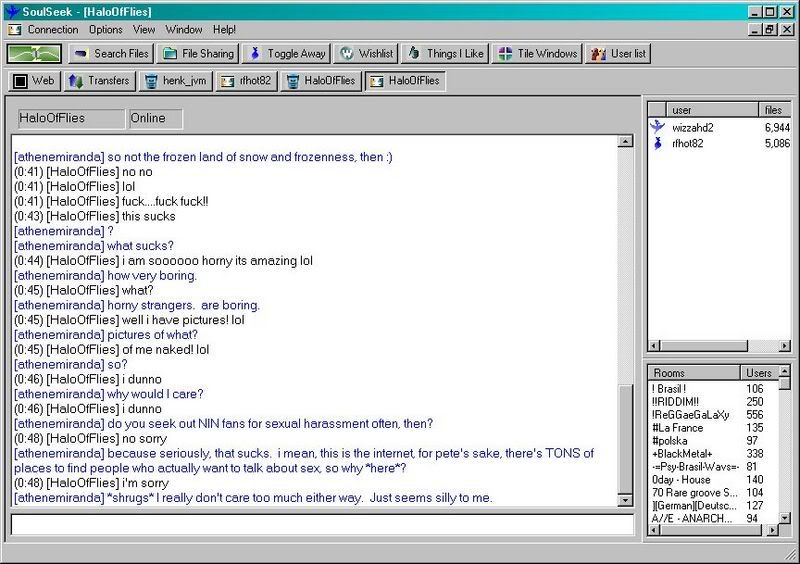
Then there's this, which happened to me about a year ago (click image to see it in a readable size):


Perhaps I've been lucky, but it was only time this has happened to me since I was a 15-year-old AOLer. I'd say it's not so much down to chance as architecture - I shared the lulz with some other folks online, and one (a straight cis guy...as far as I know) said that he'd been hassled for netsex by men on Limewire; perhaps filesharing and chatrooming lend themselves to solicitation more than other forms of online communication. Soulseek's profile settings serve to make it chattier than other such programs; the twunt originally said he'd IMed me because I'd listed the Nine Inch Nails under 'I like'. (I deleted that immediately after).

I reacted to all this in a predictable fashion; became both pissed-off and very amused, and sought Revenge. I screencapped the lulz; I banned him from downloading from me; and I went to Soulseek's FAQ to see if there was any comment on how to report abuse and annoyance. There wasn't. Sure, each internet banana republic creates its own standards, but having no harassment policy is the sort of oversight that may not be so common if they weren't all run by guys. It's due to Wikipedia's poor response to abuse reports that it took two years from the first complaint about that sock's use of intimate pictures of unconsenting women until this ban, now; they simply have no system in place to respond to this problem.

Saturday, April 19, 2008

i'm blogging this!!

teraninse says:
I mean, if your own wedding can't be a highly individualistic, idiosyncratic affair, I don't want to know what can be.
teraninse says:
that's not to say...break out the furries for bridesmaids....but..


So, um, yes. The things that were said by, and to, Kyraninse/Seraninse/Teraninse (with occasional comments from Chris, who I gather was in the same room as her at the time), related in bits and in the wrong order because I can, and edited for brevity & to protect the guilty.

teraninse says:
and when are you getting married?
(and I'd do it again) says:
oh, we got married on February 29th.
teraninse says:
......*boggle-eyed*
teraninse says:
that's...a good anniversary, IMO
(and I'd do it again) says:
*shrugs* it took all of thirty seconds. we picked the 29th because we hate the world.
teraninse says:
*snicker*
teraninse says:
I'm horrified that I didn't know though. @@
(and I'd do it again) says:
no one knows except a few people on my deadjournal list, and a few members of his family, and the two friends who came along with.
teraninse says:
chris: I think that's pretty shabby, for her not to tell me, even for someone who doesn't think marriage counts for much.


This is entirely true, especially in Chris's case. As with many young things (but worse, because I'm such a flybynight floozy), the people I've met have come along in blocks associated with different locations & different educational institutions & different internets fads; Chris has been my friend for roughly 6 years, an extraordinary length of time - outside of my siblings and the blue and purple people, there might be no one I've known longer.

(and I'd do it again) says:
honestly, I didn't put it around much because I'm not proud of it in the least.
teraninse says:
because it was a purely political/practical move?
(and I'd do it again) says:
it's playing a system I hate in a blatantly unfair way.
teraninse says:
...I'm all about manipulating an unfair system to suit me, but then I'm horrible like that.
(and I'd do it again) says:
*nodnods* yeah, I wasn't THAT wary of doing it, but I feel queasy about bragging about it. My siblings knew I was marrying, but I didn't actually tell them about it afterwards - I hope my father doesn't know at all.


There was some talk about the age problem - how young marriages are so not okay in the UK, but pretty normal in the US. (Average age at first marriage in UK: 29 F / 31 M. US: 26 F / 27.5 M. I am twenty-freaking-three). Hint: I am not from the US, so this is generally not okay with me.

teraninse says:
*pokes gently with a poker* it's not bragging just to let people know you got married
(and I'd do it again) says:
but what WOULD I be telling them, if I told them I got married?
teraninse says:
btw, I thought you might want to know, M and I are getting married?
teraninse says:
*spreads hands in shrug*
teraninse says:
Chris was still thinking that you were "going" to.
teraninse says:
I mean, you could have it come out casually over dinner conversation sometime ten years down the road, but.
(and I'd do it again) says:
no, I mean, what would I be conveying to them? that I support Georgia's hetero-only, perk-ridden marriage system?
teraninse says:
oh
(and I'd do it again) says:
that I am into the whole 'marriage' thing with the nice long history of women being property and stuff?
teraninse says:
I'm the chinese immigrant here, no stealing my lines.
(and I'd do it again) says:
that my sex life is now sanctioned by Jesus?
teraninse says:
...you would be conveying that you're getting married to M, who I'm assuming you adore?
(and I'd do it again) says:
yes, I do, but I keep the adoring fairly private...I'm just like that.
teraninse says:
...sometimes, a cigar is just a cigar.
teraninse says:
even if it has a bit of marijuana in it, it's still a cigar


And now it all gets political, as if it wasn't already:

teraninse says:
I dunno, that's like saying, I'm never willing to go through an affirming ceremony with the man I love -- just because he happens to be male (which isn't PC) and because I get some perks out of it.
teraninse says:
which -- to be honest, smacks of silly to me, on some level. I wouldn't marry chris even for the perks unless I loved him, and so what if it's easier for us just because we happen to be sanctioned by the government? that's...like wanting to chop of your limbs in sympathy of the beggar down the streeet. *bad analogy*
(and I'd do it again) says:
no, it's not because he's male that I have an issue with it, it's because I supposedly could not do this if he wasn't.
(and I'd do it again) says:
if something's restricted to heteros it can't fit with my relationships/my life because I am not hetero and never will be.
teraninse says:
yes...and no
(and I'd do it again) says:
there's no sort of relationship I could have with a man that I couldn't also have with a woman, I'm pretty sure of that
teraninse says:
yessss....
teraninse says:
but I'm assuming you don't want to have the same kind of relationship you have with M with another woman.
(and I'd do it again) says:
not any woman I know currently, no, but that doesn't mean I never will and certainly doesn't mean I never would.
(and I'd do it again) says:
so it's not about sympathy for the beggar down the street, it's about sympathy for MYSELF.


Slightly related; Belle has a shiny new post on the subject of passing, which is more or less what this is about. And I feel upset just copypasting all this, right now.

(and I'd do it again) says:
oh, i didn't even mention how annoying the actual marriage bit was; the judge sprang fucking Jesus on me.
(and I'd do it again) says:
I swear that's not even legal
teraninse says:
this is why you don't want to be in the SOUTH!
teraninse says:
amirite???
(and I'd do it again) says:
it would've helped if the ceremony itself hadn't been so yuckmaking. I'm convinced it didn't HAVE to be - he MUST've had a secular script in a drawer somewhere, surely - but about two lines in I nearly interrupted him to say 'waitwaitiwait who said anything about JESUS?' I should have, really. :/
teraninse says:
hahaha.
teraninse says:
that's...icky indeed.
(and I'd do it again) says:
i didn't want to make a scene. i was having such a nice morning up until then.


The South part seems relevant; now, I'm a n00b here, and I'm also a pretty obnoxious and socially inept human being, but the area seems to have a higher density of totally annoying men than anywhere else I've ever been. The Bookworm tells me that this is part of why her mother had the family move up to New Jersey when she herself was but a small bookworm.

From my Deadjournal at the time: Btw, I totally got married last Friday - yes, on leap day. This is only worth mentioning because the judge was a jackass. (Nakki and M say he wasn't, that he was just a 'traditional southern guy'). He ignored me the whole time and never used my name - M had a name, but I was 'the bride'. He asked (empty-handed) M for the certificate, then gave the fresh copy to M once he'd got it ready, even though I'd given it to him in the first place and I was standing there with a GIANT PURPLE HANDBAG. He even sprang fucking Jesus on me. Bitchface could've asked if we liked Jesus - I didn't feel like I could stop him at that point... (Yes, we must be the only people in _______ County who don't like Jesus, but, dude, that first amendment thing?) *le sigh* I'm not an atheist - if I was, I imagine I'd've been rather madder about it than I am. I believe in god, just not your poxy god who likes his prayers and amens laid on inch thick with a trowel, at my bloody thirty-second no-fee leap-day courthouse wedding. That was just rude, offensive and just maybe illegal. This is not holy matrimony - see, if it was holy, you wouldn't be fussed about whether I was doing it with a boy or with a girl.

There is negative problems - ie, all the above - and then there are positive problems, like this one:


(and I'd do it again) says:
and that's another problem - I don't know any married people and barely ever have done. My parents had a pretty miserable marriage for the first 11 years of my life; M's father's now living in Alabama with his 5th wife, and M's brother and aunt are divorced too...
teraninse says:
*nodnods*
(and I'd do it again) says:
i don't really know my extended family at all - just my uncle and aunt in Preston, who are very Christian and...generally not people who inspire me. So all I see is the big-media-weddings on TV, which are just cringeworthy
teraninse says:
...uck
teraninse says:
yes.
teraninse says:
I think...I'll blog about this at some point.
(and I'd do it again) says:
clearly there should be a WEDDING DRESS with 'I'm blogging this' stitched on the veil........
teraninse says:
CLEARLY!
teraninse says:
there's some slogging through icky-making weddings of both the pagan variety and the x'tian variety. haha
teraninse says:
and...oh darn...but...chinese wedding dress or european? @@
teraninse says:
ack! cultural identity strikes again!
(and I'd do it again) says:
oh, I went to an icky Pagan handfasting once. felt like a big dressing-up game, the couple split up three weeks later
(and I'd do it again) says:
OOOH, what a question!
(and I'd do it again) says:
(I do know another pagan couple who married - in Edinburgh, so I missed it - but a few months later, the wife ran off with my ex-boyfriend...)
teraninse says:
...*sigh*
teraninse says:
...
(and I'd do it again) says:
(the happy couple had been together ten years before that. *sigh*)
teraninse says:
just..no comment.
(and I'd do it again) says:
mm.
(and I'd do it again) says:
so, yeah, there's NO ONE i can look at and say 'I want what they have!'
teraninse says:
nothing wrong in creating your own
teraninse says:
I mean, what's fanfic, after all?
(and I'd do it again) says:
indeed not, but feels like I'm starting with nothing


The elephant in the room, do you see it? No? Good. It shall not be spoken of, for all I am leaning on one of its exploding pink feet. But I will say this of it; I came here - here being everywhere it's taken me - to get away from gender. I hate gender, remember? It's repugnant. Like most of us (of either designation), I could make a long list of all the times I was told UR DOIN IT RONG when I was a girl-child, but that would just make me feel shittier. I cannot tell you how glad I was to find out that there was a way to do this whole love crap without it being about gender roles. (This is still a huge part of why I love slash so fucking much - because I am a big old sop, but I despise gender. It's also why I find lesbian romance a zillion times easier than the hetero variant, and why I've basically wound up wanting to strangle all-but-one of the guys I've ever had a thing for, but I persevere. Being queer gives me a way to do straight).

Whether I feel this way because I'm queer or because I'm me is something the jury is still out on. But I am reminded of a Slate article I read two years ago;

Of course, some opponents of same-sex marriage are just anti-gay. But to dismiss all opposition to gay marriage as pure bigotry is to miss an important point. The key to evaluating the real stakes here is to think of gay rights in terms of two major categories: gay marriage and everything else. [...] And polls show consistently growing support nationwide for gay rights other than marriage. Gallup found that 90 percent of Americans support equal employment opportunities regardless of sexual orientation. And 79 percent support the idea of homosexuals serving in the armed forces, a profound change in public opinion since the 1990s, when President Clinton thought it politically prudent to abandon his push for nondiscrimination in favor of "Don't Ask, Don't Tell."

But somehow same-sex marriage is a different story.

[...]

Many people get married because they want the established sex roles the institution provides: a blushing, beautiful, white veil and miles-of-lace bride set off against her dashing, handsome, chivalrous groom. Same-sex marriage seems to undermine these very sex-specific statuses, leaving everyone a sex-neutral "applicant." Sure, we could say same-sex marriages involve two brides or two grooms, but something really is lost in this translation: At that point the terms do not describe distinctively gendered roles but are merely gendered descriptions of the same role.


...Dear god, does that last paragraph make me feel ill. I can barely believe that there's anyone alive who wants that, let alone a whole bunch of people who equate it with what your genitals looked like when you were born.

So Kyraninse gets on to the rewriting of affirmation (which is something she posted about yesterday too - and ooh, look, a Punkass post on the topic):

teraninse says:
and as a friend, I wanted to know because I wanted to add my congratulations for affirmation and blessings to the pot, regardless of what the federal system has to say about it. not that congrats and blessings have to be specifically time-tied, but...
teraninse says:
well, sometimes it is. superstition and tradition and all that.
(and I'd do it again) says:
can i ask what the congrats would be FOR, though? it's not like the relationship's changed at all because of it
teraninse says:
I'm working within my paradigm, in which if I ever married chris, I'd essentially be formally announcing to the world that I'm taking this man to be mine and I vow to honor, cherish, protect, and succor until death do us part. [In her blog post she amended this to 'until life do us part']
teraninse says:
and this would be an affirmation that would resonate, for me, within the spiritual realm also, since I believe in intent, spirit, and magic.
(and I'd do it again) says:
*nodnods* I grok that.
teraninse says:
and so...if I weren't willing to say those things, I wouldn't want to get married, even for practical purposes. I'm assuming that you also meant those things when you said them.
teraninse says:
which, to my belief, is, regardless of society and law, a very powerful thing.
(and I'd do it again) says:
yes, but I would've meant them with or without the marriage part. that's just what the relationship is like.
teraninse says:
*nod* marriage is a nice convenient excuse to have a affirmation ceremony, in my eyes. maybe this is just me, but for me it's not binding unless it's been ceremonialized.
teraninse says:
partially because of the paradigms of intent and magic that I work with.
teraninse says:
so -- in my eyes, if I congratulated you on your marriage, I'd be happy for you that this affirmation happened and was now binding, so to speak.
teraninse says:
which is NOT to say, you should advertise your marriage when you don't want to, just to make people happy.
(and I'd do it again) says:
I think I get you now - I guess my main problem is that the affirmation ceremony is coupled (hurr) to a raft of legal benefits that fucks over a huge number of people *of whom I am one*
teraninse says:
that makes sense.
teraninse says:
lots of it.
(and I'd do it again) says:
but I believe in intent, and this relationship is one of the reasons I do.
teraninse says:
but -- I don't see a reason to be ashamed of your marriage per se just because it is supported by a corrupt system.
teraninse says:
or not the marriage itself, but the ceremony of it.
teraninse says:
btw, none of this was supposed to be "chastise chastise, bad, bad thene" -- I just wanted to hash out the why and wherefores.
(and I'd do it again) says:
nah, I get that and thanks, I kinda think I needed to get it out with someone...
teraninse says:
*nod*
teraninse says:
Do you feel like the marriage ceremony is just ...well, not empty ritual -- but can have, can do without, as the chinese would say?
(and I'd do it again) says:
I don't know, because I don't know of one that would be appropriate for me, so I feel like I'm comparing 'can do without' with...nothing. Dunno what 'can have' would be like.
teraninse says:
I've talked about wedding ceremonies at great length with my friends -- one of whom's mother and father got married on a hill top somewhere with witnesses and that was all.
teraninse says:
I also attended a wedding this past summer where ...they exchanged vows they wrote themselves and that was it.
teraninse says:
If you like, and only if you do, I'd be happy to talk with you about what you might like for a possible affirmation ceremony if you feel like the yuck-making should just be ignored on the metaphysical level.
teraninse says:
and ONLY if you feel it's something you want.


Do I? I don't even know. I have too much pride to be any good with bindings, or gods for that matter. I am happy with what I have flung myself into; but I am at my most happy when not putting words to it, when just being here, words and symbols bedamned. Feck. Must hit 'publish post' now.

Monday, February 04, 2008

Castor, Achilles, Euryalus, Aretaeus, Alexander, Dubreuil

And Orestes.

[Or, to get into the spirit of the thing: Orestes and.]


I have a long memory - the kind where a good book can lodge for years, with me dropping by its cubbyhole every so often to continue our ongoing conversation. I've got broad tastes; encounters with the current mainstream are generally disastrous, and I tend to go home to sf/f eventually, but I wind up with a lot of isolated loves. Les Misérables is one of them. I don't know the first thing about other literature of the time and the place; it has no context for me, and if I want to grok all its obscurities, I grok alone.

After years of intermittent obsessing, I think I'm finally done talking to this one beautiful passage. It comes close to the end of Part 3, Book 4, Chapter 1: A Group Which Almost Became Historic, and it describes the connexion between Enjolras and Grantaire.

There are men who seem born to be the opposite, the reverse, the counterpoint. They are Pollux, Patroclus, Nisus, Eudamidas, Hephaestion, Pechméja. They live only upon condition of leaning on another; their names are continuations, and are only written preceded by the conjunction 'and'; their existence is not their own; it is the other side of a destiny which is not theirs. Grantaire was one of these men. He was the reverse of Enjolras.

We might almost say that affinities commence with the letters of the alphabet. In the series, O and P are inseparable. You can, as you choose, pronounce O and P, or Orestes and Pylades.

Grantaire, a true satellite of Enjolras, lived in this circle of young people; he dwelt in it; he took pleasure only in it; he followed them everywhere. His delight was to see these forms coming and going in the fumes of the wine. He was tolerated for his good-humour.

Enjolras, being a believer, disdained this sceptic, and being sober, scorned this drunkard. He granted him a little haughty pity. Grantaire was an unaccepted Pylades. Always rudely treated by Enjolras, harshly repelled, rejected, yet returning, he said of Enjolras; 'What a fine statue!'


Let's get our priorities straight (ha!) here; the slash, is it canon?

See, that's a totally incommensurable question to begin with. Hugo was writing before queer, before 'homosexual' was a word, let alone a rights movement; I can only guess at what he was trying to say about these two men, but he's left me a few hints. Seven, to be precise. Seven people who belong with seven other people.

Castor and Pollux are twins hatched from the same swan-egg, brothers of Helen of Troy; one mortal, the other divine but generous enough to see eternal life as worth sharing.

Achilles and Patroclus - is there anyone left who hasn't read Troy In 15 Minutes? Because, um, they were totally cousins. Totally. <3<3 Cleolinda.

Nisus, Euryalus? Even Wikipedia isn't quite sure about those two. Lovers for sure, but sexually? Maybe, maybe not.

Eudamidas is a character of 2nd-century satire; given the way people wrote at the time, I can't decide if it's more likely that he was fictional, or a vaguely real gossip-piece. He perhaps got himself on Hugo's radar via The Testament Of Eudamidas, a painting Nicolas Poussin made in 1643 about the guy and his testament, based on the original story by Lucian. This unusual document allegedly willed away not just Eudamidas's meagre possessions, but also his daughter and his mother. From the original Lucian:

Mnesippus. Eudamidas of Corinth, though he was himself in very narrow circumstances, had two friends who were well-to-do, Aretaeus his fellow townsman, and Charixenus of Sicyon. When Eudamidas died, he left a will behind him which I dare say would excite most people's ridicule: but what the generous Toxaris, with his respect for friendship and his ambition to secure its highest honours for his country, may think of the matter, is another question. The terms of the will--but first I should explain that Eudamidas left behind him an aged mother and a daughter of marriageable years;--the will, then, was as follows: To Aretaeus I bequeath my mother, to tend and to cherish in her old age: and to Charixenus my daughter, to give in marriage with such dowry as his circumstances will admit of: and should anything befall either of the legatees, then let his portion pass to the survivor. The reading of this will caused some merriment among the hearers, who knew of Eudamidas's poverty, but did not know anything of the friendship existing between him and his heirs. They went off much tickled at the handsome legacy that Aretaeus and Charixenus (lucky dogs!) had come in for: 'Eudamidas,' as they expressed it, 'was apparently to have a death-interest in the property of the legatees.' However, the latter had no sooner heard the will read, than they proceeded to execute the testator's intentions. Charixenus only survived Eudamidas by five days: but Aretaeus, most generous of heirs, accepted the double bequest, is supporting the aged mother at this day, and has only lately given the daughter in marriage, allowing to her and to his own daughter portions of 500 each, out of his whole property of 1,250; the two marriages were arranged to take place on the same day. What do you think of him, Toxaris? This is something like friendship, is it not,--to accept such a bequest as this, and to show such respect for a friend's last wishes? May we pass this as one of my five?

Toxaris. Excellent as was the behaviour of Aretaeus, I admire still more Eudamidas's confidence in his friends. It shows that he would have done as much for them; even if nothing had been said about it in their wills, he would have been the first to come forward and claim the inheritance as natural heir.


Lucian explicitly connected Eudamidas with Pylades. He was writing about two characters having a rhetorical competition over whether Greeks or Scythians had the best friendships. (Lucian himself wrote in Greek but is believed to have been Syrian). The contest begins with Toxaris, the Scythian, telling Mnesippus why Scythians make sacrifices to Orestes and Pylades; "We honour Orestes and Pylades, then, because they excelled in the Scythian virtue of loyalty, which we place above all others; and it is for this that we have bestowed on them the name of Coraci, which in our language means spirits of friendship."

Passing briefly over Alexander and Hephaestion as being too damn famous and Hollywood and canonslashy and all that: the only source I've ever, ever found on Pechméja also refers directly to Orestes and Pylades. (Male Friendship In Pre-Revolutionary France by Jeffrey Merrick, which you can read if you have the right login. I don't, but the blue person is magical like that). Jean Pechméja and Jean Baptiste Léon Dubreuil were both born in the early 1740s in the same small town in Aveyron, but after leaving said small town didn't encounter each other again til the 1770s. By then Dubreuil was a doctor, Pechmeja a writer - their friendship resumed when Pechméja fell ill and Dubreuil moved to the outskirts of Paris to care for him; in return, Merrick tells us, Pechméja dedicated a classical-themed book to Dubreuil with '"respect, affection, gratitude" (le respect, la tendresse, la reconnaissance) for his "austere virtue, generous friendship, and preservative power" (la vertu austère . . . l’amitié généreuse . . . la puissance conservatrice).' The book is about how male friendship is way better than marriage because marriage involves all that complicated sex stuff which just makes people confused and miserable. [Here you may insert your own rant about how much Brokeback Mountain sucked for drawing teh queer as being an idyllic escape from the real-life responsibilities women and children put on a guy, as if queer was somehow the opposite of being a proper grownup who cares for/belongs to a family. Go on. I'll wait here til you're done.]

Here's Merrick's word on the O and the P, if not the intervening T:

According to their contemporaries, Pechméja and Dubreuil enjoyed "the most intimate friendship" (l’amitié la plus intime) and resembled the mythological companions Orestes and Pylades. [...] Inseparable from each other, as if married to each other, Pechméja and Dubreuil shared everything: "dwelling, social circles, good things, bad things, pleasures, and pains" (logement, sociétés, biens, maux, plaisirs, et peines).


I checked the citation on that as soon as I read it, half-expecting it to lead back to Hugo. It didn't. It's from a 1780s-90s thingy called Correspondance secrète, politique, et littéraire. Was that comment influenced directly by Lucian, or was this Coraci thread running wider than that through the literary culture of the time? Also:

According to the marquis de Bombelles, Noailles pressured the local clergy, who had wanted to exclude Dubreuil from burial in consecrated ground because of the way he had died, without the last rites, as well as the way he had lived. Bombelles did not explain what they found objectionable in the life of the successful and respected doctor. No one in 1785 suggested that Pechméja and Dubreuil were sexually involved with each other or even acknowledged that they loved each other, but this one cryptic remark indicates that some contemporaries, in this case institutional advocates of traditional values, believed that friendship might involve dangerous as well as delightful possibilities.


Orestes and Pylades, incidentally, are totally cousins. (For real).

So what have we got there? Three men of myth, two of murky classical history, one who died a mere 20 years before Hugo's birth. A brother, three lovers, a testator, and a best friend who we don't really have reason to believe was also a lover. These, held up to two spirits of friendship. These, and Grantaire and Enjolras, who are not even really on speaking terms with each other. The hell?


Hugo is both quite particular about sex and also fond of making exceptions to all his rules in general; Les Misérables has it that God supports the Swedish model, and that male philanderers are bad, except for the cheerful old one; he idolises marital sex, and equates virginity with not just virtuous conduct, but with a virtuous appearance;

"Monsiuer", said Thénadier, "it is my wife's bridal cap."
The traveller looked at the object with a look which seemed to say 'there was a moment, then, when this monster was a virgin'.


And yet; 'all the nuns in the world are not equal to one mother', and other such sentiments. (I love this book, but it's part of the reason why I think anyone who says wives and prostitutes are the only women who get laid is stuck in the 19th century). Hugo seems to elevate wives and mothers when it comes to women, but men he cherishes as virgins. He makes a point of the virginity of almost all his male cast; of Jean Valjean he says; 'His youth was spent in rough and ill-recompensed labour; he never was known to have a sweetheart; he had not time to be in love.' Then later; 'Jean Valjean had never loved anything. For twenty-five years he had been alone in the world. He had never been a father, lover, husband or friend.' Marius is righteously indignant at his grandfather's suggestion that he take Cosette as a mistress; the antagonist Javert's virginity is also spelled out; 'His life was a life of privations, isolation, self-denial and chastity; never any amusement.'

But Enjolras and Grantaire? Well. The former is clear enough;
'...he did not seem to know that there was on the earth a being called woman... Woe to the love affair that should venture to intrude upon him! Had any grisette of the Place Cambrai or the Rue Saint Jean de Beauvais, seeing this college boy's face, this form of a page, those long fair lashes, those blue eyes, that hair flying in the wind, those rosy cheeks, those pure lips, those exquisite teeth, felt a desire to taste all this dawn, and tried her beauty upon Enjolras, a surprising and terrible look would have suddenly shown her the great gulf, and taught her not to confound the with the gallant cherubim of Beaumarchais the fearful cherubim of Ezekiel.


And Grantaire?
He was frightfully ugly; the prettiest shoe-binder of that period, Irma Boissy, revolting at his ugliness, had uttered this sentence: 'Grantaire is impossible,' but Grantaire's self-conceit was not disconcerted. He looked tenderly and fixedly upon every woman, appearing to say of them all: if only I would; and trying to make his comrades believe that he was in general demand.


Hugo piles up the adjectives right after that, contrasting Enjolras's 'chaste, healthy, firm, direct, hard, candid nature' with Grantaire's 'soft, wavering, disjointed, diseased, deformed ideas': again chastity is a trait that seems to extend well beyond sex - one Grantaire is devoid of even though he isn't getting any sex. Of course, I don't know what the hell he even meant by 'chastity' (and god help me, but I can't find the second volume of my French copy so I don't even know what the original goddamn word he used was). No sex? Not much sex? Not desiring sex? Sex only with people you're allowed to have sex with?

I could be a smart-alec slash canonista and say that Hugo is explicitly discussing only sex with women, but dude, did you catch the bit where I said the word didn't exist til a decade after his book came out? I am sure the OTP never occurred to him. Except for the part where he's talking about Hephaestion and Patroclus and Nisus and expecting us to grok it. You know, the part I got stuck on in the first place. My friend Kathie, being a little under three times my age, has it that the increasing visibility of queer people since the 1960s - and of queer readings of straight homosocial activities - has put new limits on straight masculinity, made it shy away even from homosocial forms more recent than those Hugo describes - constricting itself in fear of eyes like mine. I am just reading, just knowing that whatever bond he's describing is incommensurable with anything that could ever be written today.

He mentions Pylades only once more, in a chapter heading a full 400 pages later; Orestes Fasting and Pylades Drunk, in which Grantaire finally said "Vive la République! I belong to it," and 'Enjolras grasped his hand with a smile.'


A minor edit: here's 10littlebullets on LJ with some more gay metaphors Hugo pins to Enjolras.


an aside for those of you who've been net-stalking me since 2002; When I read that line early into the Lucian - "do you mean to tell me that you people actually sacrifice to Orestes and Pylades? do you take them for Gods?" "Sacrifice to them? of course we do. It does not follow that we think they are Gods: they were good men." - I put the kettle on and paced around the house until it boiled. I am staying with my person's family atm, so I had the restraint to only make one cuppa, not three.

Tuesday, November 27, 2007

[no title today]

Creeping realisation: I've written a fair bit about things I care about here, but not nearly as much as I intended about things that really hit me deep-down. I realised how ingrained this was getting on the Trans Day Of Remembrance last week. The things I write here are usually polite-disagreement territory, give or take a swearword or two; transphobia is more like I-would-cheerfully-put-your-eye-out-with-a-corkscrew land. I don't keep a corkscrew in my handbag, so when the sparkly one and I are out and about and the sparkly one gets hassled, I tend to smile. Sometimes, we both laugh. They are not nice smiles or nice laughs, even when they seem to be so; my intent is to penetrate, and then twist.

I could say more - describe specific incidents I've witnessed or had related to me, and the people who instigate them; drunk, sober, young, older, nosy, objectifying, they-think-they're-so-subtle, women, men. I could ask why it is that gender lines are, by so many people, held to be fortresses - like a Great Wall, a bulwark we pretend is visible from space (<3 Snopes), diligently patrolled to keep the Khan at bay.

But what last Tuesday was about is murder.


Coupla links; Julia Serano on 'deception' and Holly brings the 101.

Sunday, October 21, 2007

The Rules

Alas and Feminist SF (I got a minor Heroes spoiler on that thread, oh noez) are doing an excellent job of saying 'Nice, but not good enough' in JK Rowling's general direction. This comment had me running to the Indy archives, because I recalled that I've heard this conversation before.

I first read this wonderful Hari piece in a newspaper I picked up on the Tube nearly two years ago, and it's sharp enough to have stuck in my head. It's about the laws of depicting gay men in Hollywood, and boils down to this:

"There are two types of Acceptable Gay Man: you can be a sexless sissy who is fairly happy with his female friends and waspish one-liners, or you can be masculine and actually have a sex drive - in which case you will die."

[an aside: Hari missed one of the rare exceptions, The Wedding Banquet, which was Ang Lee's first gay film. It's a comedy, but a serious one with a lot of cultural smarts to share and a lot of real troubles to talk about, and the sexuality is masculine and the ending is cosy. Back when I was at university, I once had half a gender seminar dissolve into an argument about whether we liked Simon or not.]

That's Hollywood, and Hari explores the particulars in splendid detail. The underlying rule - that men having sex with men and enjoying it and enjoying life cannot be shown to the world - also seems to drive Rowling, who has gone with celibate, tragic and dead, and added silence atop of that. Gay relationships in SF/F have a distinct leaning towards tragedy; Iron Council we spoke of yesterday, China Mountain Zhang can be shelved beside it, and the LHM goes without saying (um, that's when it is shelved, rather than in the guilty sop pile next to my bed). Meanwhile in ILLUMINATUS! (and I feel in The Year Of Our War too), teh gay is a sort of comedic, pornic horror. Interview With The Vampire skirts both, looking for shock, tears and erotic frisson. (One sometimes-glorious counterexample is the Authority, though most of what I know about that I learned from reading Alis Dee).

Lesbians, from Sandman to Discworld, are better at getting away with it, but I can't help but wonder if that's because everyone knows that if there's no cock, it's not real sex. Then there's distractions like Inara - and most of the queer in the Vagina Monologues, come to that - who are just doing it for the men, because the men are so mean, and the men never let us 'be ourselves', oh wah wah, because gay has to be a 'choice', a justification, a negative rather than a positive. Sex has to have a cock. One cock. Even if you're just hiding from it. And more than one cock just can't be good.


Addendum, which I can't believe I forgot earlier: Daurizre (see #8 specifically) once wrote on the same topic, but took it in the opposite direction. She calls it 300 Syndrome, and says it thusly:

"There is, among conservatives and Republicans, what I might dub 300 Syndrome. It's been pointed out before that many Nazi leaders were homosexual, and people have pondered why it is that gays would run to a group of people that would try to kill them--the obvious answer being summed up in the phrase 'self-defense'. But there's a flip side to it, when people who otherwise loathe gays embrace certain gay men, or bisexuals, as the epitome of Manliness, all without acknowledging that they were, in fact, gay or bi. For example, the movie "300" stars three hundred Spartans, and the Spartans, like most in Greek society at the time, subtly encouraged gay relations so long as they strengthened the bonds between fellow soldiers. However, the righties who want to hold the movie up as an example of all that is white manliness ignore this--not because they're stupid, but because being gay is forgivable if you kill a whole lot of people. Alexander the Great loved Hephaestion, and slept with Bagoas, but this is okay--he killed a whole mess of folks, too, which balances the gayness out. That sort of thing. This is Don't Ask Don't Tell in action, where men and women are allowed to fight and die so long as they don't admit their sexuality."

300 was, of course, based on a book by Frank Miller. Ho hum.

Tuesday, October 09, 2007

Piffle About Gender Identity

I think I am in love with this blog. Mostly just for articulating this in a way I never could;

A term coined by a good friend of mine is "Wendying", which is the process by which a masculine-identified person expects a femme (or a small group of femmes) to deal with hir problems and take care of hir without hir ever having to confront hir issues or actually acknowledge their roots. This ties in with the Peter Pan idea of not having to grow up, and the communal expectation that femmes will get masculine-identified people to settle down and become responsible adults. Which, of course, places the burden of encouraging adult behavior on femmes, assumes that all masculine-identified people are interested in femmes as partners, and that all femmes are interested in masculine-identified people as partners.


I've never lived in that sort of queer community (that most of my close friends are queer is more of a disparate, happy coincidence), but this applies well to many heterosexual situations I've seen, or been involved with. It also chimes with a phenomena I've nattered to Drew (Newfoundland separatist, PETA enemy and the nicest MRA in the whole wide world) about; the way young men are seen, and portrayed in the media, as being 'riskier', less stable, less adult, than young women. In some places - New York City and the UK as a whole are two - women in their 20s earn, on average, more than men of the same age. It doesn't outweigh the income plunge that begins in the 30s, but it's real. Another odd effect is that men who take arts degrees earn less than men who do not go to university at all. One could speculate that the man who goes to university for the same reasons many women go to university - transferable skills, learning for the sake of learning, a little freedom without too much responsibility - become that media stereotype of the wasted student who never gets up before noon. Meanwhile 20y/o men who are in a trade, or a career that doesn't require a degree, are considered to have passed The Great Masculinity Test and can be rewarded with man$s.

Marriage has a way of conferring adulthood on a man, and conferring responsibility for another life on a woman.

I have quoted SCUM on the subject of gender identity before now, on Deadjournal, but there is no harm in doing it again;

Being an incomplete female, the male spends his life attempting to complete himself, to become female. He attempts to do this by constantly seeking out, fraternizing with and trying to live through and fuse with the female, and by claiming as his own all female characteristics - emotional strength and independence, forcefulness, dynamism, decisiveness, coolness, objectivity, assertiveness, courage, integrity, vitality, intensity, depth of character, grooviness, etc. - and projecting onto women all male traits - vanity, frivolity, triviality, weakness, etc. It should be said though, that the male has one glaring area of superiority over the female - public relations. (He has done a brilliant job of convincing millions of women that men are women and women are men.)


(It's worth mentioning that the manifesto also supports asexual supremacy; Solanas is pretty clear about the fact that she'd had relationships with men and with women before settling into asexuality.)

As I've said before, that passage isn't about gender, it's about privilege and power. Any person with agency will exhibit those 'female characteristics', and any person without will exhibit the 'male' ones. (Like being a player character in life rather than an NPC.) It's as if Solanas is describing the shock of seeing women sailing under their own steam. What does this have to do with 'Wendying'? Simply that asking someone to be your supportive, empathic Wendy is going to steal from their objectivity, integrity and assertiveness in relation to you, while all the while allowing you to be frivolous and weak (not that those are bad things) through them, without ever facing up to it yourself. Wendying is that public relations job Solanas is writing about.

Wendying is also my worst nightmare, biggest heterosexual headache, and a skill base I possess that I insist on using only on my own terms. I fail at queer identity, really I do; I look very femmy ('Earth mother' more than anything, much as I loathe the concept), but I'm far more drawn to butch ethics/dynamics, esp. in relation to other queer women. I'm that girl who'll stay awake while you nap, or offer you her shawl when you're cold, or listen without getting empathically sucked into your problems, or being responsible for them in any way. I bake a lot and repair or mod my own clothes; I also love videogames, repel wasp/spider incursions for my insect-phobic flatmates, hitch-hike, enthusiastically do basic electrical repairs, and loudly lambast the (many, many) people who address me as male on CiF. I tend to admire butch women and fancy femme ones (but not always). I should possibly make a post about how I [emotionally/spiritually] get off on being hospitable, and why, and why it may be extremely fucked up.

I also, as ever, have giant issues with the way my father Wendied (wendyed?) me when I was a teenager and will take a metaphorical knife to the metaphorical bollocks of anyone who tries to do the same, except that I can't, for I am butch and thus fundamentally bad & passive at negotiating with my own problems. Back to RadMasc;

This idea that masculine folk take care of others to the exclusion of themselves goes far beyond sex. The stereotype is definitely of someone who does not openly express emotions, does not go to others for help with hir problems, and is protecting others to the exclusion of protecting hirself. In fact, the archetype of a butch is of someone who is a guardian of the community, has a job that enables hir to support others (despite the realities that many masculine butch and/or trans folk face intense job discrimination for being visibly queer and gender variant), shrugs off emotional and physical pain without complaining or asking for help, and in general giving constant support without ever needing any of hir own.


-that [excepting the difficulties of visible queerness - I get the much more benign, but sometimes suffocating, difficulties of invisible biness instead] is the kind of ideal I have for the sort of lifestyle I'd like to lead. (I am made of fail, so atm not, but it's what I'm after and I'd be mildly surprised if I don't wind up there sooner rather than later).

One last thought; the other place I've encountered that 'butch woman', unable to reach out for help, but good at supporting others, emotional persona is in descriptions of the general behaviour pattern of the abuse survivor. I am reluctant when it comes to claiming that my teenage life involved emotional abuse, except that by most definitions it did. I like to think that I would've been like this anyway, but better at it.